Avail.video · Watched for you · 1:37:59 video · 2 min read · 1 hr 36 min saved

Pixar Co-Founder Ed Catmull on the Future of AI Filmmaking and Creativity

Outlier score0.3×Too early to tell

47,258 views vs a median of 140,093 across the channel's last 5 long-form uploads · as of Nov 6 · 3 days old, early

Avail.video calculation

Pixar co-founder and former Disney Animation president Ed Catmull sits down with Higgsfield CEO Alex Mashrabov to reflect on the early history of computer graphics and the emergence of generative AI in cinema. Catmull discusses the discipline of storytelling, the lessons learned from building RenderMan and creating Toy Story, and why high-quality filmmaking will always remain an inherently collaborative human effort.

Read the teardown

How it earns the click and holds attention, second by second.

Find in this video

Search what was said and shown

One search covers the transcript, on-screen text, claims and references. Every result jumps to its moment.

    The explainer

    What the video says, with a link to every moment

    A 2-minute read, 1 hr 36 min less than watching. Each underlined phrase opens the video at that second.

    In this extensive discussion, Pixar co-founder and former Disney Animation president Ed Catmull reflects on the parallels between the early days of computer graphics and the current generative AI wave. Catmull explains that when computer imagery was pioneered at the University of Utah under Ivan Sutherland and Alan Kay4:11, outsiders considered it crude and irrelevant to commercial filmmaking. Rather than dismissing early technological imperfections as mere slop, Catmull adopted Alan Kay's long-term compounding mindset, recognizing that working patiently on foundational technical problems would eventually align with changing computing economics.

    slide
    UNIVERSITYUniversity of UtahLOCATIONSalt Lake City, UtahFOUNDED1850KNOWN FOREarly computer graphics
    ▶ 4:08
    On screen at 4:08

    Throughout the development of Lucasfilm's computer division and later Pixar, Catmull insisted on an egalitarian culture that fused technology and art. He rejects the notion that engineers and artists cannot collaborate seamlessly15:20, pointing out that both fields require immense organization, domain rigor, and mutual respect. This philosophy drove the creation of RenderMan23:11 and informed an open academic publishing policy supported by George Lucas and later Steve Jobs28:20. Catmull notes that groundbreaking milestones like Jurassic Park and Toy Story26:15 succeeded because audiences engaged emotionally with the narrative rather than marveling solely at the underlying computational tools, a benchmark first realized when audiences focused on the characters of Luxo Jr.33:20.

    slide
    RESEARCH LABNYIT Computer Graphics LabLOCATIONOld Westbury, New YorkFOUNDED1974 by Alexander SchureDIRECTED BYEd Catmull, 1974-1979
    ▶ 28:25
    On screen at 28:25

    Addressing modern generative AI, Catmull reacts to a screening of Higgsfield’s AI-generated trailer Kök Börü47:04. While praising its visual consistency and mood, he emphasizes that the hardest parts of filmmaking—story arcs, visual pacing, lighting, and dramatic tension—cannot be automated by simply prompting an AI model. Catmull cautions against fears of immediate job elimination, comparing modern anxieties to historical transitions in visual effects and animation. He observes that having a 4K camera in every smartphone did not turn billions of phone owners into great directors, because filmmaking requires learned discipline53:40 and patience rather than just accessible capture technology.

    slide
    HIGGSFIELDORIGINALSPRESENTS
    ▶ 47:01
    On screen at 47:01

    Looking toward studio management and team composition, Catmull explains why the dream of a one-man army filmmaker1:29:20 is counterproductive. Drawing on productions like Frozen, he highlights how cinematic depth springs from diverse life experiences and collective input across writers, directors, actors, and craftspeople. He advises organizations to maintain flat communication channels1:15:20 while preserving hierarchical decision-making, utilizing objective sounding boards like the Pixar Braintrust. Ultimately, Catmull urges creatives and technologists to fully engage with new AI tools1:37:00 rather than fear them, shaping them responsibly to advance human artistic expression.
    Highlights
    1. 0:48Introduction of Ed Catmull
    2. 4:11Mentorship under Ivan Sutherland and Alan Kay
    3. 23:11Developing RenderMan and the four-year CGI revolution
    4. 33:20The impact of Luxo Jr. and shifting focus to story
    5. 47:04Review of the Higgsfield AI-generated short trailer Kök Börü
    6. 1:14:00Flat communication structures and the Pixar Braintrust
    Chapters across the 1:37:59 runtime
    How it's told

    A retrospective interview leading to an AI critique

    Format: Interview. Alex Mashrabov interviews Pixar co-founder Ed Catmull about the historical evolution of computer animation from early skepticism to Toy Story. The discussion then transitions to evaluating modern generative AI video tools, culminating in Catmull critiquing a Higgsfield AI-generated short film trailer.

    Story arc

    1. 0:00Hook & IntroEd Catmull reflects on early technological 'slop' and Alex Mashrabov introduces Catmull's legacy.
    2. 1:25Utah Roots & Early CGCatmull recounts studying under Ivan Sutherland and Alan Kay, tracking Moore's Law and exponential growth.
    3. 6:26Hollywood ResistanceCatmull recalls visiting Disney and facing broad Hollywood skepticism toward computer graphics in the 1970s.
    4. 13:21Bridging Art and TechPixar establishes an egalitarian culture pairing technical engineers and creative artists as equals.
    5. 19:28Lucasfilm & CGI MilestonesGeorge Lucas backs the technology, paving the way for RenderMan, The Abyss, and Terminator 2.
    6. 25:11Jurassic Park to Toy StoryJurassic Park proves CGI viability to Hollywood, leading directly to Pixar's first full-length CG film.
    7. 30:08Jobs Era & Open ResearchSteve Jobs acquires Pixar, backing an open scientific publishing culture and artistic autonomy.
    8. 37:18Reflections on AICatmull draws parallels between generative AI's current reception and early photography and CGI.
    9. 47:00Reviewing 'Kök Börü'Catmull screens Higgsfield's AI trailer and analyzes its narrative pacing and visual composition.
    10. 51:30Storytelling PrinciplesCatmull explains the discipline of cinematic blocking, viewer eye tracking, and scene grammar.
    11. 1:08:00The Braintrust DynamicsThe mechanics of non-hierarchical, candid peer reviews and keeping executive authority separate.
    12. 1:18:00Scale & Future TeamsEvaluating why collaborative team dynamics remain essential and dispelling the 'one-man army' film myth.
    13. 1:37:44OutroConcluding remarks, expressions of mutual gratitude, and final production credits.

    Setups and payoffs

    1. 0:07Setup Catmull warns that dismissing early tech as 'slop' ignores exponential compounding.
      ↳
      42:00Payoff Catmull notes that today's rough generative AI visuals are merely the starting baseline of a steep curve.
    2. 15:47Setup Pixar intentionally removes status divides between computer scientists and animators.
      ↳
      1:10:30Payoff The Braintrust operates successfully because no creative-versus-technical hierarchy distorts feedback.
    3. 31:00Setup Steve Jobs establishes a distinctive working dynamic with Pixar leadership.
      ↳
      1:19:50Payoff Jobs offers notes during quarterly screenings without mandating changes or sitting in the Braintrust.
    4. 47:00Setup Host screens Higgsfield's AI-generated trailer 'Kök Börü' for Catmull.
      ↳
      48:20Payoff Catmull delivers a detailed structural critique of the trailer's storytelling and blocking.

    Devices

    • Cold openTeaser excerpt highlighting Catmull's perspective on judging technological beginnings.0:00
    • Lower third info cardsInformational cards displaying contextual biographies, studio details, and film milestones.1:319:2320:30
    • On-screen screening / Picture-in-pictureVideo player screening the AI-generated animated short trailer 'Kök Börü' alongside speaker reactions.47:00
    • Historical analogyComparing early AI adoption and skepticism to the paradigm shift following Jurassic Park.25:231:03:39
    • Personal anecdotesFirsthand recollections of working with George Lucas, Steve Jobs, and early Disney leadership.7:1120:3030:08

    From the video's own structure, matched to the transcript and on-screen text.

    Teardown

    Pixar's co-founder provides credible reassurance against generative AI panic by drawing direct historical parallels to the birth of 3D computer animation.

    Below the channel's typical: 0.3× its typical views (47,258 vs a median of 140,093 across the channel's last 5 long-form uploads, as of Nov 6) · Long-form interview · 3 days old, early

    The promise

    Viewers expect Pixar co-founder Ed Catmull to explain why he is unbothered by AI and what the technology actually means for the future of human creativity.

    Packaging

    How it looks in the feed

    Show the feed as
    1:37:59

    Pixar’s Co-Founder on AI: What Happens to Creativity?

    Higgsfield AI47K views · 3d ago👉 Try Higgsfield: https://higgsfield.ai/s/edwin-catmull-main-higgsfieldai-gkpGND How can AI make us more creative? Сo-founder of Pixar Edwin Catmull and…

    Views and age as of the teardown, Nov 6, 2026. Other videos are blanked out.

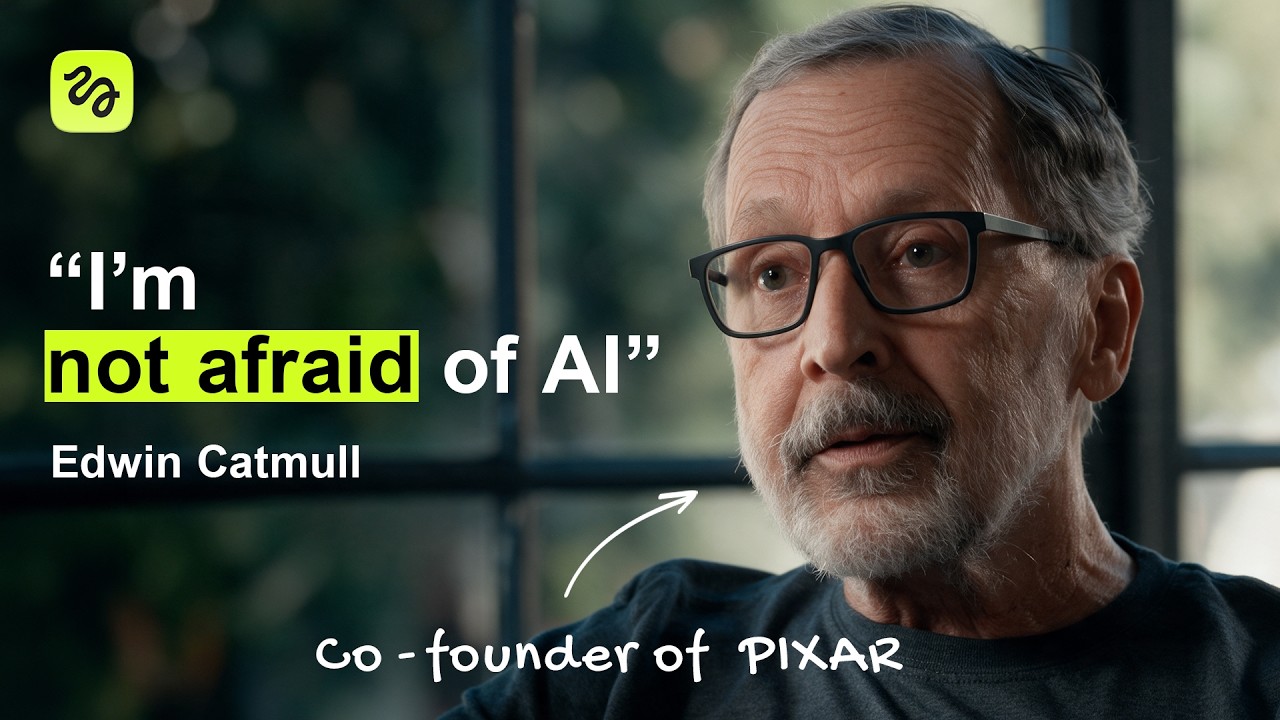
    • 4/5Thumbnail imageA crisp, cinematic portrait that reads like a high-end documentary interview. His calm, thoughtful expression establishes intellectual gravitas rather than cheap shock value.Edwin Catmull in glasses looking slightly off-camera, framed in the right two-thirds against a soft, out-of-focus window background.
    • 3/5Thumbnail text““I’m not afraid of AI” Edwin Catmull Co - founder of PIXAR”The bold quote creates an immediate contrarian punch, though stacking three separate text elements slightly clutters the frame.A neon-yellow box highlighting 'not afraid' inside the quote 'I’m not afraid of AI', followed by his name and a handwritten label 'Co - founder of PIXAR' with an arrow.
    • 4/5TitleLeans heavily on prestige authority to pose an existential question that many animators and artists are currently stressed about.Includes the high-status entity 'Pixar’s Co-Founder' and ends with the open-ended question 'What Happens to Creativity?'
    • 4/5Title + thumbnailThe title poses the anxiety-inducing question, and the thumbnail offers an unexpected, calm defiance that makes viewers want to hear his reasoning.The title asks what happens to creativity while Catmull’s quote directly counters widespread fear by stating he is not afraid.

    Curiosity gap: Why is the pioneer of computer animation completely unfazed by AI when most artists fear it will eliminate creative work?

    The three hooks

    The title, the thumbnail text and the first words spoken each make a promise, and each does a different job.

    • Title“Pixar’s Co-Founder on AI: What Happens to Creativity?”AuthorityCuriosityLoss aversionIt makes creative workers want to see what will happen to their craft from someone who built the modern animation industry.
    • Thumbnail text““I’m not afraid of AI” Edwin Catmull Co - founder of PIXAR”Contrarian takeCuriosityReliefIt makes the viewer want to find out why an industry veteran rejects the prevailing panic surrounding generative tools.
    • First words spoken“The slop, the stuff that's done poorly, and you see this, and people look at that and they say, 'Okay, more of that won't work at all.' But they can't think of in terms of, 'No, we're at the beginning.'”Contrarian takeCuriosityNoveltyIt challenges the viewer's cynicism about artificial intelligence by asserting that current low-grade output is merely the inevitable starting point of a compounding technology.
    • PairingDifferent jobsThe title establishes the topic and authority, while the thumbnail quote delivers a provocative contrarian stance.
    • StakesFitsThe packaging promises an authoritative look at the future of creativity under AI, and Ed Catmull delivers a realistic historical perspective without sensationalism.
    • UrgencyNoneThe interview presents a calm, evergreen philosophical and historical assessment rather than a time-sensitive alert.

    The first 20 seconds

    TimeWhat you seeWhat you hearWhat it does
    0:00Close-up of Pixar co-founder Ed Catmull speaking by a window."The slop, the stuff that's done poorly and..."Introduces the topic immediately by criticizing current low-grade AI output.
    0:01Ed Catmull gesturing with his left hand as he explains."...and..."Maintains conversational cadence while setting up common industry reactions.
    0:02Catmull raises both hands in an explanatory gesture."...you see this, and people look at that..."Frames how ordinary viewers or executives evaluate early tech.
    0:03Catmull continues talking with animated hand gestures."...and they say..."Builds anticipation for the flawed conclusion people reach.
    0:04Catmull frames an imaginary box with his hands."...okay..."Prepares to quote the skeptic viewpoint.
    0:05Catmull shifts his hands downward dismissively."...more of that..."Defines the mistaken expectation of simple extrapolation.
    0:06Catmull begins to lean back slightly while talking."...won't work at all."Delivers the cynical industry consensus on generative tools.
    0:07Catmull finishes the thought before shifting perspectives."But they can't think of in terms of..."Signals a counter-argument is coming.
    0:08Cut to a wider profile shot of Catmull sitting in an armchair."...no..."Visual shift emphasizes his contrarian pivot.
    0:09Catmull gestures toward his head in the wider shot."...we're at the beginning."Delivers the core thesis: current flaws are early-stage noise.
    0:10Cut back to the close-up shot as Catmull continues."People..."Refocuses attention on his facial expression as he details the fear.
    0:11Catmull holds his hands up, emphasizing the scope."...are assuming that..."Prepares to describe the industry panic.
    0:12Cut back to wide shot of Catmull seated with his phone on his lap."...somebody is going to replace the writer..."Names the central anxiety: AI replacing human creative roles.
    0:13Catmull raises his right arm wide to illustrate the thought process."...and they're going to say..."Quotes how executives naively imagine AI workflow.
    0:14Catmull gestures open-handed toward the interviewer."...make me a script."Summarizes the superficial view of automated storytelling.
    0:15Catmull pauses slightly with his hands raised.Music stays low as speech continues.Allows the ridiculousness of the premise to settle.
    0:16Catmull turns slightly back toward center."It's a worry..."Labels the emotion driving the whole conversation.
    0:17Catmull begins framing his conclusion."...by people..."Prepares to explain who actually fears this and why.
    0:18Cut back to close-up of Catmull."...who..."Tightens the frame for his closing insight.
    0:19Catmull speaks directly with intense focus."...don't understand how it works."Lands the punchline to set up the rest of the interview.
    Click confirmation
    Instantly. The title promises Pixar's co-founder talking about AI and creativity, and the video immediately opens with Ed Catmull debunking bad AI 'slop' and writer replacement fears.
    Time to the point
    0:09
    Hook
    contrarian take, stakes
    Reason to stay
    Catmull dismisses the widespread fear that AI will replace writers as a naive misunderstanding, leaving the viewer needing to hear his real prediction for creativity's future.
    Missing on purpose
    No channel intro, no greeting, no logo animation, and no title card; it drops straight into mid-sentence dialogue.
    Pace and texture
    Fast editing between close-up and medium armchair angles every 2 to 4 seconds, paired with brisk, authoritative speech and faint ambient music.

    Story map

    Explainer. A startup founder building AI video tools seeks guidance from Pixar pioneer Ed Catmull on whether generative software can make real cinema, while Catmull weighs raw technological power against traditional cinematic discipline.

    TimeSectionNew tensionStakesTurnLoops
    0:00 –3:30Introduction & The Toy Story PrecedentIs generative AI just low-grade slop, or the dawn of a new medium?HoldToy Story was considered a triumph not because people marveled at the computers, but because reviews barely mentioned the technology and focused on the story.Opens: What does a computer graphics pioneer see in generative AI?Closes: Establishes Catmull's stance on early tech slop.
    3:30 –13:00Utah Roots, Alan Kay, and Moore's LawWhy do industry incumbents consistently fail to predict exponential tech?RiseHollywood dismissed early 1970s CGI as irrelevant because polygon edges looked jagged, failing to understand that exponential compounding would soon fix every defect.Opens: How did early computer scientists maintain conviction when the output looked terrible?Closes: Connects early CGI skepticism to modern generative AI dismissals.
    13:00 –20:10Egalitarian Culture: Artists vs. EngineersWill AI software engineers replace creative film crews?HoldEngineers are not naturally more organized than artists; high performance requires treating both domains as absolute cultural peers without class hierarchy.Opens: How can creative teams guide technical development?Closes: Dismantles the stereotype of the disorganized creative.
    20:10 –31:00Lucasfilm, RenderMan, and the Digital Tipping PointHow many years does an underlying technology take to become cinema-ready?RiseAfter 20 years of irrelevance, just 6 minutes of CGI dinosaurs in Jurassic Park flipped Hollywood's mindset overnight.Opens: What is the equivalent watershed moment for AI cinema?Closes: Shows the timeline from R&D to mainstream acceptance.
    31:00 –36:50Steve Jobs, Open Culture, and Luxo Jr.When does technical wizardry become emotional art?HoldPixar knew computer animation had arrived when audiences stopped asking how Luxo Jr. was rendered and started asking if the big lamp was the mother or the father.Opens: Can generative AI elicit that same character-driven empathy?Closes: Explains Steve Jobs's hands-off support for Pixar's research.
    36:50 –47:00Generative AI Parallels and the 2030 Oscar TimelineCould an AI-assisted feature film win an Academy Award by 2030?RiseCatmull rules out a 2030 win due to multi-year development cycles, but emphasizes that AI tools will enter the pipeline invisibly just like crowd CGI.Opens: What will the first commercially successful AI film look like?Closes: Answers the host's direct question regarding award timelines.
    47:00 –56:30Critiquing Higgsfield's 'Kök Börü' & Cinematic DisciplineDoes the host company's AI-generated film trailer pass Pixar muster?RiseHaving 3 billion smartphone cameras did not flood the world with great feature films, because possessing capture tools does not confer visual discipline.Opens: What specific craft skills are missing from current AI videos?Closes: Delivers direct feedback on the host's trailer.
    56:30 –1:10:30Stylistic Constraints, Eye Tracking, and Film GrammarHow will early AI films overcome the uncanny valley?HoldToy Story succeeded by making characters out of plastic to fit hardware limits; successful early AI films will lean into stylization rather than photorealism.Opens: What storytelling tools guide viewer attention?Closes: Explains establishing shots, lighting, and pacing grammar.
    1:10:30 –1:21:10Pixar Braintrust & Honest Feedback DynamicsHow do you protect storytellers from bad executive notes?HoldThe Braintrust works because experienced peers diagnose problems candidly while having zero executive authority to mandate solutions.Opens: How did Steve Jobs fit into the Braintrust dynamic?Closes: Reveals Jobs gave notes from an audience seat without command authority.
    1:21:10 –1:37:59The 'One-Man Army' Myth & Optimal Studio Crew SizeWill AI enable a single person to produce a Hollywood blockbuster alone?FallA single person will technically be able to make a feature, but virtually no one will want to watch it because solo creators lack collaborative perspective.Opens: What will future AI-enabled production teams look like?Closes: Concludes the conversation on the enduring necessity of human collaboration.

    Payoff: delivered fully at 48:06. Catmull watches Higgsfield's AI short film trailer and delivers his core verdict: generative tools produce impressive imagery, but technology cannot substitute for storytelling discipline, pacing, and human collaboration. Ending: Catmull closes by dismantling the fantasy of the solo AI filmmaker, warning that great movies require collaborative creative friction rather than isolated prompt generation.

    Leaks

    Where a viewer might leave. Guesses from watching, not retention data.

    • 7:54 Catmull spends several minutes recounting an offer to engineer the Space Mountain roller coaster in 1975, drifting far from modern AI and animation concerns.
    • 27:00 A detailed tangent about RenderMan software licensing and academic publishing conventions at SIGGRAPH slows the interview's narrative momentum.
    • 1:12:00 A protracted review of internal Pixar executive politics and corporate culture repeats well-known anecdotes from Catmull's book without introducing fresh AI analysis.

    Steal this

    1. Debunking Cold Open: Cut straight to the authority figure dismissing the audience's worst fear in the very first sentence before any titles or host introductions. It validates the viewer's skepticism immediately and establishes the guest's contrarian perspective without throat-clearing. 0:00
    2. Real-Time Work Critique: Place the host or team's actual product on screen for an unrehearsed critique by an industry legend. It grounds an abstract philosophical interview into an actionable case study with clear stakes. 47:00
    3. Constraint-Driven Aesthetic Principle: Frame technical limitations as deliberate creative choices rather than embarrassing defects. Showing how Toy Story embraced plastic characters to mask compute limits gives modern creators a clear playbook for AI stylization. 1:02:57

    Skip this

    • Ninety-seven minutes of two men seated in armchairs with zero visual B-roll or dynamic graphic overlays during the conversation. Only works because Ed Catmull's status as a Pixar co-founder, Turing Award winner, and Disney executive provides immense built-in intellectual authority.

    Open questions

    • How steep was the retention drop during the first 35 minutes of historical background before the first direct mention of modern generative AI?
    • Did viewers understand the narrative context of the Kyrgyz-language 'Kök Börü' trailer screening without translated voiceover?

    Teardown by Avail.video from the thumbnail, the title, the first 20 seconds and the report's notes on the whole video.

    On screen

    Everything the video showed you

    Slides, frameworks, quotes and formulas, captured verbatim with the moment they appeared. Tap any card to jump there.

    Reference shelf

    People, ideas and things mentioned

    Said means mentioned aloud; Shown means it appeared on screen.

    People18

    • Edwin CatmullComputer scientist, Turing Award winner, and co-founder of Pixar.0:00Said + shown0:47Said + shown0:48Said + shown4:00Said48:05Said + shown1:37:48Said + shown
    • Alex MashrabovHost of the conversation, CEO, and co-founder of Higgsfield.0:39Said + shown0:40Said + shown17:49Said + shown18:10Said47:00Said + shown1:37:44Said + shown
    • Ivan SutherlandComputer graphics pioneer, Turing Award winner, and mentor to Ed Catmull.3:17Shown3:20Said4:26Said7:10Said
    • Peter FoldesDirector of early computer-assisted animated short film La Faim.3:25Said + shown3:39Said
    • Alan KayComputer scientist pioneer known for object-oriented programming.4:48Shown4:50Said5:03Said9:19Said
    • Gordon MooreCo-founder of Intel and formulator of Moore's Law.5:09Shown
    • Jim ClarkComputer scientist and founder of Silicon Graphics and Netscape.9:10Said9:20Shown
    • John WarnockComputer scientist, co-founder of Adobe, and Utah alumnus.9:10Said9:27Shown
    • Charles GeschkeCo-founder of Adobe alongside John Warnock.9:27Shown
    • John LasseterAnimator and director of Toy Story and Luxo Jr.1:49Shown15:35Shown31:18Shown33:32Shown
    • George LucasFilmmaker, creator of Star Wars, and founder of Lucasfilm.15:05Shown20:30Said + shown24:59Said28:10Said30:08Said
    • Walt DisneyAnimation pioneer and co-founder of The Walt Disney Company.20:30Said20:56Shown33:42Shown
    • James CameronFilmmaker and director of The Abyss, Terminator 2, and Titanic.24:14Shown24:23Shown25:11Shown
    • Steven SpielbergDirector of Jaws and Jurassic Park.25:23Shown25:52Shown
    • Steve JobsCo-founder of Apple who acquired Pixar in 1986.30:05Said30:08Said + shown30:10Said1:09:59Said1:16:50Said1:19:50Said
    • Alvy Ray SmithComputer graphics pioneer and co-founder of Pixar.31:18Shown
    • Nicole Van GoethemBelgian animator and director of Oscar-winning short A Greek Tragedy.34:44Shown
    • Tony GilroyScreenwriter and creator of the series Andor.35:54Shown

    Ideas & frameworks2

    • Moore's LawForecast that the number of transistors on a microchip doubles roughly every two years.5:09Said + shown
    • The BraintrustPixar's peer review process providing candid feedback without creative authority.48:50Said48:52Shown1:16:00Said

    Organizations16

    • PixarPioneering computer animation studio co-founded by Ed Catmull.0:42Said1:31Shown30:10Said
    • HiggsfieldGenerative AI video creation platform and studio.0:40Said + shown47:01Shown47:02Said + shown1:37:51Shown
    • National Film Board of CanadaCanadian public film and animation producer and distributor.3:31Shown3:39Said
    • University of UtahPioneering university hub for early computer graphics research.4:00Said4:08Shown
    • Xerox PARCInfluential research and development lab known for the GUI and Ethernet.4:59Shown
    • The Walt Disney CompanyAmerican multinational mass media and entertainment conglomerate.7:11Said + shown
    • Silicon Graphics (SGI)Computer hardware and software company known for 3D graphics workstations.9:23Shown
    • AdobeSoftware company renowned for PostScript, PDF, and creative applications.9:30Shown
    • Society for Information DisplayProfessional organization dedicated to electronic display technology.9:48Shown
    • Industrial Light & MagicMotion picture visual effects company founded by George Lucas.20:11Shown
    • Wētā FXNew Zealand digital visual effects company formerly known as Weta Digital.27:34Shown
    • NYIT Computer Graphics LabEarly computer graphics research facility founded in 1974 by Alexander Schure.28:25Shown
    • AppleAmerican technology company co-founded by Steve Jobs.30:15Shown
    • NeXTComputer company founded by Steve Jobs in 1985.30:25Shown
    • CalArtsCalifornia Institute of the Arts, known for its character animation program.33:42Shown
    • SIGGRAPHAnnual computer graphics conference organized by ACM SIGGRAPH.35:27Shown

    Things on screen12

    • Star Wars1977 sci-fi space opera film written and directed by George Lucas.15:05Said + shown
    • RenderManPhotorealistic 3D rendering software standard created by Pixar.23:30Said23:34Shown26:50Said
    • The Abyss1989 science fiction film directed by James Cameron featuring ILM CGI.24:14Said + shown
    • Terminator 2: Judgment Day1991 science fiction action film directed by James Cameron.25:11Said + shown
    • Jurassic Park1993 science fiction adventure film directed by Steven Spielberg.25:23Said + shown25:30Said
    • Toy Story1995 Pixar animated film, the first feature film created entirely with CGI.0:48Said0:49Said1:31Shown1:49Shown3:20Said26:15Said
    • The Adventures of André & Wally B.1984 animated short film produced by the Lucasfilm Computer Graphics Project.31:18Shown
    • Luxo Jr.1986 Pixar computer-animated short film directed by John Lasseter.33:25Said33:32Shown34:00Said
    • A Greek Tragedy1985 Belgian animated short film directed by Nicole Van Goethem.34:00Said34:44Shown
    • AndorStar Wars television series created by Tony Gilroy.35:54Shown
    • Kök BörüAI-generated animated trailer produced by Higgsfield Originals.47:00Shown48:03Shown48:04Said + shown
    • Frozen2013 Disney animated musical feature film.1:30:07Said + shown
    Video description

    A description you can paste into YouTube

    A hook, a summary, chapters in YouTube's format and what the video mentions. Copy it, edit it, and paste it into YouTube Studio.

    1,633 / 5,000 characters
    By the numbers

    What YouTube shows about this video and its channel

    As of Nov 6, 2026. YouTube's public numbers first, then Avail.video's own arithmetic on them.

    The video

    Views
    47.3K
    Likes
    698
    Comments
    53
    Published
    Nov 3, 2026
    Length
    1:37:59
    Category
    Film & Animation
    YouTube's topics
    Entertainment, Film
    Captions
    No
    HD
    Yes
    Language
    English
    Paid promotion
    None declared
    Made for kids
    No
    License
    Standard YouTube

    Creator's tags

    • higgsfield
    • higgsfield ai
    • ai filmmaking
    • pixar ai
    • ai animation
    • pixar
    • pixar animation
    • toy story
    • ai storytelling
    • ai film
    • ai movie
    • ai short film
    • ai video
    • ai video generation
    • ai cinematic video
    • ai vs artists
    • ai art debate
    • future of ai
    • steve jobs pixar
    • steve jobs
    • ai in hollywood
    • future of filmmaking
    • ai filmmaking future
    • creativity inc
    • pixar documentary
    • animation history
    • ai in movies
    • ai video editing
    • storytelling
    • animation

    The channel

    Subscribers
    516K
    Videos
    396
    Total views
    33.9M
    Channel age
    2 years (since Jan 2024)
    Country
    United States
    Uploads
    about every 3 days
    Across the last 5 long-form uploads
    Before this video
    2 days after the previous long-form upload

    Calculated by Avail.video from YouTube's public numbers

    Outlier score
    0.3× · Too early to tell
    Views against the median of the channel's last 5 long-form uploads
    Views per subscriber
    0.09
    Likes vs the channel's usual
    0.9× the channel's usual
    1.5% of views vs a usual 1.7%
    Comments vs the channel's usual
    1.5× the channel's usual
    0.11% of views vs a usual 0.074%
    Rank among recent uploads
    #6 of 6
    By views: this video and the channel's last 5 long-form uploads
    Take it to your AI

    Ask Claude or ChatGPT about this video

    Copy this report as context, paste it into a chat, then ask anything. It includes timestamps, so answers can point back to the video.

    Then ask
    • Turn the main ideas into a checklist I can use this week.
    • What are the strongest claims in this video, and what evidence does it give for each?
    • Write a short summary for someone who hasn't watched it, linking the key moments.
    • Quiz me on this video, one question at a time, and cite the timestamp for each answer.

    Watched by Avail.video · 2026-11-06