Avail.video · Watched for you · 19:26 video · 2 min read · 17 min saved

How to Have an Original Thought

Outlier score0.07×Too early to tell

547 views vs a median of 7,820 across the channel's last 15 long-form uploads · as of Nov 6 · under a day old, early

Avail.video calculation

Drawing on Arthur Schopenhauer's 1851 essay 'On Thinking for Oneself' and the life of Roman encyclopedist Pliny the Elder, this video examines why constant consumption stifles original thought. Schopenhauer argues that reading is merely thinking with someone else's head, leaving one's mind stamped over by foreign ideas. To develop genuine insight, thinkers must leave empty gaps in their days, prioritize direct observation of the world, turn over what they already know, and consult authorities only after reaching their own conclusions.

Read the teardown

How it earns the click and holds attention, second by second.

Find in this video

Search what was said and shown

One search covers the transcript, on-screen text, claims and references. Every result jumps to its moment.

    The explainer

    What the video says, with a link to every moment

    A 2-minute read, 17 min less than watching. Each underlined phrase opens the video at that second.

    Nearly two millennia ago, the Roman scholar Pliny the Elder spent virtually every waking minute having books read to him—during meals, while traveling in a litter, and even while drying off from his bath, considering walking without study a waste of life. When a dinner guest corrected a reader's pronunciation, Pliny famously lamented that the supper interruption0:15 wasted ten precious lines. In modern life, this compulsion mirrors our own endless cycle of podcasts, audiobooks, and videos filling every spare second. Yet Pliny's relentless routine0:55 prompted later thinkers to ask a fundamental question: did such an endlessly receptive man ever entertain a single original thought of his own?

    quote
    "Why then did you make him go back again? We have lost more than ten lines by this interruption."LETTERS III.5 · TR. MELMOTH, REV. BOSANQUET
    ▶ 0:13
    On screen at 0:13

    In 1851, German philosopher Arthur Schopenhauer addressed this paradox in his essay On Thinking for Oneself. Schopenhauer warned that reading is thinking with someone else's head2:18, temporarily surrendering the mind to someone else's intellectual track. He compared reading to pressing a seal into hot wax: the page stamps its foreign shape onto the mind's current mood and drift, obliterating nascent insights. Much like a compressed spring losing its elasticity3:55 when held down continuously, a mind inundated with other people's words eventually loses the very capacity to generate thoughts independently, leaving modern consumers constantly prone to distraction by digital devices4:30.

    quote
    "Reading is thinking with some one else's head instead of one's own.""ON THINKING FOR ONESELF", THE ART OF LITERATURE · TR. T. BAILEY SAUNDERS
    ▶ 2:17
    On screen at 2:17

    Schopenhauer noted a critical qualitative difference between inherited opinions and earned realizations. Merely learned facts, he claimed, resemble an artificial limb or waxen nose5:30—superficially convincing, but ready to fall off upon the slightest scrutiny. In contrast, truths forged through personal reflection belong organically to the thinker. A mind stuffed with unexamined facts resembles a disordered library of books7:50; a smaller collection, well organized through reflection, is far more useful. Quoting Goethe, Schopenhauer stressed that what you inherit must be earned8:59 before you truly possess it.

    quote
    "Truth that has been merely learned is like an artificial limb, a false tooth, a waxen nose.""ON THINKING FOR ONESELF" · TR. SAUNDERS
    ▶ 5:25
    On screen at 5:25

    The ultimate source of original insight is not books, but the living world. This distinction became tragically vivid during the eruption of Mount Vesuvius11:15 in 79 AD. Encountering a bizarre pine-tree-shaped cloud no scroll could explain, Pliny finally set aside his texts and launched warships on a perilous rescue voyage12:25, calmly dictating empirical observations until his death on the beach. Schopenhauer believed true thinkers prioritize the 'book of nature' over printed pages, emphasizing that originality does not mean chasing novelty14:00, but arriving independently at fundamental truths by looking directly at reality.

    quote
    "if a thing is new, it is seldom good; because if it is good, it is only for a short time new.""ON AUTHORSHIP", THE ART OF LITERATURE · TR. SAUNDERS
    ▶ 14:01
    On screen at 14:01

    To cultivate genuine originality, Schopenhauer offered three distinct rules. First, one must read only when thinking stagnates16:40, refusing to use books or phones to suppress quiet boredom. Second, thinkers must write down ideas immediately17:25 before they fade from memory. Finally, one should check authorities only afterwards18:15 to confirm or refine an independently formed conclusion, ensuring that one's own voice remains the resonant bass note beneath all acquired knowledge.
    quote
    read only when his own thoughts stagnate at their source"ON THINKING FOR ONESELF" · TR. SAUNDERS
    ▶ 16:32
    On screen at 16:32
    Highlights
    1. 0:15Pliny's dinner interruption
    2. 2:18Reading as thinking with someone else's head
    3. 3:00The wax seal metaphor
    4. 5:28Truth as an artificial limb or waxen nose
    5. 7:51The disordered library versus organized shelf
    6. 11:20Pliny observes the eruption of Vesuvius
    Chapters across the 19:26 runtime
    How it's told

    An animated essay pairing two historical lives

    Format: Animated video essay. The video contrasts Pliny the Elder's relentless consumption of written information with Arthur Schopenhauer's philosophy of independent reflection. Through visual analogies and the dramatic eruption of Mount Vesuvius, it builds toward three practical rules for cultivating original thought.

    Story arc

    1. 0:00The Compulsive ReaderRecounts Pliny the Elder's relentless consumption of text and parallels it with modern digital media habits.
    2. 1:53The Seal and the WaxIntroduces Schopenhauer's core thesis that constant reading forces someone else's thoughts onto your mind like a seal into wax.
    3. 4:48The Waxen NoseExplains the difference between borrowed knowledge, which is superficial like an artificial limb, and self-discovered truth.
    4. 7:36A Library in DisorderDetails Schopenhauer's analogy of an orderly small library versus a chaotic large one, advocating for thinking through what one knows.
    5. 10:43The Cloud Over VesuviusContrasts Pliny the Elder setting sail to observe the volcano himself against his nephew staying behind to copy texts.
    6. 13:50Footsteps in the SandRedefines originality not as novelty, but as independently discovering timeless truths directly from reality.
    7. 16:24The Three RulesPrescribes actionable rules: read only when thought stagnates, write insights down immediately, and consult the great authors afterwards.

    Setups and payoffs

    1. 0:13Setup Pliny chides his dinner guest that interrupting the reading lost ten lines of text.
      ↳
      19:02Payoff The narrator reveals Pliny actually lost all quiet reflection time between the lines until a volcano forced him to look.
    2. 0:36Setup Pliny's nephew scrupulously records how his uncle spent every waking minute reading.
      ↳
      12:09Payoff When Mount Vesuvius erupts, Pliny's nephew declines to join the expedition so he can stay behind and copy out excerpts.
    3. 1:28Setup Pliny scolds his nephew for taking a walk because walking wastes precious study hours.
      ↳
      17:12Payoff Taking an uninterrupted ten-minute walk without input is prescribed as the essential vehicle for generating one's own thoughts.
    4. 2:49Setup Visual metaphor of hot sealing wax pressed by a mechanical seal.
      ↳
      18:41Payoff The animation returns to the wax seal hovering over empty wax, leaving room for independent impressions.
    5. 5:25Setup Schopenhauer describes borrowed knowledge as a waxen nose that falls off under scrutiny.
      ↳
      18:19Payoff Formulating one's own answers first prevents one from acquiring an artificial facade of understanding.

    Devices

    • Historical ParallelismContrasting Roman ancient practices (enslaved readers, litter chairs) directly with modern digital analogs (podcasts, smartphones, audiobooks).0:211:36
    • Extended MetaphorsVisualizing abstract philosophical arguments through concrete physical emblems (the seal and wax, the compressed spring, the wax nose, the organ bass note).2:503:555:3015:52
    • Dramatic ClimaxShifting from philosophical critique to the historical narrative of the 79 AD eruption of Mount Vesuvius to test the thinker against reality.10:4312:28
    • Direct Viewer AddressPrompting the viewer with reflective questions and pragmatic challenges to put down their phone and leave mental space.4:4318:25

    From the video's own structure, matched to the transcript and on-screen text.

    Teardown

    An eerie contrarian thumbnail stops the feed, but the deliberate essay pace tests viewer patience by holding actionable advice until minute seventeen.

    Below the channel's typical: 0.07× its typical views (547 vs a median of 7,820 across the channel's last 15 long-form uploads, as of Nov 6) · Long-form animated video essay · 0 days old, early

    The promise

    Viewers expect to learn how to stop recycling borrowed ideas and develop truly original thinking.

    Packaging

    How it looks in the feed

    Show the feed as
    19:26

    How to Think Originally

    Philosophy Is Timeless547 views · 9h agoAt a supper in ancient Rome, Pliny the Elder complained that a guest had cost him more than ten lines of reading. Almost eighteen hundred years later…

    Views and age as of the teardown, Nov 6, 2026. Other videos are blanked out.

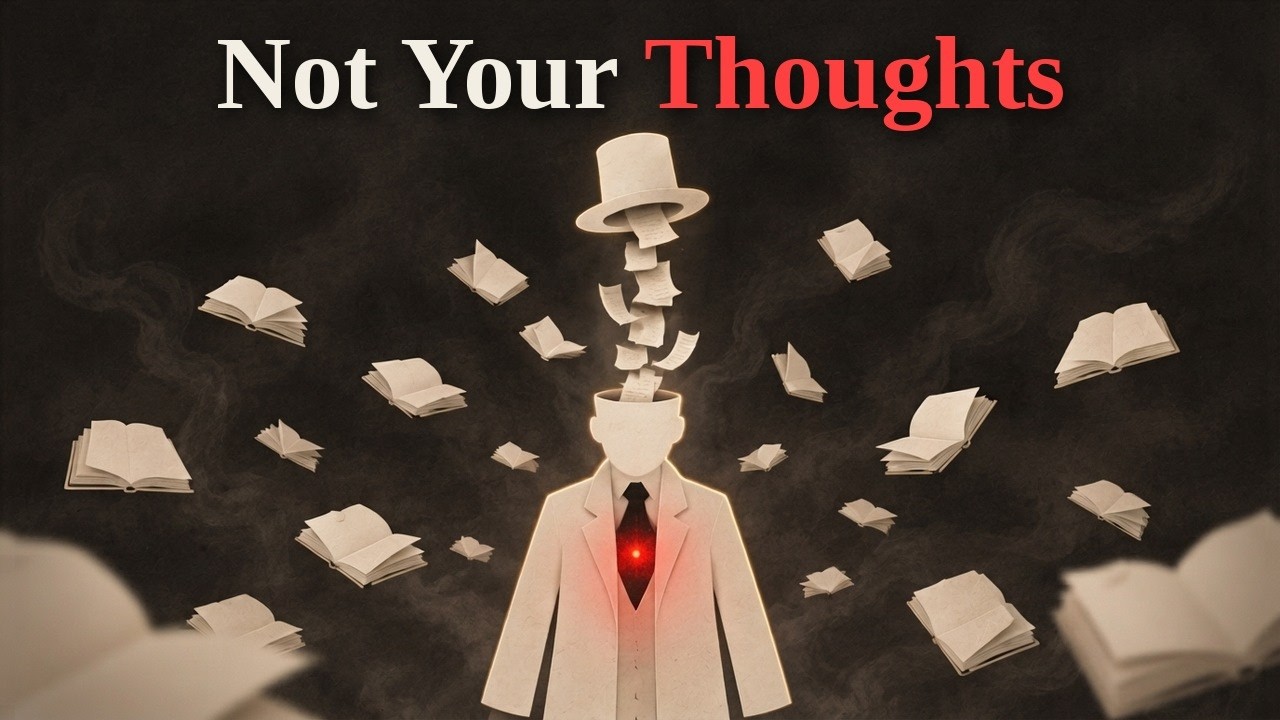
    • 4/5Thumbnail imageThe surreal Magritte-style illustration creates an immediate, eerie focal point that stands out against typical feed clutter. The floating books and hollow head communicate the theme of external mental clutter at a glance.A faceless figure in a white suit with papers flying out of an open skull toward a floating top hat, surrounded by open books on a dark background.
    • 4/5Thumbnail text“Not Your Thoughts”Three short words deliver an unsettling accusation that immediately halts the scroll. The red emphasis on the final word directs attention cleanly.White and red serif text reading 'Not Your Thoughts' centered along the top margin.
    • 3/5TitleThe title clearly identifies the topic and desired outcome, but it uses a standard essay framing. It lacks specific stakes, a named philosopher, or a time frame to make it urgent.The title is four words long: 'How to Think Originally'.
    • 4/5Title + thumbnailThe thumbnail delivers the unsettling diagnosis, while the title offers the practical solution. They divide the work cleanly rather than repeating each other.The image declares 'Not Your Thoughts' on a hollow-headed figure while the title promises 'How to Think Originally'.

    Curiosity gap: If the thoughts in my head are not actually mine, how do I reclaim my mind and think for myself?

    The three hooks

    The title, the thumbnail text and the first words spoken each make a promise, and each does a different job.

    • Title“How to Think Originally”How-toOutcomeCuriosityIt makes the viewer want a practical way to produce authentic, independent ideas.
    • Thumbnail text“Not Your Thoughts”Contrarian takeCuriosityLoss aversionIt makes the viewer question whether their everyday opinions and beliefs actually belong to them.
    • First words spoken“At a supper table almost 2,000 years ago, a man reading aloud gets a word wrong, and a guest makes him go back.”StoryCuriosityNoveltyIt makes the viewer curious to see how a bizarre ancient dinner dispute connects to developing an original mind.
    • PairingDifferent jobsThe thumbnail provokes the viewer with a disturbing claim about their own mind, and the title positions the video as the answer.
    • StakesFitsThe video tackles whether the viewer genuinely owns their thoughts, backing up the packaging's warning with practical daily habits.
    • UrgencyNoneThe video explores timeless philosophical ideas without creating manufactured deadlines or artificial FOMO.

    The first 20 seconds

    TimeWhat you seeWhat you hearWhat it does
    0:00White animated books drift through a dark, starry void.Low ambient room tone begins.Establishes a quiet, contemplative mood and visual theme around reading and books.
    0:01Books continue falling through the black background.Narrator: "At a supper table almost 2,000..."Introduces an anecdotal hook set in ancient history.
    0:02Books tumble past the frame as camera drifts downward.Narrator: "...years ago..."Maintains visual momentum while grounding the historical setting.
    0:03The last floating books descend out of frame.Narrator: "...a man reading..."Clears the screen for the scene to appear.
    0:04Minimalist white outline of a table, reader, and candle appear against black.Narrator: "...aloud gets a word wrong..."Introduces the central incident of the anecdote.
    0:05A second figure stands on the right listening to the reader.Narrator: "...and a guest..."Shows the dinner setting and audience.
    0:06The guest figure walks closer toward the table.Narrator: "...makes him go back."Introduces conflict into the narrative.
    0:07A large robed figure appears on the left side of the table.Silence / ambient hum.Reveals the host arriving to intervene.
    0:08The host looks down at the guest across the table.Narrator: "The host turns to the guest."Focuses attention on the confrontation between host and guest.
    0:09Text appears above: "'Surely you understood it?'" with 'understood' in red.Narrator: "'Surely you..."Emphasizes the host's rhetorical question in text and voice.
    0:10The quote citation 'Letters III.5' appears below the line.Narrator: "...understood it?'"Adds historical citation and authenticity to the dialogue.
    0:11The figures remain still on screen.Narrator: "He did."Delivers a blunt answer that increases narrative tension.
    0:12New text appears: "'Why then did you make him go back again?'"Narrator: "'Why then did you make him..."Deepens the host's interrogation.
    0:13The word 'again?' dims as the voice continues.Narrator: "...go back again?..."Keeps pacing synced with speech.
    0:14Text adds: "We have lost" with 'lost' highlighted in red.Narrator: "...We have lost..."Raises the stakes of the interruption.
    0:15Screen transitions to an animated scroll rolling open beside text: "more than ten lines".Narrator: "...more than ten lines..."Shifts focus to the quantifiable value of lost time.
    0:16Text finishes: "by this interruption."Narrator: "...by this interruption.'"Completes the historical quote about wasting intellectual time.
    0:17The blank parchment scroll floats beside the completed quote.Brief pause in narration.Gives the viewer a moment to absorb the lesson about wasted attention.
    0:18The scene pulls back down to reveal the host, table, and scroll hovering above.Narrator: "The host..."Re-anchors the viewer in the historical setting.
    0:19The three figures stand beneath the floating scroll.Narrator: "...was a Roman..."Begins revealing the identity of the extreme host.
    0:20Static wide view of the Roman supper scene.Narrator voice continues into the next phrase.Pulls the viewer into identifying the historical figure.
    Click confirmation
    No visible title card or thesis appears immediately; it uses an oblique story opening featuring ancient reading habits rather than stating 'how to think originally' outright.
    Time to the point
    Not within the first 20 seconds
    Hook
    in the middle of the action
    Reason to stay
    The viewer wants to know who this obsessive Roman host was and how his extreme intolerance for interruptions connects to original thinking.
    Missing on purpose
    No channel intro, no animated channel logo, no greeting to the audience, and no mention of the video title before diving into the story.
    Pace and texture
    Deliberate and calm; simple vector animations change every few seconds matched to spoken dialogue, with key words highlighted in red.

    Story map

    Explainer. A modern media consumer wants genuine original thoughts, but constant content consumption stamps over their inner voice. Arthur Schopenhauer's philosophy and Pliny the Elder's obsessive life reveal the dangers of mental surrender, building toward three rules to reclaim independent thinking.

    TimeSectionNew tensionStakesTurnLoops
    0:00 –1:53Pliny's Non-Stop RoutineIs filling every waking second with information consumption actually productive?HoldPliny seemed hyper-productive, but Schopenhauer suggests filling every waking minute meant he never had a thought of his own.Opens: How do you have a thought of your own?Closes: Why the Roman dinner host was outraged by lost lines.
    1:53 –4:48The Seal and the WaxWhat actually happens to your brain when you immediately fill every gap with media?RiseReading feels like active thinking, but Schopenhauer argues it puts your head on loan, stamping out your fragile organic ideas.Opens: How can someone read deeply without destroying independent thought?Closes: Why original thoughts vanish the moment you unlock your phone.
    4:48 –7:36The Waxen NoseIs knowledge taken from books ever genuinely yours?RiseMemorizing authorities seems smart, but without independent struggle, it is an artificial wax nose that falls off under scrutiny.Opens: What should you do with everything you have already read?Closes: Why independent discovery matters even if someone else discovered it centuries ago.
    7:36 –10:43A Library in DisorderHow do you transform passive information gathering into real ownership?HoldCollecting knowledge feels valuable, but an unexamined mind is just a messy library worth less than a few properly digested ideas.Opens: How does this theory survive contact with the real world?Closes: What to do with saved bookmarks, quotes, and open tabs.
    10:43 –13:50The Cloud Over VesuviusWill the book-obsessed scholar choose direct reality when a deadly volcano erupts?RisePliny's nephew stayed behind to copy extracts, but Pliny sailed directly into the eruption, proving thinkers must observe reality firsthand.Opens: What does originality actually mean if reality is the same for everyone?Closes: How Pliny's compulsive reading routine met its end.
    13:50 –16:24Footsteps in the SandDoes originality require coming up with something entirely new?HoldChasing novelty creates disposable takes, but true originality means arriving independently at timeless truths shared by great minds.Opens: What concrete rules can a person use to practice this daily?Closes: How Schopenhauer squared reading sacred texts with thinking for himself.
    16:24 –19:26The Three RulesHow do you apply Schopenhauer's philosophy to everyday media habits?RiseInstead of seeking information first, you must read only when thought stagnates, write insights down immediately, and check the authorities last.Closes: How to think originally and cultivate thoughts of your own.

    Payoff: delivered fully at 16:24. The video delivers three concrete rules for independent thought after sixteen minutes of historical biography and philosophical metaphors. Ending: Closes by reframing Pliny's death at Vesuvius as a failure of quiet reflection, urging the viewer to take an input-free walk before clicking the next recommended video on Kant.

    Leaks

    Where a viewer might leave. Guesses from watching, not retention data.

    • 4:42 A sudden viewer call to action ('Tell me in the comments: what's the first thing you reach for...') breaks the immersive narrative flow.
    • 7:25 A direct subscribe pitch combined with a callback to an older video pauses intellectual momentum right before the next section.
    • 10:00 Listing Pliny's 37 books and 160 extract notebooks slows the essay down right before the Vesuvius story gets underway.

    Steal this

    1. Anchor abstract philosophy to an obsessive historical character study Grounding cognitive theories in tangible habits (1 AM wakeups, shorthand writers in winter gloves) gives the viewer a human mirror for their own modern habits. 0:33
    2. Physicalize mental processes with tangible tactile metaphors Using hot sealing wax and metal stamps at 02:46 visually explains how external inputs displace fragile personal thoughts. 2:46
    3. Test philosophical theory against a life-or-death historical drama Cutting from abstract philosophy to the 79 AD eruption of Mount Vesuvius at 10:43 raises narrative tension and tests the concept against physical reality. 10:43
    4. Invert the core definition before offering the solution Reframing originality as rediscovering timeless truths rather than inventing novel gimmicks at 13:54 resets viewer expectations before delivering practical habits. 13:54

    Skip this

    • Unadorned, slow-cadence academic delivery over minimalist 2D cutouts This works because the channel has conditioned its niche for contemplative lectures; high-energy general audiences would abandon the video within sixty seconds.
    • Deliberately holding practical how-to steps until minute seventeen A broad 'How to' video usually requires early actionable payoff; this channel can withhold it because its viewers seek philosophical depth before pragmatism.

    Open questions

    • Will withholding the actionable three rules until minute seventeen hurt long-term audience retention compared to front-loaded tutorials?
    • Does the shift to the Mount Vesuvius disaster at 10:43 lift viewer retention or feel like an unrelated detour to viewers looking for quick study tips?

    Teardown by Avail.video from the thumbnail, the title, the first 20 seconds and the report's notes on the whole video.

    On screen

    Everything the video showed you

    Slides, frameworks, quotes and formulas, captured verbatim with the moment they appeared. Tap any card to jump there.

    Reference shelf

    People, ideas and things mentioned

    Said means mentioned aloud; Shown means it appeared on screen.

    People7

    • Pliny the ElderRoman author, naturalist, and naval commander who wrote Natural History.0:19Said + shown3:34Said4:41Said9:55Said10:00Said10:45Shown10:48Said11:41Said13:41Said19:02Said
    • Pliny the YoungerNephew of Pliny the Elder whose letters document his uncle's life and the Vesuvius eruption.0:34Said1:24Said10:08Said10:23Said10:38Said10:46Said11:00Said11:13Said11:53Said11:58Said12:09Said12:47Said12:50Said
    • Arthur Schopenhauer19th-century German philosopher who authored On Thinking for Oneself.2:07Said + shown2:55Said3:36Said4:02Said5:08Said6:56Said7:20Said7:49Said8:50Said8:54Said9:03Said10:33Said13:06Said13:57Said15:35Said + shown16:30Said18:34Said
    • Immanuel KantGerman Enlightenment philosopher referenced regarding intellectual autonomy.7:05Said7:07Said7:16Said + shown
    • Johann Wolfgang von GoetheGerman polymath, poet, and dramatist quoted by Schopenhauer.8:55Said8:56Said + shown
    • RectinaRoman woman who sent a distress message to Pliny the Elder from the foot of Vesuvius.12:18Said
    • PomponianusFriend whom Pliny the Elder sailed to rescue at Stabiae during the eruption.12:44Said

    Ideas & frameworks4

    • On Thinking for OneselfPhilosophical essay by Arthur Schopenhauer on independent thought versus constant reading.2:10Said + shown2:17Shown3:00Shown5:25Shown7:49Shown7:52Said + shown16:32Shown
    • Parerga and Paralipomena1851 collection of philosophical essays by Arthur Schopenhauer.2:09Shown3:29Said
    • Natural History37-book Latin encyclopedic work compiled by Pliny the Elder.10:02Said10:04Said + shown
    • The UpanishadsLate Vedic Sanskrit philosophical texts read regularly by Schopenhauer.15:36Said + shown15:37Said

    Things on screen1

    • Mount VesuviusStratovolcano on the Bay of Naples that erupted cataclysmically in 79 AD.11:20Said11:24Said + shown12:18Shown
    Video description

    A description you can paste into YouTube

    A hook, a summary, chapters in YouTube's format and what the video mentions. Copy it, edit it, and paste it into YouTube Studio.

    1,202 / 5,000 characters
    By the numbers

    What YouTube shows about this video and its channel

    As of Nov 6, 2026. YouTube's public numbers first, then Avail.video's own arithmetic on them.

    The video

    Views
    547
    Likes
    9
    Comments
    3
    Published
    Nov 5, 2026
    Length
    19:26
    Category
    People & Blogs
    YouTube's topics
    Knowledge
    Captions
    No
    HD
    Yes
    Language
    English
    Paid promotion
    None declared
    Made for kids
    No
    License
    Standard YouTube

    Creator's tags

    No tags

    The channel

    Subscribers
    9.4K
    Videos
    22
    Total views
    835.7K
    Channel age
    4 weeks (since Oct 2026)
    Country
    United States
    Uploads
    about every day
    Across the last 15 long-form uploads
    Before this video
    2 days after the previous long-form upload

    Calculated by Avail.video from YouTube's public numbers

    Outlier score
    0.07× · Too early to tell
    Views against the median of the channel's last 15 long-form uploads
    Views per subscriber
    0.06
    Likes vs the channel's usual
    1.0× the channel's usual
    1.6% of views vs a usual 1.6%
    Comments vs the channel's usual
    3.7× the channel's usual
    0.55% of views vs a usual 0.15%
    Rank among recent uploads
    #16 of 16
    By views: this video and the channel's last 15 long-form uploads
    Take it to your AI

    Ask Claude or ChatGPT about this video

    Copy this report as context, paste it into a chat, then ask anything. It includes timestamps, so answers can point back to the video.

    Then ask
    • Turn the main ideas into a checklist I can use this week.
    • What are the strongest claims in this video, and what evidence does it give for each?
    • Write a short summary for someone who hasn't watched it, linking the key moments.
    • Quiz me on this video, one question at a time, and cite the timestamp for each answer.

    Watched by Avail.video · 2026-11-06