Avail.video · Watched for you · 30:39 video · 2 min read · 29 min saved

Every Field of Linguistics Explained

Outlier score6.0×Overperformer

413,673 views vs a median of 68,589 across the channel's last 15 long-form uploads · as of Nov 6

Avail.video calculation

Linguist Jon Jones provides a comprehensive, field-wide tour of linguistics, exploring how human language operates across every layer of structure and analysis. The guide moves systematically through the core subfields of phonetics, phonology, morphology, syntax, semantics, and pragmatics before branching out into broader domains including typology, historical linguistics, sociolinguistics, acquisition, neurolinguistics, sign languages, and computational models. Along the way, he clarifies fundamental principles of descriptive science, dispels common linguistic myths, and highlights ongoing debates within the discipline.

Read the teardown

How it earns the click and holds attention, second by second.

Find in this video

Search what was said and shown

One search covers the transcript, on-screen text, claims and references. Every result jumps to its moment.

    The explainer

    What the video says, with a link to every moment

    A 2-minute read, 29 min less than watching. Each underlined phrase opens the video at that second.

    Linguistics is the scientific study of the unconscious mental architecture that allows humans to effortlessly generate and comprehend infinite novel utterances. As Jon Jones establishes, modern linguistics is strictly descriptive rather than prescriptive0:22, treating systematic native speaker speech as empirical data rather than grammatical error. Human language is characterized by design features first famously cataloged by Charles Hockett0:33, including arbitrariness, productivity, discreteness, duality of patterning, and displacement. To investigate these principles, linguists draw upon four empirical sources2:03: native speaker grammaticality judgments, corpus analysis, field documentation, and experimental psycho-neurolinguistic trials.

    quote
    "ain't""what's he up to?"
    ▶ 0:23
    On screen at 0:23

    The foundational core of language is analyzed in hierarchical tiers from acoustic physics to contextual use. It begins with phonetics1:53, classifying sound production through articulatory airstream mechanisms, places, manners of articulation, and the International Phonetic Alphabet. Above the physical sound wave lies phonology4:40, which organizes sounds into cognitive abstractions called phonemes tested via minimal pairs and constrained by phonotactic syllable structures. Moving up to meaningful components, morphology5:43 examines how free and bound morphemes combine derivationally or inflectionally across isolating, agglutinative, fusional, and polysynthetic systems. Sentences are governed by syntax7:12, revealing recursive hierarchical constituent trees that operate independently of literal meaning, as demonstrated by Chomsky's colorless green ideas8:18.

    slide
    PhoneticsThe study of speechsounds and theirphysiological productionand acoustic qualities.
    ▶ 1:54
    On screen at 1:54

    Moving beyond syntactic form, semantics9:23 investigates compositionality, entailment, prototype theory, and event aspect (Aktionsart), while pragmatics11:30 uncovers communicated meaning in context through Gricean conversational implicatures11:40 and Austin and Searle's speech acts12:28. Broadening to multi-language comparisons, typology and Greenbergian universals15:39 classify basic word orders like SVO and SOV, while historical linguistics16:09 reconstructs ancestral tongues like Proto-Indo-European through regular sound changes such as Grimm's Law16:40.

    slide
    SemanticsThe study of linguistic meaning.
    ▶ 9:25
    On screen at 9:25

    Finally, linguistics investigates language in social reality, the human mind, and modern technology. Sociolinguistics17:19 shows that all dialects are fully rule-governed, while contact linguistics19:15 documents how pidgins expand into natural creoles. The puzzle of child language acquisition20:46 pits Chomsky’s poverty of the stimulus and Universal Grammar against Tomasello's usage-based statistical learning. Meanwhile, neurolinguistics23:02 localizes comprehension and production networks via aphasias, sign languages26:27 demonstrate that grammar is independent of auditory channels, and computational linguistics27:35 explores the capabilities of modern large language models, while documentary linguistics28:49 races to preserve the world's rapidly disappearing endangered languages.
    chart
    Figure 3.4: Dialect Regions in the ANAE
    ▶ 17:25
    On screen at 17:25
    Highlights
    1. 1:50Four primary sources of linguistic evidence
    2. 28:49Endangered languages and revitalization efforts
    Chapters across the 30:39 runtime
    How it's told

    A timed subfield-by-subfield tour of linguistics

    Format: Explainer. The host races against a 30-minute countdown to deliver a structured survey of linguistics, journeying from internal grammar up to social, cognitive, and applied disciplines.

    Story arc

    1. 0:00IntroductionThe host defines linguistics as the scientific study of language and sets up a 30-minute challenge to cover the field.
    2. 0:17What Language Actually IsHockett's core design features, descriptive linguistics, arbitrariness, and primary sources of linguistic data are introduced.
    3. 1:50PhoneticsExplores the physiological and acoustic properties of speech, airstream mechanisms, the International Phonetic Alphabet, and suprasegmentals.
    4. 4:40PhonologyCovers how languages organize mental sound units, detailing phonemes, allophones, minimal pairs, and phonotactic constraints.
    5. 5:45MorphologyDeconstructs word formation, derivational and inflectional morphemes, morphological typology, and hierarchical word structure.
    6. 7:15SyntaxExamines sentence formation, constituency testing, recursive rules, generative grammar, and syntactic movement.
    7. 9:23SemanticsInvestigates literal meaning, covering compositionality, entailment, presupposition, prototype theory, polysemy, and Aktionsart.
    8. 11:26PragmaticsExplains meaning in context through Gricean conversational maxims, implicature, deixis, and speech act theory.
    9. 13:40Sponsorship InterludeFeatures a walkthrough of sponsor Monarch Money's personal finance and budgeting interface.
    10. 14:44Core Hierarchy ReviewReviews the concentric rings of internal grammar before expanding into external and cognitive fields.
    11. 15:02Typology & UniversalsSurveys word-order patterns across global languages and Greenberg's implicational universals.
    12. 16:09Historical LinguisticsDetails language change over time, the comparative method, Proto-Indo-European reconstruction, Grimm's law, and grammaticalization.
    13. 17:19SociolinguisticsAnalyzes language variation, dialects, AAVE grammar, and Labov's three waves of sociolinguistic research.
    14. 19:16Contact, Pidgins & CreolesExamines the mechanics of language contact, code-switching, pidgin creation, and the process of creolization.
    15. 20:45Language AcquisitionDebates native language acquisition milestones, contrasting Chomskyan nativism and Universal Grammar with usage-based learning.
    16. 23:03Psycho- & NeurolinguisticsExplores how the brain processes language in real time, garden path sentences, cortical localization, and aphasias.
    17. 24:31Language & ThoughtEvaluates linguistic relativity and the Sapir-Whorf hypothesis, focusing on spatial orientation in Guugu Yimithirr.
    18. 25:31Writing SystemsContrasts spoken language with writing technologies, classifying alphabets, syllabaries, logographs, abjads, and abugidas.
    19. 26:27Sign LanguagesDemonstrates sign languages as complete natural systems with distinct phonologies, highlighting Nicaraguan Sign Language.
    20. 27:35Computational LinguisticsDiscusses natural language processing, vector semantics, and large language models.
    21. 28:11Applied LinguisticsSurveys practical implementations in speech pathology, forensic authorship analysis, and language policy.
    22. 28:49Endangered LanguagesAddresses global language loss, documenting disappearing varieties, and revitalization initiatives.
    23. 29:56ConclusionSynthesizes the complete map of linguistics as the timer finishes and delivers the sign-off.

    Setups and payoffs

    1. 0:12Setup Concentric circles and branching tree diagrams are displayed as a structural roadmap.
      ↳
      14:44Payoff The concentric circle model returns as a midpoint summary and is revisited at the end.
    2. 0:16Setup A 30-minute countdown timer is initialized on screen.
      ↳
      30:06Payoff The tour wraps up its final subfield precisely as the timer runs down to zero.
    3. 11:35Setup Gricean maxims of conversation and deliberate flouting are marked with a foreshadowing card.
      ↳
      20:39Payoff Academic infighting during 'The Linguistics Wars' is framed as a direct flouting of Gricean maxims.
    4. 5:46Setup Hierarchical bracket nesting is demonstrated in morphology using 'unlockable'.
      ↳
      7:15Payoff Syntax applies identical structural nesting rules to entire phrases and sentences.
    5. 19:54Setup The genesis of pidgins and their nativization into creoles is established.
      ↳
      27:04Payoff Nicaraguan Sign Language is showcased as real-time visual proof of spontaneous creolization.

    Devices

    • Diagrammatic mappingConcentric circle graphics and branching tree diagrams keep the viewer oriented across 20 distinct subfields.0:1214:4429:56
    • Interactive sound demonstrationsThe host produces non-pulmonic speech sounds, ejectives, clicks, and pitch contours directly into the microphone.2:304:26
    • Kinetic text graphicsAnimated on-screen text dynamically illustrates phonetic shifts, minimal pairs, and morpheme combinations.0:465:08
    • Clinical archival footageDocumentary recordings of stroke patients demonstrate fluent and non-fluent aphasia speech patterns.23:3823:48
    • Pop-culture clip cutawaysHumorous clips from comedy films emphasize theoretical points.22:4823:5927:44

    From the video's own structure, matched to the transcript and on-screen text.

    Teardown

    A timed, zero-fluff syllabus tour that turns an entire college degree into an engaging, visual sprint.

    A real overperformer: 6.0× its typical views (413,673 vs a median of 68,589 across the channel's last 15 long-form uploads, as of Nov 6) · Long-form explainer · 48 days old

    The promise

    You will get a complete, structured overview of the entire field of linguistics condensed into an accessible half-hour lesson.

    Packaging

    How it looks in the feed

    Show the feed as
    30:39

    ALL of Linguistics, explained

    languagejones413K views · 1mo agoThanks to Monarch for partnering with me! Start your free trial and get 50% off your first year of total money clarity using my link…

    Views and age as of the teardown, Nov 6, 2026. Other videos are blanked out.

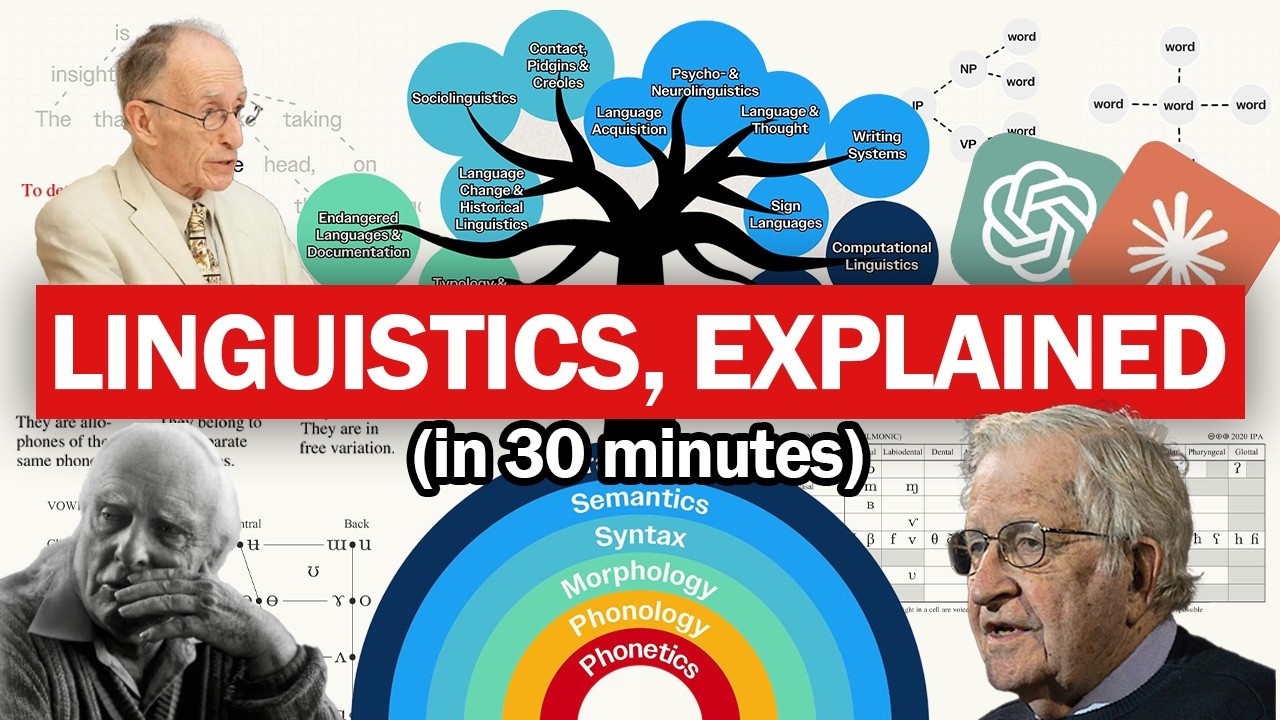
    • 4/5Thumbnail imageThe collage is packed with recognizable intellectual iconography and linguistic diagrams, signaling deep academic substance without feeling dry. The bright red banner anchors the eye dead center amid the busy background.Cutout portraits of famous linguists like Noam Chomsky flank central branch diagrams, an IPA vowel chart, and modern AI logos.
    • 4/5Thumbnail text“LINGUISTICS, EXPLAINED (in 30 minutes)”It makes a bold scope promise and gives a concrete time commitment that lowers the barrier to entry. While it echoes the title, adding the exact thirty-minute timeframe adds high perceived value.Bold white letters inside a red banner read 'LINGUISTICS, EXPLAINED' over black outlined text '(in 30 minutes)'.
    • 4/5TitleCapitalizing 'ALL' sets massive scope and authority, promising zero gatekeeping or missing subfields. It is clear, concise, and tells anyone interested in language exactly what they are clicking on.Title text reads 'ALL of Linguistics, explained' in 29 characters.
    • 4/5Title + thumbnailTogether, they set up an audacious trade: mastery of an entire academic field in exchange for just thirty minutes of your attention. The diagrams and portraits prove it is real academic content rather than superficial trivia.The title promises totality ('ALL'), while the thumbnail establishes the exact time frame ('in 30 minutes') against textbook charts.

    Curiosity gap: How can anyone genuinely summarize the entire academic field of linguistics in just thirty minutes?

    The three hooks

    The title, the thumbnail text and the first words spoken each make a promise, and each does a different job.

    • Title“ALL of Linguistics, explained”System promiseCuriosityOutcomeIt makes the viewer want an all-in-one breakdown that connects every moving part of the study of language.
    • Thumbnail text“LINGUISTICS, EXPLAINED (in 30 minutes)”Number promiseOutcomeCuriosityIt makes the viewer want a fast, complete education on a complex college subject within a manageable half-hour investment.
    • First words spoken“You produce and understand sentences you've never heard before, effortlessly, thousands of times a day”Curiosity gapCuriosityNoveltyIt forces viewers to confront the mystery that they effortlessly process thousands of brand-new sentences every day without having any clue how their brain does it.
    • PairingDifferent jobsThe title asserts total coverage of the topic, while the thumbnail introduces the speed and accessibility constraint of thirty minutes.
    • StakesFitsThe packaging promises a 30-minute explanation of all linguistics, and the video systematically delivers every major subfield in that exact timeframe.
    • UrgencyManufacturedThe host imposes an arbitrary 30-minute stopwatch constraint to create artificial pace and tension for a subject that has no real-world time sensitivity.

    The first 20 seconds

    TimeWhat you seeWhat you hearWhat it does
    0:00Minimalist graphic of a person silhouette under the sentence 'My cat unlocked my phone with her nose.'Voiceover: 'You produce and understand sentences'Presents a bizarre yet instantly understandable sentence to anchor the core concept.
    0:01Second famous sentence appears below: 'Colorless green ideas sleep furiously.' with arrows pointing toward the person.Voiceover: 'you've never heard before, effortlessly,'Reinforces the paradox that novel sentences are processed without friction.
    0:02Two arrows pulse vertically towards and away from the user icon.Voiceover: 'thousands of times a day,'Emphasizes the scale and frequency of everyday language production.
    0:03Sentences dissolve into rapid scrolling scrambled text streams.Voiceover continues smoothly without pause.Visually simulates the vast unconscious data flow of language.
    0:04Scrambled cipher text speeds up through upper and lower arrows.Subtle paper shuffle audio beneath clean narration.Builds visual momentum while the speaker frames the puzzle.
    0:05Scrambled text fades out into light gray blurred margins.Voiceover: 'and you have almost'Clears the screen to focus viewer attention on the upcoming turn.
    0:06A dashed curved line draws across the person silhouette's head.Voiceover: 'no conscious idea'Illustrates the boundary between conscious awareness and unconscious linguistic processing.
    0:07The dashed line completes across the entire canvas.Voiceover: 'how you're doing it.'Delivers the core insight that creates the central curiosity gap.
    0:08The dashed line and icon fade out into a dark transition.Brief pause in speech before cut.Resets the visual stage for the presenter introduction.
    0:09Cut to talking head in front of a bookshelf lit with warm light.Presenter: 'Linguistics is the science'Establishes a human face and authoritative academic atmosphere.
    0:10Text overlay: 'Linguistics / The scientific study of language.'Presenter: 'of figuring out how.'Directly defines the discipline and connects it back to the opening puzzle.
    0:11Presenter continues speaking to camera.Presenter: 'Its object is the hidden system'Maintains eye contact to bridge definition into subfield breakdown.
    0:12Animation of concentric colored rings expanding outward.Presenter: 'giving rise to that ability.'Visually introduces the nested hierarchy of linguistic study.
    0:13Concentric rings label subfields: Phonetics, Phonology, Morphology, Syntax, Semantics, Pragmatics.Short transition beat.Previews the roadmap and depth of topics to be covered.
    0:14The diagram shifts into a sprawling tree with bubble branches of applied fields.Presenter: 'Let's go through'Expands scope to show the immense breadth of the subject matter.
    0:15Tree diagram shows Sociolinguistics, Psycholinguistics, Computational Linguistics, and more.Presenter: 'the whole field.'Confirms the grand promise of the title: explaining all of linguistics.
    0:16Black screen with bold red digital countdown timer showing '29:59.85'.Presenter: 'Start your timer.' with mechanical stopwatch click sound.Establishes clear constraints and stakes: covering everything in 30 minutes.
    0:17Textured background with title card: 'What Language Actually Is'.Ticking clock effect and subtle bass thump.Signals the official start of Section 1.
    0:18Title card remains centered on concrete texture.Percussive sound design fades.Lets the chapter topic register with the viewer.
    0:19Cut back to the presenter speaking directly to camera.Presenter: 'Linguists'Immediately dives into the first concept without delay.
    0:20Presenter gestures while explaining language definitions.Presenter begins the first substantive lesson.Begins teaching immediately after the setup.
    Click confirmation
    Yes. Within 10 seconds, it defines linguistics, and by 00:15 promises to cover 'the whole field' under a 30-minute timer.
    Time to the point
    0:15
    Hook
    bold claim, payoff preview
    Reason to stay
    A 30-minute countdown challenge to cover every branch and subfield of linguistics from scratch.
    Missing on purpose
    No channel logo splash, no creator name introduction, no 'welcome back guys', and no subscription or like request.
    Pace and texture
    Very fast. Visuals change every 1 to 2 seconds, alternating between clean motion graphics and direct talking-head delivery with crisp sound effects.

    Story map

    Explainer. The host races a 30-minute countdown clock to explain every fundamental branch of linguistics, proving to the viewer how their unconscious daily speech actually works.

    TimeSectionNew tensionStakesTurnLoops
    0:00 –1:53Foundations: What Language Actually IsHow does our brain produce infinite novel sentences without conscious effort?RiseWe think language is about grammar police and correctness, but linguistics is strictly descriptive data collection.Opens: Can 20+ distinct subfields really be mapped out in under 30 minutes?Closes: Defines what language actually is versus animal communication.
    1:53 –4:40Phonetics: Physical Sound MechanicsHow do physical vocal organs create infinitely distinguishable sound waves?HoldEnglish spelling suggests sound is chaotic, but acoustic measurements and the IPA show it is exact biomechanics.Opens: How does the brain translate these physical acoustic waves into mental meaning?Closes: Shows how vowels and consonants are systematically mapped in physical space.
    4:40 –5:43Phonology: Mental Sound SystemsWhy do speakers hear physically different sounds as identical?HoldA sound difference that changes meaning in one language is completely ignored by native speakers of another.Opens: How do these mental sound units join together into meaningful pieces?Closes: Explains phonemes, allophones, and why foreign accents occur.
    5:43 –7:12Morphology: Word ConstructionAre words single solid blocks, or modular puzzle pieces?RiseWords are not flat chains of letters; they possess hidden internal hierarchical order.Opens: Does this same hierarchical structure apply to full sentences?Closes: Resolves how languages build words through derivation, inflection, and agglutination.
    7:12 –9:23Syntax: Sentence ArchitectureHow can finite rules generate infinite unique sentences?RiseA sentence can be completely devoid of meaning while still being syntactically flawless.Opens: If syntax is distinct from meaning, how do words actually mean anything?Closes: Demonstrates phrase constituency and recursive structure.
    9:23 –11:30Semantics: Literal MeaningHow do words systematically combine to form logical truth conditions?HoldDictionary definitions fail in practice because the brain relies on fuzzy category prototypes.Opens: What happens when literal meaning fails to explain real human conversations?Closes: Clarifies compositionality, entailment, presupposition, and lexical aspect.
    11:30 –13:41Pragmatics: Meaning in ContextWhy do humans rarely say what they actually mean?RiseFlouting conversational rules does not create failure; it generates extra meaning like sarcasm.Opens: How do these core internal grammar systems expand into society and history?Closes: Explains Gricean implicature, speech act theory, and conversational turn-taking.
    13:41 –15:02Mid-Video Break: Sponsor & Structural ReviewDoes the tour retain its structure halfway through?FallPauses the lesson for a sponsor workflow demonstration, then re-anchors the viewer with a review diagram.Opens: Will the video finish the remaining subfields before the 30-minute timer expires?Closes: Summarizes the internal grammar levels (phonetics to pragmatics).
    15:02 –17:19Typology & Historical LinguisticsDo all world languages share universal rules, and how do they drift over time?HoldLanguage change is not random deterioration; it follows regular, reconstructible sound laws.Opens: What forces trigger these changes inside living human societies?Closes: Shows Proto-Indo-European reconstruction and Greenbergian word-order universals.
    17:19 –20:46Sociolinguistics & Language ContactWhy do dialects carry stigma, and what happens when different languages collide?RiseNonstandard dialects and creoles are not bad grammar; they are complex, rule-based systems created under social pressure.Opens: How do infant brains build these complex rule systems without being taught?Closes: Explains dialect variation, code-switching, and creolization.
    20:46 –24:36Acquisition, Psycho-, & NeurolinguisticsIs language hard-coded into an innate biological organ or learned through general cognition?RiseThe classic neat model of brain centers (Broca and Wernicke) is largely incomplete; language is an interconnected dynamic network.Opens: Does this neural linguistic system change how we think about reality?Closes: Outlines child acquisition milestones and real-time brain parsing.
    24:36 –27:35Thought, Writing Systems, & Sign LanguagesIs language defined by speech, thought, or writing?HoldWriting is just an optional recent technology, whereas sign languages share identical mental grammar to spoken tongues.Opens: Can modern computers replicate this human cognitive machinery?Closes: Debunks strong Sapir-Whorf determinism and proves sign language validity.
    27:35 –30:39Computation, Applied Fields, & Language LossCan AI truly understand language, and what happens when half of world languages vanish?RiseWhile AI masters fluent speech generation, half of all human languages face extinction by the end of the century.Opens: How does this complete roadmap alter the viewer's awareness of their own mind?Closes: Completes the 30-minute whole-field challenge and closes the overarching loop.

    Payoff: delivered fully at 30:06. The host completes the final subfield breakdown and reconnects it to the opening thesis exactly as the 30-minute clock runs out. Ending: A concise verbal summary tying all layers together, followed by standard channel call-to-actions (Patreon, like, subscribe) and a sign-off.

    Leaks

    Where a viewer might leave. Guesses from watching, not retention data.

    • 13:41 A hard transition into a 60-second personal finance app sponsorship halts educational pacing.
    • 18:57 A direct pitch for the host's online course with an on-screen QR code creates an exit cue right after an intellectual topic.
    • 25:31 A taxonomic breakdown of historical writing systems (abjads vs. abugidas) feels academic and slows down the conversational energy.

    Steal this

    1. Concrete challenge timer setup Placing a literal running digital stopwatch on screen immediately after an ambitious promise establishes an objective pacing constraint that holds the viewer accountable. 0:16
    2. Nested graphic roadmap Using concentric rings for core systems and a branching tree for applied fields gives the viewer a visual map, showing where they are and how much remains. 0:12
    3. Direct acoustic micro-demonstrations Physically making odd phonetic sounds (ejectives, clicks, voiced vs. voiceless pairs) directly into the mic instantly makes abstract theory tangible and entertaining. 2:30
    4. Self-referential foreshadowing tags Flashing a literal '*FORESHADOWING*' graphic on screen creates an explicit open loop that rewards viewer recall minutes later. 12:00

    Skip this

    • Extended personal sponsor integration A 1-minute finance sponsor read in the middle of a dense educational speedrun works only because the host has established deep authority and viewer trust.
    • Specialized course waitlist plug at minute 19 Halting a fast-paced overview to pitch a paid course works for an academic creator with an established niche audience, but risks killing viewer momentum on a broader channel.

    Open questions

    • What was the drop-off rate during the Monarch Money sponsor read between 13:41 and 14:44?
    • Did casual viewers stick around through the dense academic middle chapters (phonology and syntax) or jump directly to sociolinguistics and AI?

    Teardown by Avail.video from the thumbnail, the title, the first 20 seconds and the report's notes on the whole video.

    On screen

    Everything the video showed you

    Slides, frameworks, quotes and formulas, captured verbatim with the moment they appeared. Tap any card to jump there.

    Reference shelf

    People, ideas and things mentioned

    Said means mentioned aloud; Shown means it appeared on screen.

    People20

    • Charles F. HockettAmerican linguist who compiled the influential list of design features of language.0:35Said + shown
    • Noam ChomskyPioneering linguist associated with Generative Grammar and Universal Grammar.8:18Said8:22Said9:02Said9:07Shown9:10Said + shown11:11Said11:23Said21:11Said
    • H. Paul GriceBritish philosopher of language who formulated conversational maxims and implicature.11:35Said + shown11:40Said11:45Said + shown
    • J. L. AustinBritish philosopher of language who originated Speech Act Theory.12:29Said12:32Said + shown12:44Said + shown
    • John SearleAmerican philosopher who expanded upon speech act theory and illocutionary forces.12:30Said12:32Said + shown
    • Joseph GreenbergAmerican linguist famed for foundational work in linguistic typology and universals.15:38Said15:39Said
    • William LabovPioneering founder of quantitative sociolinguistics and the study of dialect variation.17:56Said + shown17:58Said
    • Max WeinreichRussian-American linguist who popularized the definition of a language as a dialect with an army and navy.17:37Said17:38Said
    • Randy Allen HarrisAuthor and linguistics scholar who chronicled 'The Linguistics Wars'.20:34Shown20:35Said + shown
    • Geoffrey K. PullumLinguist and co-author of empirical assessments of poverty of stimulus arguments.21:24Shown
    • Barbara C. ScholzPhilosopher and linguist researching arguments surrounding linguistic nativism.21:24Shown
    • Michael TomaselloCognitive psychologist and advocate of usage-based language acquisition.21:29Said21:30Said + shown
    • Joan BybeeAmerican linguist recognized for usage-based models and morphological analysis.21:31Said + shown
    • Adele GoldbergAmerican linguist known for work on Construction Grammar and cognitive linguistics.21:31Said + shown
    • Paul BrocaFrench physician and anatomist who identified the brain region controlling speech articulation.23:32Said + shown
    • Carl WernickeGerman physician and neuropathologist who discovered the brain center for speech comprehension.23:32Shown23:42Said
    • Byron PetersonStroke survivor featured demonstrating the characteristics of fluent Wernicke's aphasia.23:48Shown
    • Hank AzariaActor featured in a comedic film cutaway clip as Agador Spartacus.23:59Said
    • Edward SapirAmerican anthropologist-linguist associated with the linguistic relativity hypothesis.24:36Said + shown
    • Benjamin Lee WhorfAmerican linguist renowned for formulating the hypothesis of linguistic relativity.24:36Said + shown

    Ideas & frameworks6

    • International Phonetic AlphabetStandardized system of phonetic notation representing speech sounds across all spoken languages.2:54Shown3:26Shown4:03Shown4:08Said + shown
    • Proto-Indo-EuropeanReconstructed common ancestral language of the Indo-European family.16:21Shown16:31Said
    • Grimm's LawSystematic sound shift describing Proto-Indo-European stop consonants into Proto-Germanic.16:37Shown16:38Said16:40Said
    • Guugu YimithirrAustralian Aboriginal language famed for using absolute geographic cardinal directions.24:58Said + shown
    • American Sign LanguageNatural visual-gestural language with distinct phonological and syntactic rules.26:35Shown26:38Said
    • Nicaraguan Sign LanguageSign language that spontaneously emerged among deaf children in Nicaragua around 1980.27:04Said27:10Said

    Organizations1

    • Monarch MoneyPersonal finance and budgeting platform sponsoring the video.13:41Said + shown13:56Shown14:34Shown

    Things on screen3

    • The Linguistics WarsAcademic book by Randy Allen Harris documenting debates between generative semantics and syntax.20:34Said + shown
    • Industrial Society and Its FutureManifesto by Ted Kaczynski analyzed using forensic linguistics techniques.28:20Shown
    • EthnologueComprehensive reference publication and database cataloging the world's living languages.29:00Shown
    Video description

    A description you can paste into YouTube

    A hook, a summary, chapters in YouTube's format and what the video mentions. Copy it, edit it, and paste it into YouTube Studio.

    1,552 / 5,000 characters
    By the numbers

    What YouTube shows about this video and its channel

    As of Nov 6, 2026. YouTube's public numbers first, then Avail.video's own arithmetic on them.

    The video

    Views
    413.7K
    Likes
    9.2K
    Comments
    457
    Published
    Sep 18, 2026
    Length
    30:39
    Category
    Education
    YouTube's topics
    Knowledge
    Captions
    No
    HD
    Yes
    Language
    English
    Paid promotion
    None declared
    Made for kids
    No
    License
    Standard YouTube

    Creator's tags

    No tags

    The channel

    Subscribers
    344K
    Videos
    194
    Total views
    22.7M
    Channel age
    11 years (since Oct 2015)
    Country
    United States
    Uploads
    about every 7 days
    Across the last 15 long-form uploads
    Before this video
    7 days after the previous long-form upload

    Calculated by Avail.video from YouTube's public numbers

    Outlier score
    6.0× · Overperformer
    Views against the median of the channel's last 15 long-form uploads
    Views per subscriber
    1.20
    Likes vs the channel's usual
    0.9× the channel's usual
    2.2% of views vs a usual 2.5%
    Comments vs the channel's usual
    0.2× the channel's usual
    0.11% of views vs a usual 0.48%
    Rank among recent uploads
    #3 of 16
    By views: this video and the channel's last 15 long-form uploads
    Take it to your AI

    Ask Claude or ChatGPT about this video

    Copy this report as context, paste it into a chat, then ask anything. It includes timestamps, so answers can point back to the video.

    Then ask
    • Turn the main ideas into a checklist I can use this week.
    • What are the strongest claims in this video, and what evidence does it give for each?
    • Write a short summary for someone who hasn't watched it, linking the key moments.
    • Quiz me on this video, one question at a time, and cite the timestamp for each answer.

    Watched by Avail.video · 2026-11-06