Avail.video · Watched for you · 46:40 video · 2 min read · 45 min saved

Kohler & Kohler: Childcare Reform, Housing Costs & Market Valuation

Outlier score1.0×Typical

134,817 views vs a median of 134,201 across the channel's last 5 long-form uploads · as of Nov 6

Avail.video calculation

In the debut episode of Kohler & Kohler, veteran financial journalist Alan Kohler teams up with his son, fellow finance reporter Chris Kohler, to dissect key macroeconomic and household finance issues. They explore the historical policy decisions behind Australia's housing affordability crisis, Alan's controversial proposal to overhaul and nationalize childcare, the fundamental metrics of stock valuation in the 'Decoded' segment, and audience concerns about an impending stock market crash.

Read the teardown

How it earns the click and holds attention, second by second.

Find in this video

Search what was said and shown

One search covers the transcript, on-screen text, claims and references. Every result jumps to its moment.

    The explainer

    What the video says, with a link to every moment

    A 2-minute read, 45 min less than watching. Each underlined phrase opens the video at that second.

    The inaugural episode of Kohler & Kohler unites veteran Australian financial broadcaster Alan Kohler and his son, Nine News finance journalist Chris Kohler, for a wide-ranging examination of public policy, market history, and personal finance. Alan begins by reflecting on his retirement after 31 years as the national finance presenter for ABC News, noting that media often hyper-focuses on daily conflicts while missing monumental structural shifts, such as Australia's refusal to sign the Kyoto Protocol5:38 and the long-term energy deadlock that followed.

    A central turning point discussed is the 1999 Ralph Review of Business Taxation6:58, which introduced the 50% capital gains tax discount. Intended primarily to nudge retail investors into domestic equities, the discount inadvertently supercharged 25 years of property inflation, where residential property prices appreciated at roughly double the growth rate of incomes. Alan points out that while mortgage interest rates in 1989 reached 15%, the surge in national household debt to $2.5 trillion means that today's 37.4% mortgage repayment burden9:55 relative to income matches historical peaks, placing severe financial strain on younger generations.

    The conversation turns to the national childcare system, which Alan argues acts as an arbitrary tax on young families. Under current arrangements, Australian mothers face steep marginal subsidy tapers that make working additional days financially unviable. Alan reviews his initial viral proposal of spending $60 billion to nationalize childcare centres22:14 funded by superannuation infrastructure bonds, before adjusting his thesis: Australia should instead adopt a dual framework akin to the public and independent school model23:20, ensuring public childcare is universal while restricting public subsidies exclusively to non-profit operators.

    In the educational 'Decoded' segment, the hosts demystify fundamental equity analysis, explaining why nominal share prices are misleading32:45 without evaluating total market capitalization and the price-to-earnings (P/E) multiple. They benchmark historical average market multiples around 15 times earnings against modern tech multiples, contrasting the sustainable profitability of current artificial intelligence firms against the 100x multiples seen during the dot-com bubble.

    Finally, addressing an audience inquiry regarding potential stock market crashes39:00, Alan observes that market corrections rarely happen when widespread fear dominates the narrative; rather, crashes arrive when market bears capitulate during peak euphoria. While acknowledging emerging headwinds—such as competitive pressure from Chinese artificial intelligence models42:45—the hosts emphasize the dangers of market timing, concluding with Alan's investment skepticism toward non-yielding speculative assets like cryptocurrency and bullion45:15.
    Highlights
    1. 0:43Launch of Kohler and Kohler podcast
    2. 2:40Alan reflects on 31 years at ABC
    3. 6:581999 Ralph Review and 50% CGT discount
    4. 16:40Childcare crisis and nationalization proposal
    5. 32:25Decoded: Why a $50 share can be cheaper than a $10 share
    6. 39:00Audience Q&A: Is a stock market crash coming?
    Chapters across the 46:40 runtime
    How it's told

    A two-host studio finance and policy podcast

    Format: Podcast. Father and son finance journalists Alan and Chris Kohler discuss economic policy history, debate nationalized childcare models, break down stock valuation principles, and answer audience questions.

    Story arc

    1. 0:00Intro & BanterFather and son introduce the podcast, joke about alternative show names, and reflect on Alan's retirement from ABC after 31 years.
    2. 4:36Retrospective on Economic StoriesAlan revisits pivotal moments he covered or missed, notably the Kyoto Protocol, the 1999 CGT discount, and the root causes of the housing crisis.
    3. 13:46Sponsor Break 1Mid-roll advertisements for ubank and UniSuper.
    4. 15:18Childcare PolicyThe hosts examine Alan's radical idea of nationalizing childcare, breaking down the costs, subsidies, private equity presence, and link to housing affordability.
    5. 30:28Sponsor Break 2Mid-roll advertisements for UniSuper and ubank.
    6. 32:06Decoded - Valuing StocksEducational segment explaining why a $50 stock can be cheaper than a $10 stock using market capitalization, P/E ratios, and tech bubble comparisons.
    7. 38:48Audience Q&A - Market CrashesAddressing a question from listener Sherpa the pug about market crashes, historical precedents, and emerging threats from Chinese AI.
    8. 44:54Speculative Assets & Wrap-UpAlan explains his reluctance to invest in Bitcoin and Gold, followed by concluding remarks and episode close.

    Setups and payoffs

    1. 0:47Setup Chris mentions receiving podcast title suggestions from viewers
      ↳
      1:08Payoff Chris reads out the best pun-based title suggestions like "Blue Kohler, White Kohler" and "Father Figures"
    2. 3:53Setup Alan recalls Chris listening to producer calls on school drives
      ↳
      4:00Payoff Chris does an impression of Alan answering the phone abruptly to Marco Bass
    3. 9:44Setup Alan mentions Michael Read's AFR chart
      ↳
      9:46Payoff Full-screen graphic displays the AFR chart showing mortgage repayments as a share of income from 1985 to present
    4. 13:36Setup Chris teases discussing nationalization of childcare after the break
      ↳
      15:38Payoff Deep dive into Alan's proposed nationalization of childcare and its financial feasibility
    5. 38:46Setup Chris promises audience questions right after the Decoded segment
      ↳
      38:52Payoff Chris reads the question from "Sherpa the pug" about market crash risks

    Devices

    • Puns and WordplayPuns on the surname Kohler (collar, caller, cooler) used to generate comedic title suggestions1:082:13
    • Data VisualizationInserting an Australian Financial Review chart on screen to contextualize mortgage serviceability historically9:46
    • AnalogyComparing subsidized grandparent childcare to the financial backing of "the Bank of Mum and Dad"27:2227:36
    • Segment BrandingFormalizing an educational breakdown under the recurring banner "Decoded" sponsored by UniSuper32:06
    • Historical BenchmarkingListing percentage drops of crashes in 1929, 1987, 2000, 2008, and 2020 to frame potential market downturn risks41:4843:29

    From the video's own structure, matched to the transcript and on-screen text.

    Teardown

    This video converts existing fans of veteran financial journalist Alan Kohler through father-son rapport, but misleads broader search viewers by packaging a multi-topic variety podcast as a dedicated childcare documentary.

    About typical for the channel: 1.0× its typical views (134,817 vs a median of 134,201 across the channel's last 5 long-form uploads, as of Nov 6) · Long-form podcast · 24 days old

    The promise

    A viewer believes they will learn whether universal free childcare can realistically work in Australia and what it would cost taxpayers.

    Packaging

    How it looks in the feed

    Show the feed as
    46:40

    Should Childcare Be Free?

    Chris Kohler134K views · 3w agoChris and Alan look at whether childcare could be made free… and what sort of impacts that would have. Then again, maybe Chris is just trying to score some…

    Views and age as of the teardown, Nov 6, 2026. Other videos are blanked out.

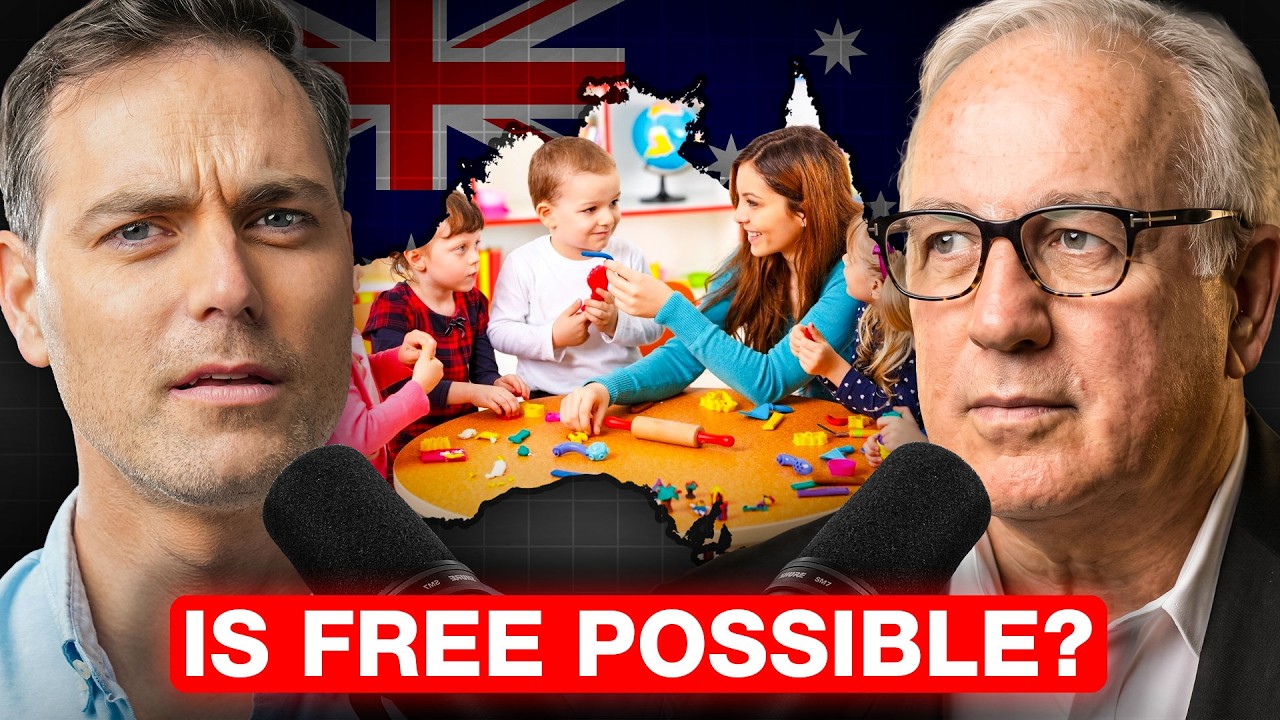
    • 4/5Thumbnail imageThe layout clearly signals an Australian economic discussion using podcast framing. Flanking faces and the central map cutout establish the debate and topic instantly.Two expressive faces flank a cutout of the Australian map containing a classroom of children playing at a table.
    • 4/5Thumbnail text“IS FREE POSSIBLE?”At three words, the copy is short, readable, and reframes the topic around practical feasibility. The high-contrast red bar makes it impossible to miss.Bold white letters on a bright red banner reading 'IS FREE POSSIBLE?'.
    • 3/5TitleThe title is clear and easy to understand, but it feels like a standard essay prompt. It lacks the geographic specificity and urgency shown in the artwork.A four-word question: 'Should Childcare Be Free?'.
    • 4/5Title + thumbnailThe packaging splits the job well. The title poses the moral policy question, while the thumbnail questions whether the math actually works.The title asks 'Should Childcare Be Free?' while the image asks 'IS FREE POSSIBLE?' over an Australian flag and map.

    Curiosity gap: The viewer wants to know what economic obstacles prevent Australia from offering free childcare.

    The three hooks

    The title, the thumbnail text and the first words spoken each make a promise, and each does a different job.

    • Title“Should Childcare Be Free?”Curiosity gapCuriosityReliefIt makes the viewer want to hear the case for and against wiping out childcare bills.
    • Thumbnail text“IS FREE POSSIBLE?”Curiosity gapCuriosityOutcomeIt makes the viewer want to see if zero-cost childcare can realistically be funded.
    • First words spoken“Hello, Dad.”StoryNoveltyCuriosityThe opening words establish a personal father-and-son dynamic that makes the viewer curious how their family relationship will influence economic debate.
    • PairingDifferent jobsThe title asks about the policy goal, while the thumbnail text focuses on economic feasibility.
    • StakesOver-promisesThe packaging promises an exhaustive investigation into universal childcare feasibility, but the video spends less than a third of its runtime on the subject within a loose podcast format.
    • UrgencyNoneThe title and thumbnail frame an ongoing macroeconomic debate with no immediate deadline or breaking policy event attached.

    The first 20 seconds

    TimeWhat you seeWhat you hearWhat it does
    0:00Young man in a cream shirt seated with a podcast microphone."Hello, Dad."Establishes an unusual father-son co-host dynamic immediately.
    0:01Cut to older man with glasses in a maroon shirt smiling."G'day, son."Confirms the family relationship and sets a relaxed tone.
    0:02Cut back to the younger man smiling warmly."It's nice to be with you."Reinforces the warm personal rapport between the two.
    0:03Young man continues smiling directly at his father off-camera.(silence)Lets the friendly interaction breathe.
    0:04Cut to older man laughing gently."It's good to be with you, too."Shows mutual affection and comfort on camera.
    0:05Cut to younger man gesturing with his hands."We've been talking about doing this for a long time, hey?"Signals the launch of a long-planned collaboration.
    0:06Younger man looking expectantly at his dad.(silence)Holds attention on the shared project milestone.
    0:07Cut to older man nodding thoughtfully."We have, and finally we're doing it."Affirms the start of their show.
    0:08Older man smiling warmly into the room."We're doing it."Hands conversational momentum back to the son.
    0:09Cut to younger man throwing hands out in excitement."We're doing it. I'm really..."Adds energetic body language to the scene.
    0:10Younger man laughing openly."...excited. Kohler and Kohler."Names the father-son podcast brand.
    0:11Younger man smiles and settles back into his chair.(laughter)Creates an informal, unscripted lounge atmosphere.
    0:12Younger man turns slightly and begins bantering."And as discussed, no one's really sure..."Sets up an inside joke about their shared surname.
    0:13Younger man keeps talking while looking over."...which Kohler is which."Delivers the playful self-deprecating line.
    0:14Younger man smiles and shrugs gently."I mean..."Trails off to invite a rebuttal.
    0:15Cut to older man smiling dryly."We are sure."Delivers deadpan comedic timing.
    0:16Older man looking calmly toward his son.(silence)Allows the dad's punchline to land.
    0:17Cut back to younger man smiling in response."We're pretty sure."Playfully walks back the statement.
    0:18Younger man takes a quick breath.(silence)Prepares to shift from banter toward the episode topic.
    0:19Younger man leans slightly back and gestures."I'm a bit flat, but I..."Begins framing his initial point or mood.
    0:20Younger man mid-sentence in the studio setup."...I"Clip cuts mid-phrase.
    Click confirmation
    No. The video opens entirely on father-son podcast banter and brand naming, making no visual or verbal mention of childcare in the first 20 seconds.
    Time to the point
    Not within the first 20 seconds
    Hook
    personal confession
    Reason to stay
    The warmth and novelty of a real father-and-son duo hosting a debate podcast together.
    Missing on purpose
    No title card, no animated logo, no theme music, and no upfront preview clip before the conversation starts.
    Pace and texture
    Relaxed two-camera studio setup cutting every one to three seconds with natural conversational pauses and no music or sound effects.

    Story map

    Explainer. A millennial business journalist and his veteran financial reporter father debate whether Australia can afford universal free childcare while untangling the housing crisis and market valuation traps.

    TimeSectionNew tensionStakesTurnLoops
    0:00 –2:40Podcast Launch & Title BanterWill the father and son establish a compelling dynamic, and what is this new show actually called?HoldThey acknowledge audience suggestions for clever pun names, but decide to stick with their plain family name.Opens: What will their new show cover, and how will Alan handle leaving TV?Closes: Established show format and branding.
    2:40 –13:4631 Years at the ABC & Housing RootsWhat major systemic shifts did Australia's top finance reporter miss while covering day-to-day news?RiseAlan admits he missed the importance of the 1999 CGT discount, which ended up fueling the modern housing affordability crisis.Opens: How does past tax policy connect to today's mortgage stress?Closes: Revealed Alan's biggest reporting oversights.
    13:46 –15:18Sponsor Break: uBank & UniSuperWhen will the promised title topic on childcare actually begin?FallSag: no turnOpens: Will childcare discussion deliver on the thumbnail hook?
    15:18 –30:26The Economics of Free ChildcareCan Australia realistically afford full nationalization of childcare without triggering hyper-inflation?RiseAlan retreats from total nationalization, arguing instead for a two-thirds public, one-thirds private model matching the school system.Opens: How will the government fund the required $33 billion annual running costs?Closes: Answered whether 100% free national childcare is economically feasible.
    30:26 –32:05Sponsor Break: UniSuper & uBankWill the remainder of the episode continue policy debate or pivot elsewhere?FallSag: no turnOpens: What beginner investing topic will they cover next?
    32:05 –38:45Decoded: Share Prices vs Market CapWhy would a $50 share be fundamentally cheaper than a $10 share?HoldShare price is arbitrary without counting issued shares to find market cap and comparing that to earnings.Opens: Are current AI stock valuations entering a historic bubble?Closes: Explained how P/E ratios and share issuance dictate true stock value.
    38:45 –44:40Audience Q&A: Is a Market Crash Coming?Is the stock market overdue for a catastrophic correction?RiseWidespread fear of a crash means one is unlikely right now; crashes hit only after the bears fully capitulate.Opens: What unforeseen factor could sow the seeds of the next collapse?Closes: Provided historical drawdown benchmarks and near-term market crash outlook.
    44:40 –46:40Bitcoin, Gold & Wrap-UpShould conservative investors allocate capital to safe-haven alternatives like gold or Bitcoin?FallAlan dismisses both assets entirely because they generate no cash flow and trade purely on speculation.Closes: Addressed alternative asset strategies and concluded the episode.

    Payoff: delivered in part at 23:02. The hosts break down the numbers and propose a two-thirds state-funded model between 15:18 and 30:26, but the segment represents less than a third of the video's total runtime. Ending: The co-hosts dismiss gold and crypto as speculative non-investments, laugh about their conversational wandering, and confirm they will record another episode next week.

    Leaks

    Where a viewer might leave. Guesses from watching, not retention data.

    • 0:20 The video opens entirely on father-son banter and inside jokes about podcast names, offering zero visual or verbal confirmation of the childcare topic.
    • 4:36 The conversation moves into a 10-minute retrospective on 1990s industrial disputes and housing taxes, drifting far away from the titled subject.
    • 13:46 A 90-second double sponsor break airs right before the hosts have said a single word about childcare.
    • 30:26 The childcare discussion ends completely, followed by another ad break and a complete format pivot into stock market definitions.

    Steal this

    1. Tease a controversial policy word right before an ad break to protect retention across commercial drop-offs. Saying 'nationalization, a big scary word, right after the break' creates an open loop that carries the audience through an ad block. 13:36
    2. Ground generational economic grievances in a single historical comparison chart. Showing repayments at 37.4% of income in 1989 versus today instantly validates millennial financial stress without turning it into whiny opinion. 9:44
    3. Use absurd audience usernames to disarm intimidating, serious financial topics. Reading an anxiety-driven retirement crash question from 'Sherpa the pug' injects levity into a heavy topic without mocking the underlying fear. 38:53

    Skip this

    • Opening a 46-minute video with three minutes of unscripted personal banter about retirement and family nicknames. This relies entirely on Alan Kohler's 31 years of established mainstream television goodwill; an unknown creator will face an immediate 50% audience drop-off.
    • Titling and thumbnailing a variety podcast after a 15-minute middle segment. Packaging a loose conversational show around one narrow policy prompt alienates viewers who clicked for an essay while frustrating regulars looking for the broader podcast.

    Open questions

    • Did the video experience severe audience drop-off at 13:46 during the first mid-roll sponsor break before childcare was introduced?
    • What percentage of viewers used chapter markers to skip the opening 15 minutes of retirement and housing chat to find the childcare segment?
    • How does retention compare between the policy discussion (15:18-30:26) and the stock market tutorial (32:05-38:45)?

    Teardown by Avail.video from the thumbnail, the title, the first 20 seconds and the report's notes on the whole video.

    On screen

    Everything the video showed you

    Slides, frameworks, quotes and formulas, captured verbatim with the moment they appeared. Tap any card to jump there.

    Reference shelf

    People, ideas and things mentioned

    Said means mentioned aloud; Shown means it appeared on screen.

    People12

    • Chris KohlerAustralian finance journalist and co-host of Kohler & Kohler0:00Said + shown
    • Alan KohlerVeteran Australian financial journalist, publisher, and co-host of Kohler & Kohler0:01Said + shown0:04Said + shown
    • AlfieAlan Kohler's first grandchild1:47Said
    • Marco BassFormer 7:30 Report television producer4:00Said
    • John HowardPrime Minister of Australia from 1996 to 20075:36Said5:38Said
    • Bob HawkePrime Minister of Australia from 1983 to 19916:28Said
    • Paul KeatingPrime Minister and Treasurer of Australia during the Hawke-Keating era6:29Said
    • John RalphAustralian businessman who chaired the Ralph Review of Business Taxation7:06Said
    • Michael ReadAustralian Financial Review journalist9:36Said9:46Said + shown
    • Wayne GretzkyCanadian former professional ice hockey player12:44Said
    • Warren BuffettBillionaire investor and CEO of Berkshire Hathaway35:48Said38:15Said
    • Sherpa the PugAudience listener who submitted a question on market crashes38:54Said

    Ideas & frameworks2

    • Kyoto Protocol1997 United Nations treaty committing state parties to reduce greenhouse gas emissions5:15Said
    • Ralph Review of Business Taxation1999 Australian tax review committee that recommended the 50% capital gains tax discount6:58Said

    Organizations5

    • Australian Broadcasting CorporationAustralia's national public broadcaster where Alan Kohler reported for 31 years2:40Said
    • uBankAustralian digital bank and podcast sponsor13:46Said + shown31:08Said + shown
    • UniSuperMajor Australian superannuation fund and podcast sponsor14:34Said + shown30:28Said + shown
    • Productivity CommissionAustralian Government independent research and advisory body21:25Said
    • NvidiaAmerican technology company and manufacturer of GPUs35:35Said

    Things on screen3

    • BitcoinDecentralized cryptocurrency created in 200944:40Said
    • RØDE microphoneMicrophone used by both hosts to record the podcast0:00Shown
    • iPad / tabletTablet device held by Chris Kohler to read notes and audience questions1:05Shown
    Video description

    A description you can paste into YouTube

    A hook, a summary, chapters in YouTube's format and what the video mentions. Copy it, edit it, and paste it into YouTube Studio.

    1,332 / 5,000 characters
    By the numbers

    What YouTube shows about this video and its channel

    As of Nov 6, 2026. YouTube's public numbers first, then Avail.video's own arithmetic on them.

    The video

    Views
    134.8K
    Likes
    1.7K
    Comments
    482
    Published
    Oct 12, 2026
    Length
    46:40
    Category
    People & Blogs
    YouTube's topics
    Society
    Captions
    No
    HD
    Yes
    Language
    —
    Paid promotion
    None declared
    Made for kids
    No
    License
    Standard YouTube

    Creator's tags

    No tags

    The channel

    Subscribers
    635K
    Videos
    331
    Total views
    631M
    Channel age
    3 years (since Jun 2023)
    Country
    —
    Uploads
    about every 11 days
    Across the last 5 long-form uploads
    Before this video
    7 days after the previous long-form upload

    Calculated by Avail.video from YouTube's public numbers

    Outlier score
    1.0× · Typical
    Views against the median of the channel's last 5 long-form uploads
    Views per subscriber
    0.21
    Likes vs the channel's usual
    1.0× the channel's usual
    1.3% of views vs a usual 1.3%
    Comments vs the channel's usual
    1.4× the channel's usual
    0.36% of views vs a usual 0.26%
    Rank among recent uploads
    #3 of 6
    By views: this video and the channel's last 5 long-form uploads
    Take it to your AI

    Ask Claude or ChatGPT about this video

    Copy this report as context, paste it into a chat, then ask anything. It includes timestamps, so answers can point back to the video.

    Then ask
    • Turn the main ideas into a checklist I can use this week.
    • What are the strongest claims in this video, and what evidence does it give for each?
    • Write a short summary for someone who hasn't watched it, linking the key moments.
    • Quiz me on this video, one question at a time, and cite the timestamp for each answer.

    Watched by Avail.video · 2026-11-06