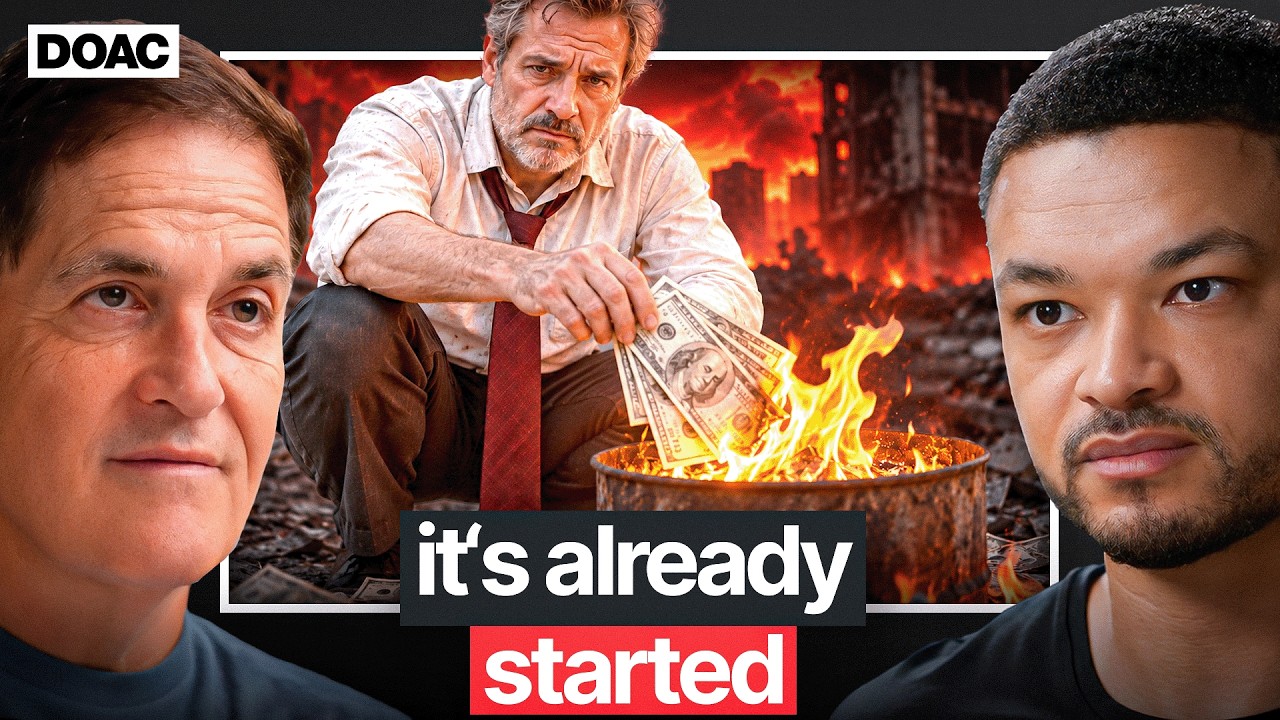
In this wide-ranging interview on The Diary Of A CEO, entrepreneur Mark Cuban offers a sober, contrarian counterpoint to mainstream artificial intelligence euphoria. Beginning with the broader financial markets, Cuban describes how equities have transformed into meme stocks trading like baseball cards0:14, where intraday movements are divorced from net present values and driven by anticipated news spikes. While drawing parallels to the dot-com crash of 2000, he notes that enduring winners will emerge just like Amazon and Dell survived the crash2:10, though picking whether OpenAI or Anthropic will prevail remains premature.
Cuban systematically deconstructs the assertion that artificial intelligence possesses genuine intelligence. He emphasizes that large language models are purely predictive3:33, utilizing statistical calculations to guess the next token rather than understanding real-world semantics or consequences. Highlighting inherent latency, he points out that AI models are immediately out of date3:27 upon release. To illustrate the profound gap between AI and sensory perception, Cuban compares autonomous navigation against a seeing-eye dog and shares the vivid two-year-old sippy cup example5:34, explaining that a toddler immediately grasps physical cause and human emotional reaction, whereas an AI model has no comprehension of physical context or consequence.
Rather than fearing apocalyptic artificial general intelligence, Cuban sees practical enterprise shifts. As foundation models train indiscriminately on open publications, organizations are withdrawing intellectual property, turning to trade secrets instead of patents8:47 to protect proprietary workflows. While automation will trigger economic displacement, he anticipates historical cycles of creative destruction and new jobs10:35, comparable to the historical decline of cassette and vinyl record manufacturing in Terre Haute, Indiana.
On personal and operational levels, Cuban embraces automation, employing dozens of autonomous AI agents12:23 to eliminate administrative friction. At his venture Cost Plus Drugs14:58, automated bots track adversary lawsuits, public contracts, and open records requests, freeing staff to execute high-value strategy. He advises students and professionals that their core competitive advantage lies not in static data retrieval, but in asking superior questions10:06 and integrating multidisciplinary inputs.
Finally, Cuban sounds the alarm on macroeconomic fragility created by the AI infrastructure arms race. The colossal capital expenditure on GPUs and facilities creates soaring private debt for hyperscalers20:56, while market dynamics rely heavily on Nvidia subsidizing its customers20:56. Cuban warns that without breakthroughs that achieve higher computational efficiency with drastically less energy, the current buildout risks severe financial distress.