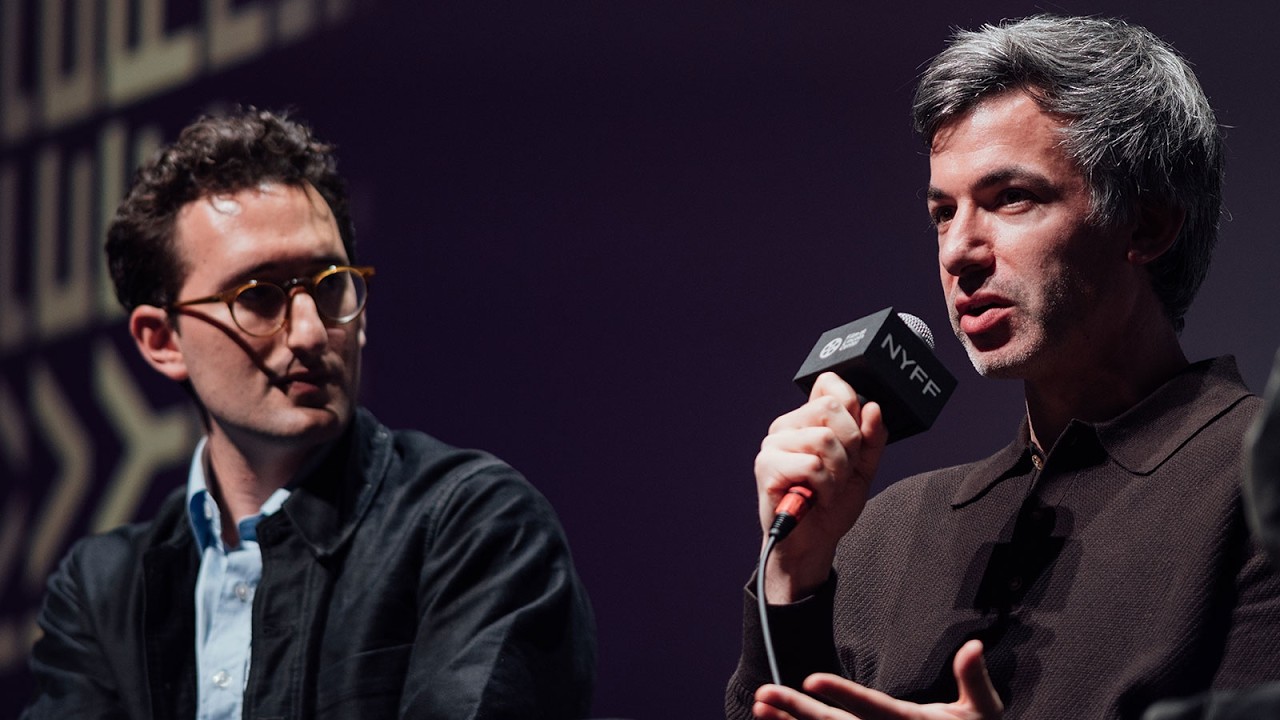
At the 64th New York Film Festival presented by Film at Lincoln Center, director Lance Oppenheim and collaborator Nathan Fielder sat down with festival artistic director Dennis Lim for a post-screening discussion of their documentary You Can See Everything. Lim opened the Q&A by asking attendees to refrain from posting spoilers or recording the conversation, emphasizing that the project relies heavily on audience surprise, prompting humorous banter about public shaming0:52.
Oppenheim traced the film's origins to a cold email in 20211:35 after noticing on distributor tracking software that Fielder had watched 60% of his debut documentary Some Kind of Heaven. The two became friends and later visited the Magic Castle in Los Angeles2:15, where a mention of Theranos founder Elizabeth Holmes sparked a conversation. Oppenheim had learned that Holmes was seeking someone to document her life and had previously contacted studio A24. Fielder, having read John Carreyrou’s investigative book Bad Blood, initially doubted there was an untold story left to capture, but was intrigued to meet her in person. A24 agreed to finance the experiment without any guaranteed storyline, allowing the filmmakers to enter her home with cameras under an open-ended mandate4:35.
During filming, the crew constantly experienced intense cognitive dissonance5:30, as members routinely argued over whether Holmes was acting genuinely or performing falsehoods during routine domestic scenes. Oppenheim described the bizarre atmosphere as resembling the otherworldly Zone in Andrei Tarkovsky’s Stalker7:20. Though Fielder initially intended to stay behind the camera, the subjects repeatedly directed questions toward him, leading camera operators to pan in his direction and inadvertently turning him into an on-screen participant investigator8:35.
Technically, the filmmakers abandoned an initial single-camera anamorphic setup after just one day because slow lens re-framing caused them to miss pivotal spontaneous moments. Together with cinematographer David Bolan, they pivoted to a three-camera verité arrangement9:30 utilizing 25-250mm zoom lenses and a hidden static wide camera. The production was limited to seven total crew members10:38 with only four inside the residence at a time, shooting up to 16 hours a day relying strictly on ambient natural lighting. They also adopted an unusually tight aspect ratio12:40 to eliminate environmental distractions and scrutinize facial expressions.
Addressing their current relationship with the subjects, Oppenheim and Fielder confirmed that Holmes remains incarcerated serving her sentence14:25 and neither she nor partner Billy Evans has watched the finished cut. Direct communication ceased after Evans attempted to exert editorial control, threatening the production's independence. In closing, Fielder shared that he and editor Adam Locke-Norton are still grappling with the footage's meaning20:30, before Oppenheim gave a heartfelt shout-out to their crew21:20 seated in Alice Tully Hall.