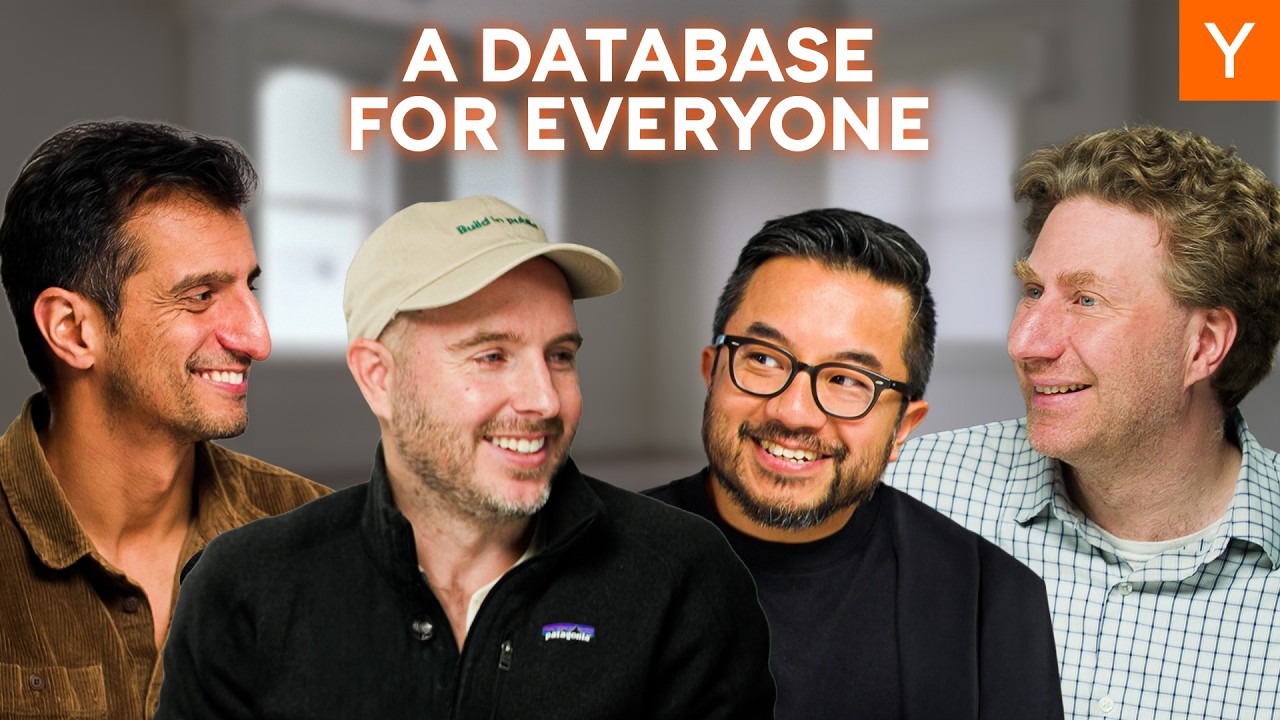
In this episode of the Lightcone podcast, Y Combinator partners Garry Tan, Jared Friedman, and Harj Taggar sit down with Paul Copplestone, co-founder and CEO of Supabase, to discuss how generative AI and autonomous agents have transformed software infrastructure. Supabase has experienced explosive growth, scaling from 8 million to nearly 50 million databases under management, with over 1 million databases spun up weekly1:50 and roughly 70% of new activity generated directly by AI agents1:08. Paul explains that while YC historically advised founders to 'make something people want', the new reality for infrastructure companies is building what agents want.
To accommodate autonomous workflows, Supabase underwent a radical strategic shift. Paul outlines the three chapters of Supabase2:50: evolving from an Airtable-like dashboard in 2020, to a scalable API platform in 2021, and finally into a code-first, Git-native platform tailored for agent sandboxes and CLIs. Copplestone notes that software design must adapt to autonomous users, highlighting their initiative to overhaul error messages. Instead of returning opaque HTTP 500 errors, Supabase embeds self-healing instructions and documentation links into error payloads30:25, allowing agents to debug and resolve errors autonomously without human intervention.
The rise of AI models has also democratized software creation, expanding the market far beyond traditional software engineers. Paul and the hosts examine the rapid emergence of non-technical domain expert builders8:09, pointing to examples like a 50-year-old Brazilian taxi driver who built an entire local rideshare service directly from his mobile phone. Garry Tan illustrates this paradigm shift through his own personal project, Control Tower and GBrain10:30, a customized operating system built on hosted Supabase Postgres and PGVector that manages finances, health metrics, and automated email triaging.
To handle the unprecedented volume of micro-applications and personal databases, Copplestone reveals Supabase's acquisition of Turso and introduction of Supabase Spark16:21. This architecture leverages SQLite compatibility to scale down efficiently for lightweight prototyping and personal agents while maintaining Postgres compatibility for enterprise workloads scaling up to petabytes. Copplestone also shares how he used voice-directed coding to build OpenUSD.dev40:10 entirely hands-free without looking at the underlying code.
Finally, the conversation examines startup economics in an AI-native world. Tan and Copplestone observe that small 10 to 15 person startups are reaching tens of millions in ARR43:35 with high profit margins, reducing the necessity of raising traditional Series A rounds. Reflecting on durability, Copplestone emphasizes the Lindy effect of databases45:35, betting that while AI interfaces evolve rapidly, stateful database infrastructure remains an enduring 50-year bet.