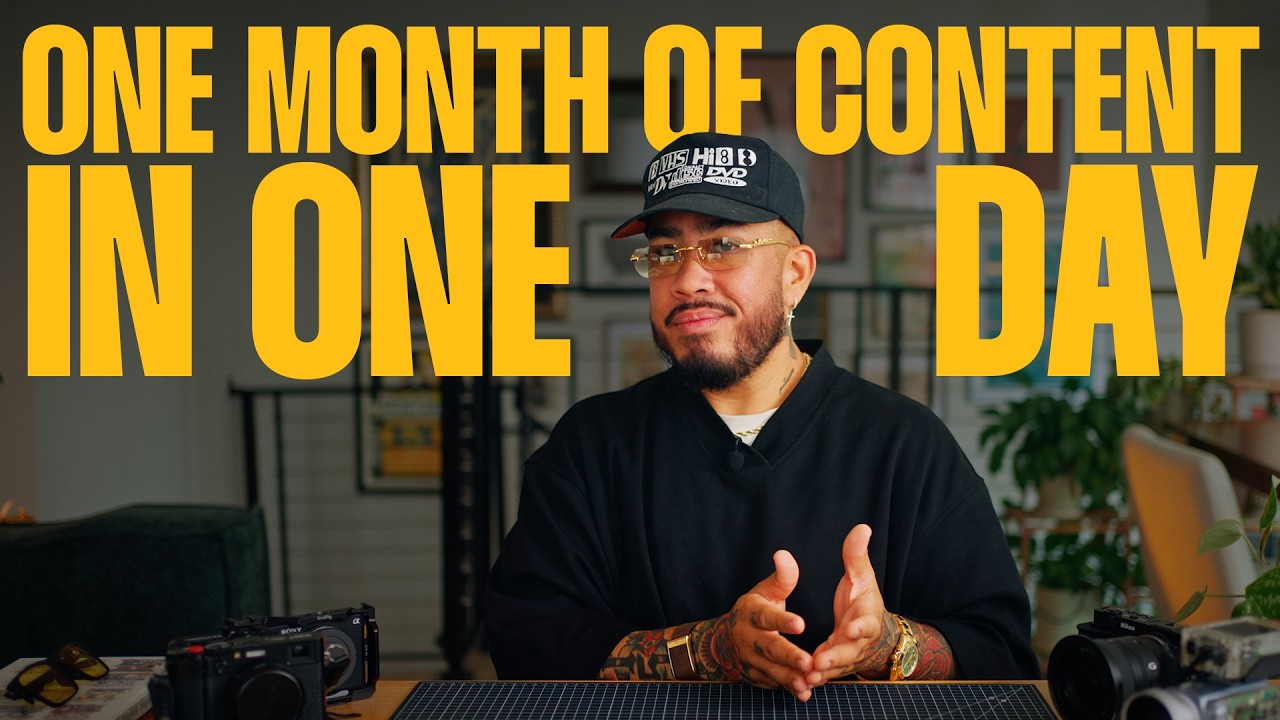
Creating consistent content without burning out requires replacing impulse-driven shooting with a disciplined, reproducible framework. In this video, veteran filmmaker Adrian Per shares the exact strategy that allows him to capture a full month of content in a single filming day. Most creators struggle because they wait for fleeting motivation, interweaving writing, filming, and editing haphazardly throughout the week. Adrian stresses that sustainable content creation relies on a solid system rather than raw talent or high-end gear, outlined in his three-pillar framework0:38.
The first pillar of this system is time blocking1:02. Instead of juggling tasks simultaneously, creators should dedicate specific, non-negotiable days to distinct phases of production: one block for scripting, one for filming, one for editing, and one for posting. Adrian demonstrates this principle with a weekly calendar schedule2:08, showing how separating stages prevents mental fatigue and scattered effort. When creators attempt to write and film on the same day, neither task receives full focus; by dedicating an entire day to a single creative endeavor, creators build productive momentum and eliminate time-wasting busy work and scattered multitasking3:29.
The second pillar centers on writing before filming4:24. Showing up to a shoot without a finalized script leads to continuous improvisation and costly reshoots. Adrian plans every detail beforehand, mapping out shot compositions and camera angles on a script and shot list. Crucially, he films not in script sequence, but by prioritizing setup efficiency over chronological order5:02. By shooting every scene requiring the same background, lighting, or lens configuration back-to-back—regardless of whether they belong to different videos—creators eliminate the exhausting downtime of tearing down and rebuilding setups, guided strictly by a pre-planned shot list7:04.
The final pillar is the hook system9:56, which multiplies the reach of completed videos with minimal extra labor. Rather than posting a finished video just once, Adrian recommends keeping the body of the video identical while filming two to four alternate openings. Because social media platforms only serve posts to a small slice of a creator's audience at any given moment, posting different hooks to unique audiences12:24 allows creators to test various emotional triggers—such as humor, authority, or direct problem-solving—without confusing existing followers. In his final summary of the system14:45, Adrian reminds creators that structured schedules do not restrict creativity; they provide the essential container needed to sustain long-term consistency.