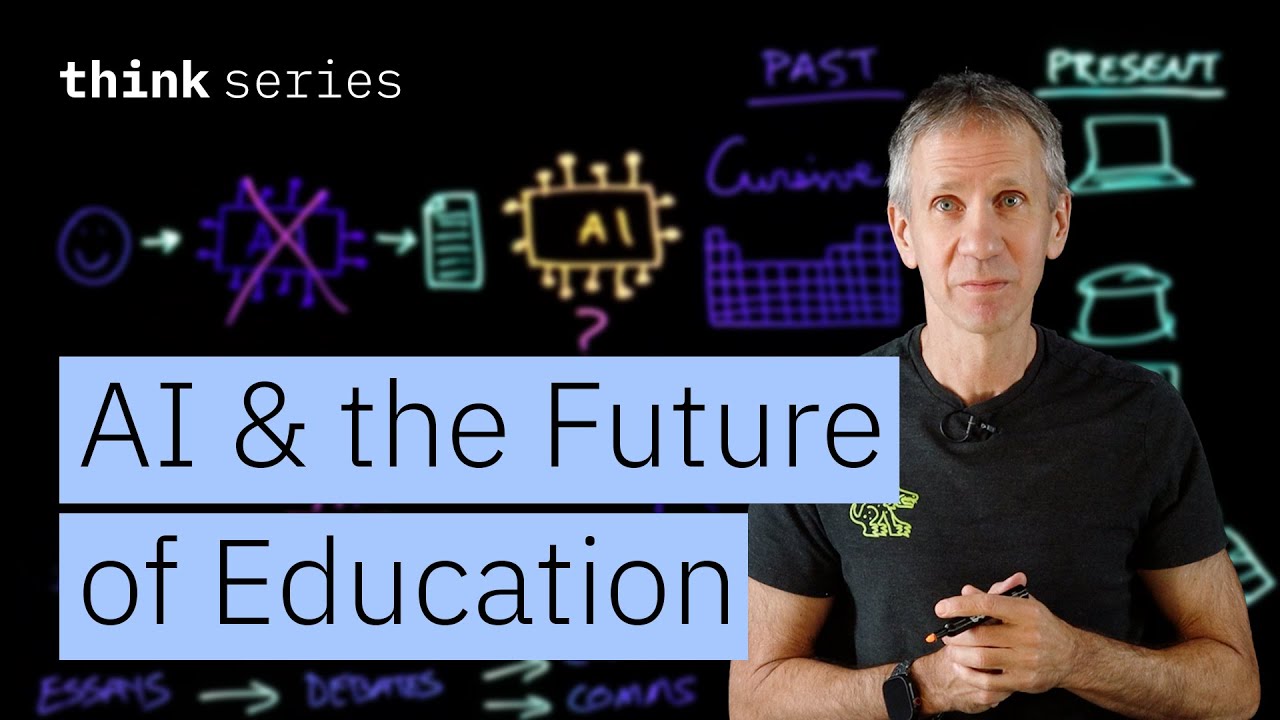
As generative artificial intelligence transforms modern society, educators face a defining dilemma: whether to ban AI tools or integrate them into curricula. Jeff Crume, an adjunct professor and IBM Distinguished Engineer, argues that banning AI in the classroom0:20 is counterproductive because detection algorithms will inevitably fail as models improve. Rather than trying to halt technological progress, educators must recognize that the train has left the station0:48 and pivot toward using AI to elevate student learning.
Historically, educational priorities have continuously shifted alongside technological innovations. Crume illustrates this transition by highlighting how society once devoted significant instructional time to teaching cursive penmanship1:18, memorizing the periodic table2:10, performing manual long division2:58, and reading physical paper maps3:35. In modern classrooms and workplaces, these skills have been largely superseded by laptops, digital databases, calculators, and GPS systems. Just as earlier tools freed learners from repetitive mechanical burdens, AI tools represent the next logical phase in educational evolution.
Thriving in an AI-assisted world demands distinct human competencies. Crume outlines core AI era skills5:35, prioritizing mental adaptability, out-of-the-box creativity, and rigorous critical thinking to verify AI outputs and anticipate unintended consequences. Furthermore, AI introduces transformative pedagogical capabilities. It can deliver just-in-time concept refreshers6:58, serve as an infinitely patient personalized tutor7:28 that adapts explanations to individual learning styles, operate as an automated grammar and style editor8:15, and assist students with disabilities through accessibility adaptations. For instructors, AI can handle lesson planning and administrative grading, allowing teachers to focus on individualized mentoring while expanding educational access10:40 globally via cloud-delivered tools.
To effectively leverage these advantages, institutions must emphasize AI literacy and ethical judgment12:12, reinforcing the principle that capability alone does not justify action without considering societal impact. In practice, educators should replace easily automated assignments with activities that foster deeper engagement, such as substituting essays with live classroom debates13:10, replacing rote memorization with core scientific principles13:55, and swapping basic arithmetic drills for higher-order calculus and algebraic reasoning. Since no forward-looking employer will ever forbid workers from using AI15:10, schools must train students using modern tools to prepare them for competitive 21st-century careers.