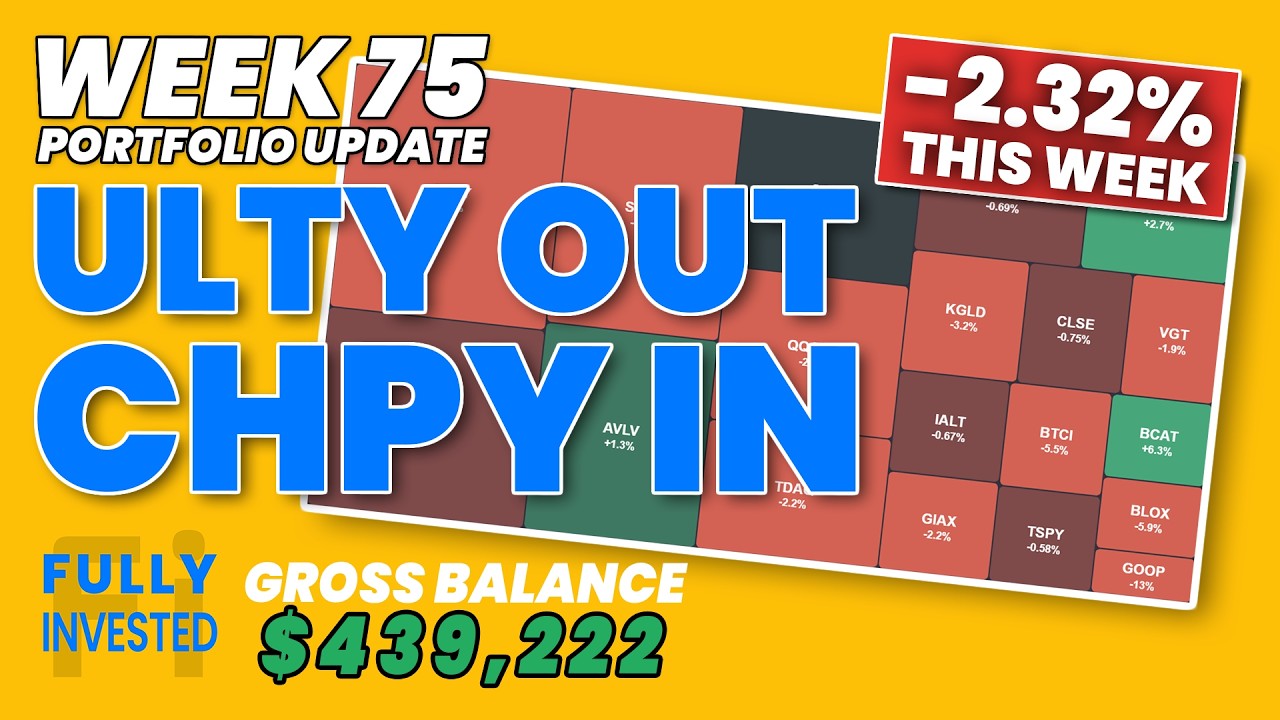
In his week 75 update, host Job details navigating a brutal week in the markets characterized by sharp downturns in technology stocks and semiconductor names, culminating in an aggressive Friday drop. His leveraged investment strategy amplifies both gains and drawdowns, resulting in a weekly decline of 2.32% and a portfolio loss exceeding $4.7K as explained during the market overview and benchmark comparison0:25. This pushed his net portfolio balance under the psychological $200,000 threshold, dropping to $197,596.30. Operating on roughly 2x margin leverage, Friday alone inflicted a 6.35% drop of $13.3K across his holdings, underscoring the volatility inherent in his approach.
Job's core financial framework involves depositing 100% of his bi-weekly W-2 salary and side incomes directly into Robinhood, splitting purchases into 10% broad growth ETFs and 90% high-yield income funds. All living expenses and mortgage payments are financed by borrowing against his portfolio on margin at a 4.75% interest rate, a process detailed in his weekly cash flow architecture1:40. The strategy relies on maintaining a positive spread between the high distribution yields of his assets—averaging roughly 15.47%—and the lower margin borrowing rate. This net income generated covers debt service with excess cash flow reinvested to achieve financial independence and early retirement by age 40.
With gross portfolio assets at $439.2K and margin debt rising to $242.3K, Job examines his narrowing safety buffer during the margin health evaluation9:05. His portfolio equity ratio declined to 44.83%, approaching more critical territory. Factoring in a 25% blended margin maintenance requirement, he calculates that his portfolio would trigger a margin call if gross assets declined to $109.8K—an equivalent 19.8% broad market drop. To mitigate ongoing capital degradation, he executed a pivotal portfolio change by selling his entire ULTY position22:50 to purchase CHPY. While closing ULTY locked in a realized loss of $13.2K, he notes it removes a major NAV-eroding instrument in favor of higher quality underlying semiconductor exposure.
Looking ahead, Job explores several defensive adjustments to safeguard his margin buffer, such as reallocating stable hedges or utilizing future paychecks to build cash reserves, as modeled in his hedging and scenario planning27:30. Despite market headwinds, the portfolio delivered $950.01 in weekly dividend income, keeping him on track with an annualized run-rate of nearly $68,000 to steadily compound his way toward financial independence.