Avail.video · Watched for you · 20:45 video · 1 min read · 20 min saved

Simulating Millions of AI Agents to Predict the Future: MiroFish Full Guide & Demo

Outlier score1.6×Above typical

75,882 views vs a median of 47,179 across the channel's last 13 long-form uploads · as of Nov 2

Avail.video calculation

Tim from Tech With Tim introduces MiroFish, an open-source AI swarm intelligence engine that builds a parallel digital society to forecast future events. He explains its underlying five-stage architecture—from GraphRAG knowledge graph extraction to dual-platform social debate—and demonstrates a real-world prediction test for Dubai real estate. Finally, he walks through deploying the application via a Hostinger VPS and using OpenAI and Zep Cloud API keys.

Read the teardown

How it earns the click and holds attention, second by second.

Find in this video

Search what was said and shown

One search covers the transcript, on-screen text, claims and references. Every result jumps to its moment.

    The explainer

    What the video says, with a link to every moment

    A 1-minute read, 20 min less than watching. Each underlined phrase opens the video at that second.

    MiroFish is an open-source swarm intelligence prediction system designed to simulate thousands of autonomous AI personas debating real-world events. Host Tim begins by displaying an interactive knowledge graph visualization0:10 that maps out entities, power structures, and dependencies before presenting a detailed ten-year real estate forecast0:46 generated for downtown Dubai. Rather than using simple time-series extrapolation, MiroFish creates a parallel digital environment where autonomous agents model human social dynamics.

    Behind the scenes, MiroFish relies on a structured five-stage pipeline2:34. First, it performs GraphRAG graph construction3:32 on user-provided unstructured documents such as news articles and financial reports. In stage two, the platform populates agent persona profiles3:40, assigning distinct traits, memory imprints, and behavioral biases to each participant. Next, MiroFish initiates a dual-platform simulation3:50 where agents interact across short-form Twitter-style posts and Reddit-style threaded discussions. The engine is powered by the OASIS simulation framework4:15 from CAMEL-AI, alongside Zep Cloud for persistent memory4:22, a FastAPI backend, and Vue.js on the frontend.

    framework
    Five Stages, Fully AutomatedGraph Build → Environment → Simulation → Report → Interact9 / 31
    ▶ 2:33
    On screen at 2:33

    To demonstrate setup, Tim showcases a quick deployment workflow using a Hostinger VPS Docker container6:10. Setting up MiroFish requires connecting an LLM API key supporting the OpenAI standard and a Zep Cloud API key8:38 to handle long-term agent memory. Tim emphasizes that while OpenAI GPT-4o7:30 offers a cost-effective option for running multi-agent rounds, users can substitute other providers by adjusting the base URL.

    formula
    GPT-40 = GPT 4.0
    ▶ 7:31
    On screen at 7:31

    In the practical run, Tim feeds in a detailed research report11:40 compiled with Claude regarding Dubai property trends and Middle Eastern geopolitical friction. MiroFish ingests the markdown data to extract dozens of autonomous personas14:00, including simulated investors, military figures, and political personas. During the Info Plaza and Topic Community simulation17:00, agents debate across simulated hours. Finally, the system executes deep agent interviews18:25 to synthesize a comprehensive report, after which users can engage in interactive direct chats19:45 with specific personas to investigate their reasoning.
    Highlights
    1. 0:05MiroFish concept and knowledge graph demo
    2. 2:34The five-stage simulation architecture
    3. 4:15Core tech stack including OASIS and Zep Cloud
    4. 5:40Deploying MiroFish on a Hostinger VPS
    5. 11:20Feeding Dubai real estate context into MiroFish
    6. 19:25Deep interaction with simulated personas
    Chapters across the 20:45 runtime
    How it's told

    A technical explainer followed by a deployment walkthrough

    Format: Tutorial. Tim explains the multi-agent swarm architecture of MiroFish using slides and case studies before walking through deploying it on a cloud VPS. He then runs a complete five-stage prediction simulation on Dubai real estate trends and interviews the generated personas.

    Story arc

    1. 0:00Hook & Demo OverviewTim previews the MiroFish knowledge graph and report predicting Dubai real estate trends.
    2. 1:17What is MiroFishPitch deck explaining swarm intelligence, parallel digital worlds, and GitHub popularity.
    3. 2:31Five-Stage PipelineDetailed technical breakdown of how GraphRAG, agent personas, dual-platform simulation, and report generation work.
    4. 4:13Tech Stack & Use CasesOverview of underlying tools (OASIS, Zep, FastAPI) and real-world trading/research examples.
    5. 5:13Cloud Setup & DeploymentDeploying MiroFish via Hostinger VPS, configuring OpenAI and Zep Cloud API keys.
    6. 10:30Full Project SimulationUploading Dubai property market data, defining simulation rounds, and running the five-phase engine.
    7. 16:52Swarm Simulation Live FeedObserving autonomous agents interact, post, and debate on Twitter/Reddit clones.
    8. 17:48Report Analysis & Deep InteractionReviewing generated market forecasts and directly interviewing individual agents.
    9. 20:25Conclusion & OutroFinal thoughts, partner acknowledgment, and channel sign-off.

    Setups and payoffs

    1. 0:36Setup Tim sets up predicting Dubai real estate prices based on recent geopolitical events
      ↳
      19:03Payoff The simulation generates a comprehensive forecast report predicting long-term growth
    2. 0:54Setup Tim introduces interacting directly with the 32 autonomous simulated agents
      ↳
      19:42Payoff Tim opens the workbench and interviews the simulated Donald Trump agent
    3. 2:33Setup Tim outlines the 5-stage automated pipeline conceptually
      ↳
      12:59Payoff Tim steps through each of the 5 phases during the live execution run
    4. 5:43Setup Tim recommends selecting the Hostinger KVM 2 VPS plan
      ↳
      10:30Payoff The KVM 2 server completes deployment and launches the live containerized MiroFish app
    5. 8:28Setup Tim explains setting up Zep Cloud for agent memory
      ↳
      13:06Payoff Zep integrates during stage 1 to store knowledge graph relationships and agent memories
    6. 12:28Setup Tim introduces Wispr Flow for voice dictation
      ↳
      19:26Payoff Tim uses Wispr Flow hands-free to dictate prompts to the report agent and Trump persona

    Devices

    • RHETORICAL_QUESTIONTim hooks viewers by asking what would happen if a million people could be simulated to forecast the future1:17
    • PICTURE_IN_PICTUREPresenter camera bubble positioned over screen recordings to maintain face-to-camera connection while guiding software0:066:0513:13
    • SPONSORED_INTEGRATIONHostinger VPS one-click deployment presented as the recommended effortless solution compared to complex local setup5:356:21
    • TOOL_DEMOReal-time dictation with Wispr Flow demonstrated organically while composing simulation prompts12:2819:26
    • METAPHORDescribing the multi-agent debate environment as a "parallel digital world" or "simulated society"1:461:56

    From the video's own structure, matched to the transcript and on-screen text.

    Teardown

    A high-curiosity demo showing a complex multi-agent simulation within the first ten seconds hooks technical viewers before guiding them through an accessible cloud setup.

    Above the channel's typical: 1.6× its typical views (75,882 vs a median of 47,179 across the channel's last 13 long-form uploads, as of Nov 2) · Long-form tutorial · 199 days old

    The promise

    A viewer believes they will learn how to build an autonomous multi-agent AI system with MiroFish to simulate and forecast any scenario.

    Packaging

    How it looks in the feed

    Show the feed as
    20:45

    MiroFish Full Tutorial — Predict Any Scenario With AI

    Tech With Tim75K views · 6mo agoDeploy MiroFish with one click using Hostinger: https://www.hostg.xyz/SHJGj Get 10% off with code techwithtim MiroFish is one of the coolest AI projects that…

    Views and age as of the teardown, Nov 2, 2026. Other videos are blanked out.

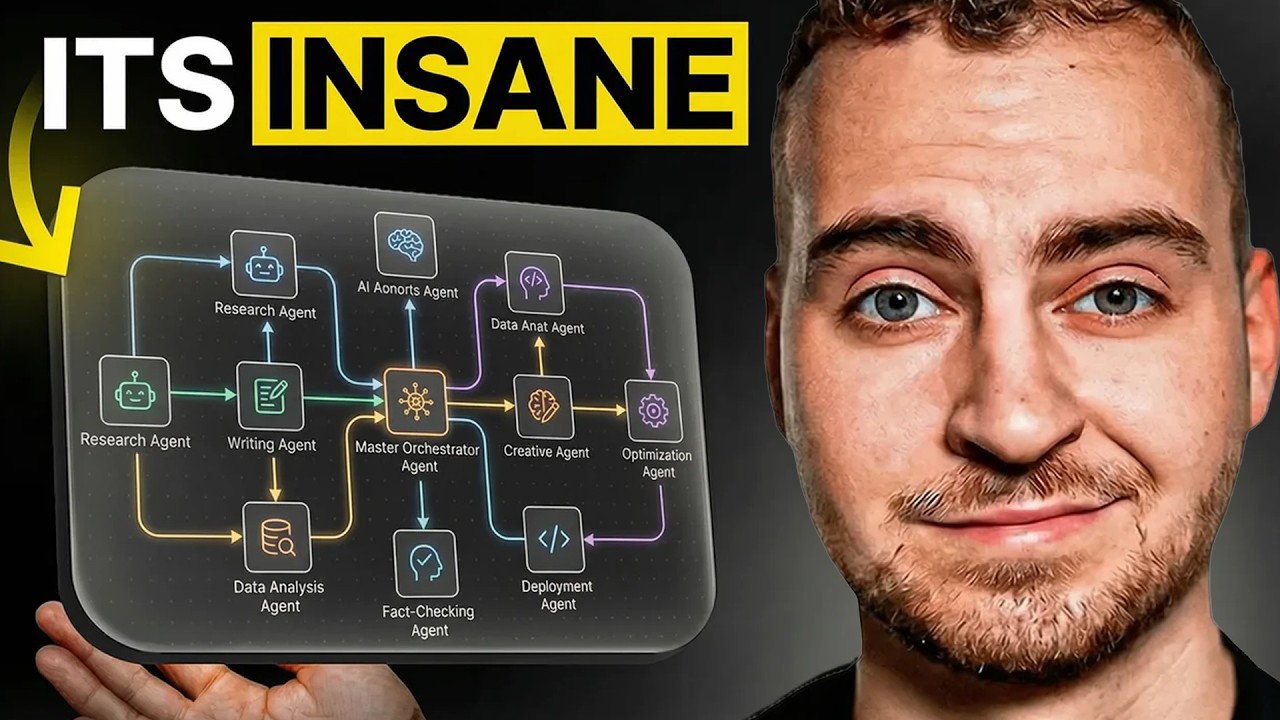
    • 4/5Thumbnail imageThe composition balances a direct human gaze with an intricate multi-agent workflow card. The diagram text is small on mobile, but the visual structure of connected AI nodes immediately communicates advanced technology.A close-up face occupies the right half looking forward while an open palm displays a floating glass card full of interconnected AI agent icons pointed to by a yellow arrow.
    • 3/5Thumbnail text“ITS INSANE”The phrasing is standard click-friendly hyperbole rather than a unique insight. However, at just two words with strong yellow-and-white contrast, it remains effortless to scan.Two words in large block lettering reading 'ITS INSANE' sit in the top-left quadrant.
    • 4/5TitleIt combines a clear educational label with a bold, high-stakes capability promise. Developers immediately know what library is covered and what power they will unlock.The title pairs the specific framework 'MiroFish Full Tutorial' with the outcome 'Predict Any Scenario With AI'.
    • 4/5Title + thumbnailThe elements support each other by dividing technical specificity and emotional intrigue. The title names the tool and the capability, while the graphic shows the multi-agent wiring diagram that makes it plausible.The thumbnail displays a complex agent architecture graphic alongside the title's promise to predict any scenario.

    Curiosity gap: How an interconnected cluster of specialized AI agents can actually be orchestrated to simulate and predict real-world events.

    The three hooks

    The title, the thumbnail text and the first words spoken each make a promise, and each does a different job.

    • Title“MiroFish Full Tutorial — Predict Any Scenario With AI”How-toOutcomeCuriosityIt makes the viewer want a complete walkthrough to build predictive simulation workflows using AI.
    • Thumbnail text“ITS INSANE”Curiosity gapCuriosityNoveltyIt makes the viewer want to find out what feature or capability in the diagram warrants such an extreme reaction.
    • First words spoken“This is one of the coolest AI projects that I have ever played with.”Curiosity gapNoveltyCuriosityIt makes the viewer want to find out what makes this specific tool stand out above every other AI project.
    • PairingDifferent jobsThe thumbnail graphic and text generate emotional hype and visual curiosity, while the title specifies the software tool and practical use case.
    • StakesFitsThe video presents MiroFish as an advanced swarm simulation tool for scenario analysis and delivers a complete, functioning simulation run matching that scope.
    • UrgencyNoneThe video offers a tutorial on a trending open-source repository without manufacturing artificial deadlines or fear of missing out.

    The first 20 seconds

    TimeWhat you seeWhat you hearWhat it does
    0:00Presenter sitting in front of laptop; text banner 'MIROFISH DEMO' at bottom left.This is one of the coolestImmediately establishes a talking-head format with clear topic branding.
    0:01Presenter talking directly to camera with hands resting on laptop.AI projects that I haveFrames the subject as an exceptional, high-interest tool.
    0:02Presenter begins gesturing with both hands.ever played with.Delivers personal endorsement and excitement.
    0:03Presenter pauses gesturing, leaning slightly forward.[silence / breath]Creates a brief beat before revealing the name.
    0:04Large text 'MIROFISH' appears across top; graphic fish logo appears bottom right.It is called MiroFish,Directly names the tool alongside visual branding.
    0:05Text and logo stay on screen as speaker gestures playfully.MyroFish, however you want to pronounce it,Keeps the tone conversational and approachable.
    0:06Cut to screen share showing an intricate knowledge graph with speaker in circular inset.and the finished resultInstantly shows visual proof of what the tool produces.
    0:07Complex node network with hundreds of red and blue dots and connecting lines.ends up giving you a reallyCaptures attention with an impressive, complex visual display.
    0:08Mouse cursor hovers over the center of the dense node cluster.detailed knowledge graphIdentifies what the visual representation actually is.
    0:09Cursor moves through network of nodes; speaker glances down at screen.that looks something like this,Connects verbal description directly to the screen demo.
    0:10Cursor clicks and explores nodes in the graph view.that allows you to effectivelyTransitions from showing the artifact to explaining its practical utility.
    0:11Full graph view remains visible while speaker gestures in circular webcam frame.predictIntroduces the high-stakes core value proposition.
    0:12Network graph remains static while cursor hovers near center.the futureDelivers the ultimate hook promise: predicting future events.
    0:13Cursor shifts slightly among nodes; presenter talks with open hand gesture.by usingPrepares to explain the technical mechanism.
    0:14Dense web of relationship links visible across the screen.a swarm intelligenceIntroduces the AI architecture powering the capability.
    0:15Webcam inset shows presenter emphasizing words with two-hand gesture.of hundredsQuantifies the scale of the system.
    0:16Screen share view of MiroFish relationship visualizer.of different agentsClarifies that autonomous multi-agent simulation is involved.
    0:17Mouse moves across node cloud; legend visible on bottom left.acrossMaintains visual context while continuing technical setup.
    0:18Webcam inset shows presenter continuing explanation smoothly.[sentence continues]Keeps narrative flowing into the full methodology.
    0:19Cursor points near dense central cluster of the graph.[sentence continues]Maintains viewer focus on the data visualization.
    0:20Graph interface displays tabs for Atlas, Double column, and workbench.[sentence continues]Shows UI depth, teasing advanced functionality to come.
    Click confirmation
    Immediately confirms the click at 00:00 with on-screen text 'MIROFISH DEMO' matching the video title, followed by showing the live interface at 00:06.
    Time to the point
    0:12
    Hook
    bold claim, payoff preview
    Reason to stay
    The viewer wants to see how this complex swarm intelligence graph is built and how it actually predicts future events.
    Missing on purpose
    No generic greeting, channel intro, logo animation, or subscribe callout before getting straight to the tool and its output.
    Pace and texture
    Fast and punchy; cuts from a full-screen camera to a rich UI screen recording within six seconds, accompanied by confident, energetic narration without pauses.

    Story map

    Tutorial. A creator sets out to configure and run an autonomous multi-agent simulation tool to forecast Dubai real estate prices, navigating deployment friction and API setup to produce a synthesized consensus report.

    TimeSectionNew tensionStakesTurnLoops
    0:00 –1:14Hook & Proof of ConceptCan multi-agent swarm intelligence actually predict complex future outcomes?RiseTim reveals the finished knowledge graph and Dubai report immediately, but hasn't shown how to deploy or run the software yet.Opens: How does MiroFish build these agents and generate forecasts?Closes: What the finished simulation output looks like.
    1:14 –5:12Architecture & Five StagesHow does the system transform raw context documents into an interacting society of AI personas?HoldThe architecture sounds complex and theoretical, but Tim shows real-world examples like Polymarket trading bots before moving to deployment.Opens: Can an ordinary viewer deploy this stack without complex local configuration?Closes: How the five-stage automated pipeline operates conceptually.
    5:12 –7:00VPS Deployment SetupWill setting up this open-source tool require hours of environment troubleshooting?FallTim steers away from tedious local terminal installation to a one-click Hostinger cloud template.Opens: Will the automated Docker deployment launch without errors?Closes: How to bypass local software dependency conflicts.
    7:00 –10:40API Configuration & Memory SetupHow many API keys and external services are required to make the simulation run?HoldThe framework requires persistent memory and LLM compute, therefore Tim configures OpenAI and Zep Cloud credentials in the deployment form.Opens: What happens when the container launches and connects to these APIs?Closes: Where to get API keys and how to manage simulation token costs.
    10:40 –13:35Data Preparation & Input PromptingWhat quality of input data is needed to keep the simulation from hallucinating generic answers?RiseRaw prompts are not enough, therefore Tim prepares and uploads a 30-page research brief on Dubai market trends generated by Claude.Opens: How will MiroFish convert this document into distinct agent personas?Closes: How to structure input documents and define scenario prompts.
    13:35 –18:05Autonomous Simulation & Social FeedsWill the generated agents actually debate realistically across the simulated platforms?RiseThe interface is partly in Chinese and the progress indicators glitch, but the parallel Twitter and Reddit feeds successfully generate multi-agent debates.Opens: What final consensus will the agents reach regarding property prices?Closes: How the knowledge graph and agent debate cycles run in real time.
    18:05 –20:45Report Generation & Persona InteractionDoes the finished report provide concrete forecasting value or just conversational noise?FallThe system conducts automated interviews with debating agents, therefore allowing the user to interrogate specific personas directly.Closes: The forecast conclusion for Dubai real estate and how to inspect individual agent reasoning.

    Payoff: delivered fully at 19:03. The video generates the full predictive report on Dubai real estate trends and demonstrates live interactive Q&A with generated personas. Ending: Tim summarizes the experiment, encourages viewers to run their own simulations, repeats the cloud deployment link, and delivers a quick call to like and subscribe.

    Leaks

    Where a viewer might leave. Guesses from watching, not retention data.

    • 5:35 A direct pivot to an extended Hostinger checkout walkthrough interrupts the technical momentum for viewers seeking pure code or free local installation.
    • 7:15 Navigating standard developer portals to copy-paste OpenAI and Zep API keys slows visual pacing with mundane account setup.
    • 16:15 Explaining abstract simulation wheels and waiting out UI rendering while noting that trackers do not work creates a lull in narrative progression.

    Steal this

    1. Show the finished complex artifact within the first 10 seconds before explaining how it works Proves the tool delivers impressive visual results immediately, establishing high visual credibility before diving into architecture. 0:06
    2. Ground abstract multi-agent swarms with recognizable human archetypes Naming agents after well-known figures or clear roles makes autonomous debates easy to follow and inherently entertaining. 3:01
    3. Chain AI tools by using an LLM to prep input data for an upstream simulation engine Eliminates the friction of manual data collection by showing viewers how to prompt one model to generate the contextual brief needed by another. 11:34
    4. Interrogate individual simulation agents directly after generating a collective report Allows the user to inspect the underlying rationale behind an AI synthesis, turning a static document into an interactive verification tool. 19:42

    Skip this

    • Channeling an open-source tutorial primarily through a paid cloud hosting partner template Relies on pre-existing viewer trust and sponsor integration; smaller creators risk viewer backlash if they skip comprehensive local installation instructions.
    • Casually running multi-agent test runs that burn through API credits on high-tier models Works because established creators treat model API fees as business expenses, whereas everyday hobbyist viewers are sensitive to runaway token costs.

    Open questions

    • What was the audience retention drop-off during the checkout demonstration between 05:40 and 06:40?
    • How many viewers encountered configuration errors when trying to run the tool locally rather than on the sponsored VPS?
    • How reproducible and accurate are MiroFish's market predictions compared to simple single-prompt LLM summaries?

    Teardown by Avail.video from the thumbnail, the title, the first 20 seconds and the report's notes on the whole video.

    On screen

    Everything the video showed you

    Slides, frameworks, quotes and formulas, captured verbatim with the moment they appeared. Tap any card to jump there.

    Reference shelf

    People, ideas and things mentioned

    Said means mentioned aloud; Shown means it appeared on screen.

    People5

    • Tim RuscicaSoftware developer and host of the Tech With Tim YouTube channel0:00Shown1:08Shown2:10Shown3:02Shown6:22Said + shown7:07Shown9:00Shown11:21Shown18:14Shown20:30Shown20:38Shown
    • Donald TrumpFormer US President simulated as an autonomous persona in MiroFish1:08Said + shown3:06Said4:07Said14:07Shown19:46Said20:00Said + shown
    • Nancy PelosiUS politician simulated as an agent persona1:09Said3:06Said14:06Shown
    • Sarah ChenExample financial analyst agent persona shown in slide architecture3:40Shown
    • Asim MunirField Marshal simulated as an agent persona in the Dubai geopolitical simulation1:06Shown17:36Shown

    Ideas & frameworks1

    • GraphRAGKnowledge graph construction technique for extracting entities and relationships from unstructured documents3:32Said + shown4:16Shown

    Organizations4

    • HostingerWeb hosting and cloud VPS provider sponsoring the video deployment walkthrough5:35Said + shown6:21Shown9:25Shown20:28Shown
    • OpenAIAI research company and provider of GPT-4o API models4:34Shown7:05Said + shown
    • MiniMaxChinese LLM provider supported in MiroFish4:36Shown8:04Shown
    • GitHubSoftware repository platform hosting the open-source MiroFish codebase1:25Said + shown

    Things on screen10

    • MiroFishOpen-source multi-agent swarm intelligence simulation engine for scenario forecasting0:05Said + shown1:14Said1:25Shown5:17Shown
    • OASISMulti-agent social interaction simulation engine developed by CAMEL-AI4:14Said + shown4:36Shown
    • Zep CloudLong-term persistent memory service for autonomous AI agents4:22Said + shown8:28Shown8:40Said + shown
    • ClaudeAnthropic LLM used to prepare the background research report on Dubai real estate4:32Said + shown11:22Said + shown
    • PolymarketDecentralized prediction market platform featured in a multi-agent trading bot case study4:40Said + shown
    • Wispr FlowAI-powered voice dictation application used for hands-free prompt input12:30Said + shown19:26Shown19:49Shown
    • FastAPIPython web framework powering the MiroFish backend4:28Shown
    • Vue.jsJavaScript frontend framework used for the MiroFish web interface4:29Shown
    • DockerSoftware containerization platform running MiroFish on the VPS6:34Shown9:25Shown
    • CursorAI code editor used to display the Dubai markdown report11:22Shown
    Video description

    A description you can paste into YouTube

    A hook, a summary, chapters in YouTube's format and what the video mentions. Copy it, edit it, and paste it into YouTube Studio.

    1,277 / 5,000 characters
    By the numbers

    What YouTube shows about this video and its channel

    As of Nov 2, 2026. YouTube's public numbers first, then Avail.video's own arithmetic on them.

    The video

    Views
    75.9K
    Likes
    1.7K
    Comments
    71
    Published
    Apr 16, 2026
    Length
    20:45
    Category
    Education
    YouTube's topics
    —
    Captions
    Yes
    HD
    Yes
    Language
    Canadian English
    Paid promotion
    Declared
    Made for kids
    No
    License
    Standard YouTube

    Creator's tags

    • tech with tim
    • Hostinger
    • Wispr Flow
    • MiroFish
    • ai future prediction
    • ai agents simulation
    • mirofish ai project
    • ai chaos experiment
    • large-scale ai deployment
    • ai innovation showcase
    • ai generated predictions
    • future tech ai
    • ai modeling techniques
    • ai experiment results
    • artificial intelligence breakthroughs
    • ai automation trends
    • ai for data scientists
    • ai in research
    • ai platform mirofish
    • ai system scalability

    The channel

    Subscribers
    2.1M
    Videos
    2.3K
    Total views
    249.5M
    Channel age
    12 years (since Apr 2014)
    Country
    Canada
    Uploads
    about every 2 days
    Across the last 13 long-form uploads
    Before this video
    —

    Calculated by Avail.video from YouTube's public numbers

    Outlier score
    1.6× · Above typical
    Views against the median of the channel's last 13 long-form uploads
    Views per subscriber
    0.04
    Likes vs the channel's usual
    2.6× the channel's usual
    2.2% of views vs a usual 0.83%
    Comments vs the channel's usual
    1.5× the channel's usual
    0.094% of views vs a usual 0.064%
    Rank among recent uploads
    #4 of 14
    By views: this video and the channel's last 13 long-form uploads
    Take it to your AI

    Ask Claude or ChatGPT about this video

    Copy this report as context, paste it into a chat, then ask anything. It includes timestamps, so answers can point back to the video.

    Then ask
    • Turn the main ideas into a checklist I can use this week.
    • What are the strongest claims in this video, and what evidence does it give for each?
    • Write a short summary for someone who hasn't watched it, linking the key moments.
    • Quiz me on this video, one question at a time, and cite the timestamp for each answer.

    Watched by Avail.video · 2026-11-02