Avail.video · Watched for you · 56:55 video · 1 min read

Matt Haig: Writing Process, Bestsellers, and Creativity | How I Write

Outlier score1.0×Typical

171,364 views vs a median of 171,215 across the channel's last 8 long-form uploads · as of Oct 30

Avail.video calculation

In this episode of How I Write, host David Perell sits down with internationally bestselling novelist Matt Haig, author of The Midnight Library. Haig details his erratic, stop-start writing rhythm, his approach to drafting and ruthless editing, and why authentic human imperfection will always triumph over artificial intelligence. He also reflects on overcoming career lows, learning to trust personal intuition, and the cathartic power of blending fantasy with everyday emotional reality.

Read the teardown

How it earns the click and holds attention, second by second.

Find in this video

Search what was said and shown

One search covers the transcript, on-screen text, claims and references. Every result jumps to its moment.

    The explainer

    What the video says, with a link to every moment

    A 1-minute read. Each underlined phrase opens the video at that second.

    In this in-depth conversation, bestselling novelist Matt Haig explores how he navigates the delicate craft of storytelling while achieving massive commercial reach. Despite being viewed as a prolific writer, Haig confesses that his creative schedule is nearly ninety percent stop and only ten percent start0:55. He emphasizes that true creative labor frequently occurs away from the screen, where ideas and fragments slowly percolate in the subconscious before turning into rapid, urgent drafting sessions often triggered while traveling2:20.

    When it comes to revision, Haig relies on a trusted fifteen-year relationship with his editor Francis Bickmore3:40. Rather than merely polishing individual sentences, Haig often uses editorial feedback to uncover structural weaknesses, even deleting tens of thousands of words4:35 to rebuild stories from the ground up. This willingness to embrace imperfection extends to his perspective on technology; he argues that life evolves through mutations and mistakes7:50, making human vulnerability, messiness, and emotional authenticity irreplaceable in an era saturated by automated AI content.

    Haig also champions simplicity in prose, preferring monosyllabic, everyday words like "home" or "sky" because of their infinite archetypal resonance14:30. When drafting fiction, he describes entering an unconscious flow state resembling one's own dreams17:00. However, he admits that his enthusiasm often turns into a rushed narrative sprint, a tendency he playfully commemorates with an and then tattoo on his wrist19:20 to remind himself of the natural pacing of lived experience.

    Reflecting on his career milestones, Haig notes that his greatest artistic and commercial breakthroughs emerged not from analyzing market trends, but from moments of total professional vulnerability. After being dropped by his publisher, he embraced narrative freedom to write The Humans28:10, discovering through an alien protagonist unacknowledged truths about his own neurodivergence. Haig urges writers to reject both cynical commercialism and elitist pretensions, emphasizing that genuine artistic fulfillment comes from trusting personal instinct54:35 and daring to share authentic emotional comfort with readers.
    Highlights
    1. 0:43The 90 percent stop writing rhythm
    2. 7:45Why AI makes human messiness valuable
    3. 13:40The archetypal power of simple monosyllabic words
    4. 25:00Escaping commercial and literary traps
    5. 39:05Winnie the Pooh as psychological archetype therapy
    6. 44:10Switching Nora Seed from a male protagonist
    Chapters across the 56:55 runtime
    How it's told

    A studio interview on storytelling and writing

    Format: Interview. Host David Perell interviews bestselling author Matt Haig about his drafting habits, editing relationships, and balancing artistic purity with mass-market appeal.

    Story arc

    1. 0:00IntroductionHaig's book success and opening premises.
    2. 0:29Drafting & RoutineStop-start habits, incubating titles, travel as inspiration.
    3. 2:52Editing RelationshipWorking with Francis Bickmore and cutting bloated text.
    4. 6:43AI vs Human ArtWhy human imperfection and messiness will prevail over AI polish.
    5. 11:12Midroll SponsorOverview of Alpha School.
    6. 12:31Style & AccessibilityMonosyllabic words, universal archetypes, avoiding pretentious elitism.
    7. 16:26Fiction vs Non-FictionNavigating the unknown subconscious versus known facts.
    8. 20:25The Spectrum of ToneFrom hopeless despair in early work to hard-earned optimism.
    9. 24:33Commercial vs Pure IntentThe perils of market chasing and finding intrinsic voice.
    10. 29:15Case Study: The HumansExternalizing personal struggle via alien allegory and autism realization.
    11. 36:24Lessons from Children's BooksImaginative freedom and Winnie the Pooh mental health archetypes.
    12. 44:16Crafting The Midnight LibraryTransforming Nora Seed away from a direct self-insert.
    13. 48:06Redefining SuccessTurning down commercial compromises and trusting gut instincts.
    14. 56:48ConclusionHandshake and wrap-up.

    Setups and payoffs

    1. 0:21Setup Asking if it is acceptable to explicitly write for the mass market
      ↳
      25:10Payoff Haig argues that calculating the market guarantees failure, while honest personal writing reaches the masses
    2. 17:00Setup Comparing fiction writing to stepping into one's own dreams
      ↳
      35:32Payoff Haig explains why surreal logic in fiction feels truer than strict realism in an internet age
    3. 27:43Setup Mentioning the experience of being dropped by book publishers
      ↳
      48:06Payoff Recounting how earlier financial panic gave way to the confidence to reject commercial compromises

    Devices

    • MetaphorWriting fiction compared to fishing on the banks of a subconscious lagoon16:1731:08
    • ContrastMechanical precision of electronic dance music contrasted with raw live pub performances to illustrate the value of human flaw6:21
    • AnecdoteA visit to the Louvre and a debate over 18th-century French art used to illustrate trusting one's own taste55:07

    From the video's own structure, matched to the transcript and on-screen text.

    Teardown

    David Perell pairs the undeniable social proof of a 10-million-copy bestseller with an intimate craft breakdown that systematically disproves the idea of a mass-market formula.

    About typical for the channel: 1.0× its typical views (171,364 vs a median of 171,215 across the channel's last 8 long-form uploads, as of Oct 30) · Long-form interview · 64 days old

    The promise

    A viewer believes they will learn practical advice and unconventional techniques from bestselling author Matt Haig to overcome writer's block and craft a massively successful book.

    Packaging

    How it looks in the feed

    Show the feed as
    56:55

    How to Write a Book Millions of People Read (Matt Haig Interview)

    David Perell171K views · 2mo agoLearn more about Alpha School at ⁠https://go.alpha.school/howiwrite Matt Haig sold more than 10 million copies of his book, The Midnight Library. I just…

    Views and age as of the teardown, Oct 30, 2026. Other videos are blanked out.

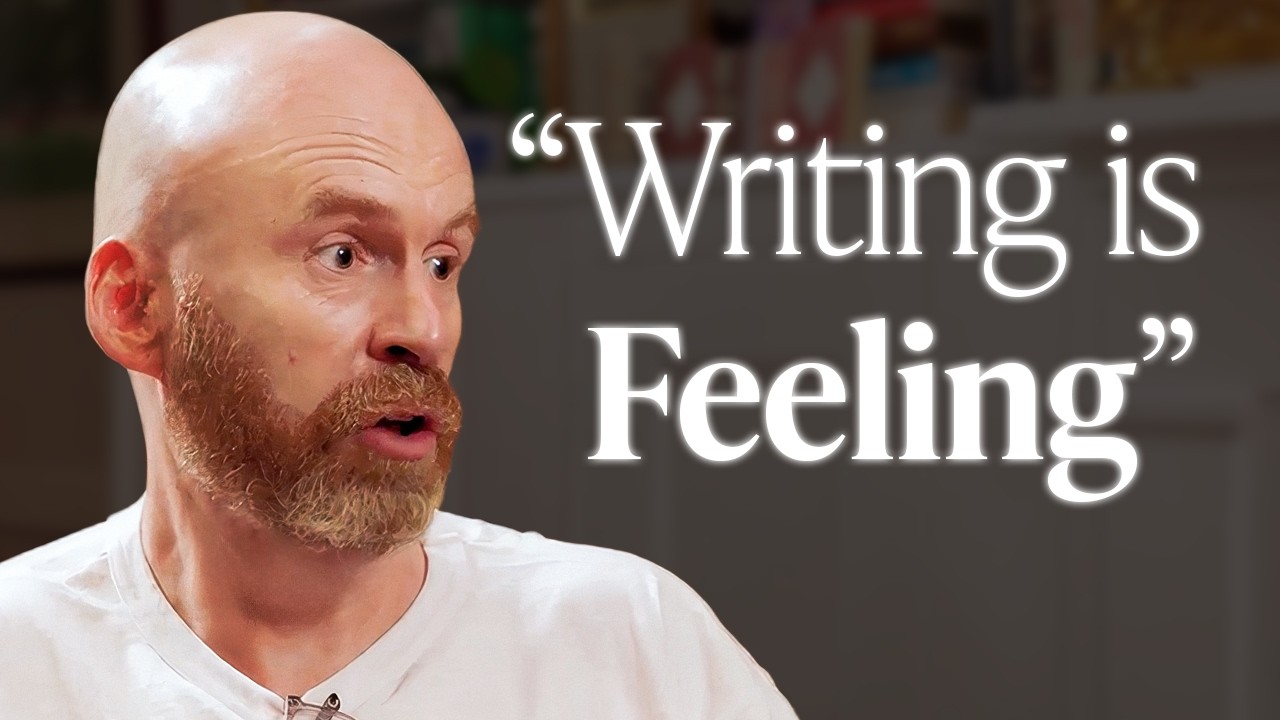
    • 4/5Thumbnail imageA tight crop on a high-emotion, animated facial expression grabs attention immediately. The composition leaves clean negative space on the right for readable copy.Matt Haig mid-sentence with wide eyes and an open mouth against an out-of-focus interior background.
    • 4/5Thumbnail text““Stuck? Write the Kids' Version””At five words, it delivers an unusual piece of advice that challenges standard writing advice. It addresses a specific pain point with a surprising fix.White serif text in quotes on the right reads '“Stuck? Write the Kids’ Version”'.
    • 4/5TitleThe title clearly defines the desired outcome and pairs it with credible authority. It directly addresses aspiring authors who want commercial reach.The title uses an aspirational how-to frame with the guest's name: 'How to Write a Book Millions of People Read (Matt Haig Interview)'.
    • 4/5Title + thumbnailThe title sells the ultimate destination while the thumbnail offers an intriguing first step. They complement each other rather than duplicating information.The thumbnail presents a specific tactic for getting unstuck, while the title promises scale and names the bestselling author.

    Curiosity gap: Why drafting a children's version is the secret to getting unstuck and writing a book that sells millions of copies.

    The three hooks

    The title, the thumbnail text and the first words spoken each make a promise, and each does a different job.

    • Title“How to Write a Book Millions of People Read (Matt Haig Interview)”How-toOutcomeCuriosityProofIt makes writers want the exact blueprint used by a proven author to achieve massive cultural impact.
    • Thumbnail text““Stuck? Write the Kids' Version””Contrarian takeCuriosityReliefNoveltyIt makes blocked writers want to understand how simplifying a book into a children's format can solve their creative stall.
    • First words spoken“Matt Haig sold more than 10 million copies of his book The Midnight Library.”ResultsProofOutcomeCuriosityNaming Matt Haig's 10-million sales record in the first sentence makes the viewer want to understand the exact mechanics behind that scale.
    • PairingDifferent jobsThe thumbnail presents an unconventional tactic for writer's block, while the title promises the large-scale outcome of bestselling success.
    • StakesOver-promisesThe packaging promises an actionable blueprint for selling millions of books, but Haig repeatedly insists that trying to write for mass appeal is a trap and that honest self-expression is the only real method.
    • UrgencyNoneThe video is an evergreen craft discussion with no time-sensitive claims, fear of missing out, or urgent calls to action.

    The first 20 seconds

    TimeWhat you seeWhat you hearWhat it does
    0:00Matt Haig sitting in an armchair with on-screen text 'Matt Haig'.Matt Haig sold...Instantly introduces the subject and matches the title.
    0:01Matt Haig smiling and talking in the interview setting....more than 10 million copies...Drops massive social proof and authority upfront.
    0:02Graphic of 'The Midnight Library' book cover....of his book The Midnight Library.Shows the recognizable work that validates the claim.
    0:03Book cover graphic with tagline and bestseller badges visible.Short pause in narration.Lets the magnitude of the sales figure sink in.
    0:04Host cuts in front of bookshelves, talking directly to camera.And I just checked on Amazon, it has...Transitions from guest credential to additional proof.
    0:05Host gestures enthusiastically to camera....more than 288,000...Builds anticipation for the sheer scale of audience response.
    0:06Amazon product page graphic displaying rating and review count....reviews.Visually verifies the social proof claim.
    0:07Amazon listing highlighted with #1 Best Seller badge.Slight pause under graphic.Reinforces the guest's elite status in publishing.
    0:08Host speaking to camera in home office.This book was a total hit, a smashing...Sums up the achievement in plain terms.
    0:09Host raises hand to emphasize the scale....success.Closes the proof phase of the hook.
    0:10Cut to host sitting in the studio interview chair.So I invited Matt on the show to ask...Explains the premise of the video.
    0:11Host gestures toward Matt across from him....him how he does it.States the core question viewers want answered.
    0:12Wide two-shot of interview with text 'What's his writing process?'.What's his writing process?Highlights the first practical takeaway promised.
    0:13Text changes to 'How does he tell great stories?'.How does he tell great stories?Frames the interview around craft and storytelling techniques.
    0:14Close-up on Matt Haig gesturing while speaking.Ambient room tone / voiceover resumes.Offers payoff preview of the guest in deep explanation mode.
    0:15Matt Haig talking intently.Host VO: But also...Creates an open loop beyond standard craft advice.
    0:16Cut back to host addressing the viewer directly....given how successful he's been...Refocuses viewer attention on the stakes of the conversation.
    0:17Host looks straight into the camera....I had to ask.Teases a deeper or more personal question.
    0:18Host pauses slightly for dramatic effect.Instrumental swell.Builds tension right before the main interview begins.
    0:19Host maintaining direct eye contact.Host preparing to deliver the setup.Holds viewer engagement through the transition.
    0:20Host speaking on camera to conclude intro tease.Audio leads into the next beat.Pushes viewer across the threshold into the interview.
    Click confirmation
    Instantly. The first frame displays Matt Haig and his name on screen while the narration names his 10-million-copy bestseller, directly matching the video title.
    Time to the point
    0:03
    Hook
    bold claim, stakes, question
    Reason to stay
    Discovering the exact writing habits, storytelling methods, and personal approach that allowed Matt Haig to sell 10 million copies.
    Missing on purpose
    No channel intro sequence, no host greeting ('hey guys'), no request to like or subscribe, and no idle chit-chat before establishing the guest's credentials.
    Pace and texture
    Fast cuts every 1 to 2 seconds mixing talking head, studio B-roll, book cover art, Amazon screenshots, and on-screen text questions over steady, upbeat narration.

    Story map

    Explainer. David Perell questions bestselling novelist Matt Haig to extract the tactical blueprint behind a 10-million-copy hit, but Haig reveals that trying to engineer commercial success guarantees failure and only radical self-honesty reaches scale.

    TimeSectionNew tensionStakesTurnLoops
    0:00 –2:55The Stop-Start RoutineHow does an author who sold 10 million books actually structure his workday?HoldMatt looks prolific from the outside, but 90% of his time is spent away from the desk doing nothing while ideas incubate.Opens: What is his writing routine and how does he tell great stories?Closes: Daily drafting schedule routine.
    2:55 –6:45Editorial Collaboration and Ruthless DeletionsCan an author fix a broken manuscript through line editing?HoldTinkering with single sentences is usually a distraction, so small critiques cause him to delete up to 50,000 words at once.Opens: How does he manage rewrites with an editor?Closes: First draft revision method.
    6:45 –11:12AI vs. Human ImperfectionWill AI eliminate the need for human fiction writers?RiseAI generates flawless polish by looking backwards, but human life evolves through messy mistakes and painful experiences that machines cannot feel.Opens: What will books look like in an AI-saturated future?Closes: The future of human storytelling against AI.
    11:12 –12:35Sponsor: Alpha SchoolWhy is conventional schooling failing kids?FallSag: no turnOpens: None.Closes: None.
    12:35 –16:26The Power of Monosyllabic WordsDoes high-impact writing require sophisticated vocabulary?HoldLiterary culture praises rare words, but basic words like home and sky hold universal archetypal power across all demographics.Opens: Which language choices bridge the gap to a mass audience?Closes: How word choice influences accessibility.
    16:26 –20:25Drafting Flow and the 'And Then' HabitHow do you stay in flow without letting logic stall the story?HoldHaig writes so fast that his drafts become a manic string of 'and then' moments, requiring major structural cleanup later.Opens: How does he balance unconscious flow against plot structure?Closes: First draft pacing and flow mechanics.
    20:25 –24:33Tone Shift and Simple PremisesWhy did Haig's bleak early work fail while The Midnight Library succeeded?RiseWriting despair is easy, but finding authentic, hard-earned hope inside darkness gives readers a practical reason to care.Opens: How did he land on the premise of The Midnight Library?Closes: The origins of The Midnight Library's premise.
    24:33 –29:15The Paradox of the Commercial TrapShould an author explicitly write what the market is buying?RiseChasing current store trends guarantees failure because books take years to publish, meaning you can only write what you personally want to read.Opens: Is it okay to write for the mass market?Closes: The core question on engineering bestsellers.
    29:15 –36:24Allegory, Autism, and Objective RealityHow do you write personal truth without freezing under exposure?HoldPutting his struggles into an alien character allowed Haig to explore neurodivergence honestly before he even had an official diagnosis.Opens: How does fiction unlock subconscious realizations?Closes: The inspiration behind The Humans.
    36:24 –41:05Unstuck via Children's BooksHow do you break out of a creative dead-end on an adult novel?HoldAdult fiction gets tangled in realism, so rewriting the concept through the lens of children's story tropes immediately frees the narrative.Opens: Why draft a children's version when blocked (thumbnail hook)?Closes: Thumbnail premise explained.
    41:05 –45:30Emotional Contagion and Recasting ProtagonistsWhy was the original version of The Midnight Library not working?RiseWriting a male lead felt too much like writing himself and made the text guarded, so switching to a female protagonist let him inject deeper vulnerability.Opens: Why was Nora Seed created?Closes: How The Midnight Library was saved in revision.
    45:30 –53:15The Hedonic Treadmill and Saying NoDoes reaching the top of the bestseller list fix self-doubt?HoldHitting number one just moves the goalpost, so true creative autonomy comes from turning down high-paying commercial offers that feel wrong.Opens: What happens after you reach massive commercial scale?Closes: The reality of publishing ambition.
    53:15 –56:55Demystifying Plot and Trusting TasteHow do you choose between commercial entertainment and literary respect?FallPlot is simply a character searching for something, so writers must trust their own emotional reactions over critics and gatekeepers.Opens: How should a writer judge their own work?Closes: Final definitions of commercial vs literary fiction.

    Payoff: delivered in part at 25:21. Haig dismantles the title's implied formula by proving that publishing lead times make market-chasing impossible, meaning the only viable path is writing purely for yourself. Ending: Perell closes with a short discussion on trusting personal taste against institutional critics, ending abruptly on a warm handshake and thanks.

    Leaks

    Where a viewer might leave. Guesses from watching, not retention data.

    • 11:12 David hard-cuts from an intense philosophical debate about AI and human soul directly into an unprompted sponsor ad read, breaking conversational immersion.
    • 31:40 The dialogue shifts into personal therapy anecdotes and taking a six-month break from work, temporarily moving away from practical craft techniques.
    • 50:45 The discussion wanders into British class distinctions, Lord Byron, and John Keats, which feels niche and less actionable for modern writers.

    Steal this

    1. Authority proof stacking in the first ten seconds Before asking any questions, the host names the guest's 10-million sales record and shows a screenshot of 288,000 Amazon reviews to make the guest's advice undeniable. 0:00
    2. Actionable contrarian thumbnail pull quote The thumbnail uses a punchy 5-word quote that attacks a universal pain point ('Stuck? Write the Kids’ Version') instead of just repeating the interview title. 37:28
    3. Dismantling the core question with industry math Instead of answering 'how to write for the market,' the guest explains the multi-year publishing pipeline to prove that trend-chasing is mathematically impossible. 25:21
    4. Radical plot reduction heuristic The speaker boils down all storytelling into a two-line binary model (commercial fiction finds what it seeks, literary fiction does not), giving the audience a sticky framework. 53:15

    Skip this

    • An unhurried 57-minute studio interview with minimal camera movement and long unbroken answers. This pacing relies on David Perell's existing brand as a long-form interviewer and Matt Haig's celebrity status; an unknown creator would face severe viewer drop-off without frequent visual changes.

    Open questions

    • Did the Alpha School midroll at 11:12 cause a notable retention cliff compared to the rest of the conversation?
    • How many viewers clicked specifically for the thumbnail quote about children's books and dropped off before it was addressed at 37:28?
    • What proportion of the total viewership came from fans of The Midnight Library versus David Perell's writing course community?

    Teardown by Avail.video from the thumbnail, the title, the first 20 seconds and the report's notes on the whole video.

    On screen

    Everything the video showed you

    Slides, frameworks, quotes and formulas, captured verbatim with the moment they appeared. Tap any card to jump there.

    Reference shelf

    People, ideas and things mentioned

    Said means mentioned aloud; Shown means it appeared on screen.

    People13

    • Matt HaigBestselling British author of fiction, non-fiction, and children's literature.0:00Said + shown0:01Said + shown1:00Said11:30Said17:20Said23:00Said35:00Said47:00Said56:52Said
    • David PerellWriter, teacher, and host of the How I Write podcast.0:04Said0:12Shown6:14Said11:12Said12:30Said20:00Said34:00Said50:37Said56:50Said
    • Francis BickmoreLiterary editor who has worked with Matt Haig for over 15 years.3:40Said4:58Said
    • A. A. MilneEnglish author who created Winnie-the-Pooh.38:37Said + shown39:05Said39:07Said + shown40:24Said + shown
    • Christopher RobinCharacter from the Winnie-the-Pooh series.40:09Said
    • John KeatsEnglish Romantic poet admired by Matt Haig.50:44Said + shown50:50Said50:59Said + shown53:48Shown
    • Lord ByronEnglish Romantic poet.51:11Said
    • Virginia WoolfEnglish modernist author.52:27Said
    • T. S. EliotPoet and essayist.52:27Said
    • John HughesAmerican film director.52:37Said
    • Jorge Luis BorgesArgentine short-story writer and essayist.52:38Said52:41Said
    • Edvard MunchExpressionist painter of The Scream.42:31Said + shown42:37Said + shown
    • Douglas AdamsEnglish author.30:58Said

    Organizations1

    • Alpha SchoolK-12 educational institution featured as the podcast sponsor.11:30Said + shown12:30Said

    Things on screen5

    • The Midnight LibraryInternationally bestselling speculative fiction novel by Matt Haig.0:02Said + shown0:04Shown22:36Said + shown22:40Said44:10Said44:16Said + shown
    • The HumansNovel by Matt Haig featuring an alien visiting Earth, exploring humanity and neurodivergence.4:39Said + shown4:40Said28:10Said28:18Said + shown
    • The Possession of Mr. CaveEarly, dark novel written by Matt Haig during a period of personal depression.20:35Said20:43Said + shown
    • The Life ImpossibleNovel written by Matt Haig following the success of The Midnight Library.33:19Said + shown33:20Said
    • Winnie-the-PoohClassic children's book series created by A. A. Milne.38:37Said + shown38:40Said
    Video description

    A description you can paste into YouTube

    A hook, a summary, chapters in YouTube's format and what the video mentions. Copy it, edit it, and paste it into YouTube Studio.

    1,703 / 5,000 characters
    By the numbers

    What YouTube shows about this video and its channel

    As of Oct 30, 2026. YouTube's public numbers first, then Avail.video's own arithmetic on them.

    The video

    Views
    171.4K
    Likes
    2K
    Comments
    140
    Published
    Aug 26, 2026
    Length
    56:55
    Category
    People & Blogs
    YouTube's topics
    Religion
    Captions
    No
    HD
    Yes
    Language
    English
    Paid promotion
    None declared
    Made for kids
    No
    License
    Standard YouTube

    Creator's tags

    • writing advice
    • how to write
    • writing guide
    • writing
    • advice
    • writing lessons
    • writing books
    • writing online
    • writing essays
    • writing articles
    • knowledge
    • productivity
    • david perell
    • how i write
    • podcast

    The channel

    Subscribers
    333K
    Videos
    772
    Total views
    26.4M
    Channel age
    9 years (since Jan 2017)
    Country
    United States
    Uploads
    about every 6 days
    Across the last 8 long-form uploads
    Before this video
    —

    Calculated by Avail.video from YouTube's public numbers

    Outlier score
    1.0× · Typical
    Views against the median of the channel's last 8 long-form uploads
    Views per subscriber
    0.51
    Likes vs the channel's usual
    0.8× the channel's usual
    1.1% of views vs a usual 1.5%
    Comments vs the channel's usual
    0.7× the channel's usual
    0.082% of views vs a usual 0.11%
    Rank among recent uploads
    #5 of 9
    By views: this video and the channel's last 8 long-form uploads
    Take it to your AI

    Ask Claude or ChatGPT about this video

    Copy this report as context, paste it into a chat, then ask anything. It includes timestamps, so answers can point back to the video.

    Then ask
    • Turn the main ideas into a checklist I can use this week.
    • What are the strongest claims in this video, and what evidence does it give for each?
    • Write a short summary for someone who hasn't watched it, linking the key moments.
    • Quiz me on this video, one question at a time, and cite the timestamp for each answer.

    Watched by Avail.video · 2026-10-30