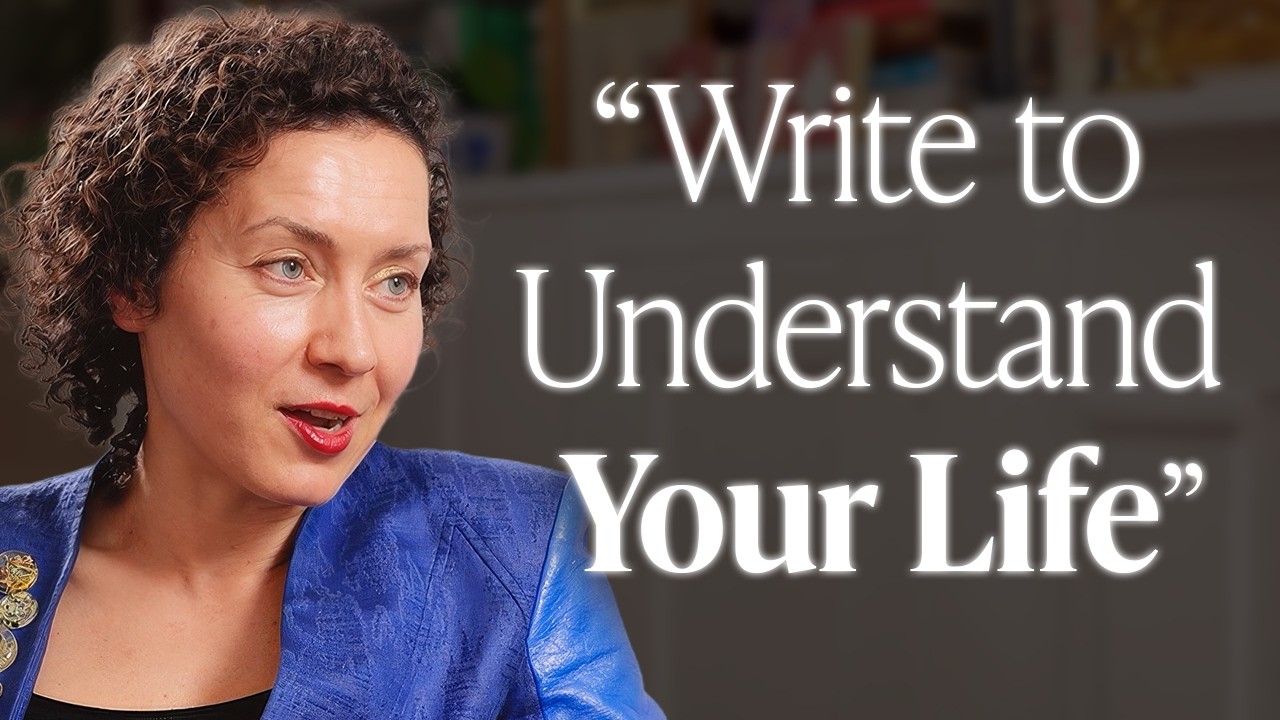
For nearly two decades, writer and essayist Maria Popova has mapped human wisdom, literature, and art on The Marginalian (originally Brain Pickings). In this intimate episode of How I Write, host David Perell invites Popova to discuss how literature serves as a guide for living, an anchor during suffering, and an instrument of perception. Popova begins by urging creators toward spending time in physical archives0:49, warning that the digital internet merely skims the surface of collective human consciousness. She points out that historic creative artifacts—such as original un-digitized tape reels at the 92nd Street Y1:40 or historical notebooks preserved at the Library of Congress3:04—reside in institutional basements, reminding researchers that preserving primary sources honorably across centuries is a vital human duty.
Moving to personal writing practices, Popova contrasts introspective memoirs with the observational diary. Reflecting on her four months of recording daily nature observations in Patagonia5:35, she defines the diarist's task as converting raw units of objective reality into units of subjective meaning. She celebrates diarist literature, highlighting Mary Shelley's intimate notebooks8:45 as a testament to how an uncompromising attentiveness to beauty shielded Shelley through devastating personal loss. This deliberate outward focus reflects British philosopher Iris Murdoch's concept of unselfing through art and nature26:15, in which the ego dissolves, allowing one to perceive reality without narcissistic distortion.
Popova also challenges modern disciplinary boundaries, demonstrating how science and poetry complement rather than oppose one another. Recounting how philosopher and performer Emily Levine introduced her to poetry21:10, Popova explains that poetry unlocks backdoors of consciousness inaccessible to analytical logic alone. While science meets the world on reality's terms, poetry broadens the terms on which humans meet themselves. This synthesis was historic: Galileo's background in perspective drawing32:55 enabled him to accurately illustrate the rugged, material craters of the moon, overturning centuries of mystical celestial dogma. Popova celebrated this holistic perspective in her own creative work, composing poetic divination cards from 19th-century ornithology35:20.
Examining her creative routine, Popova prioritizes presence over productivity12:20, noting that she writes almost everything while walking for hours and uses the keyboard solely for transcription. She remains skeptical of sudden epiphanies, advocating instead for incremental revelation and steady labor41:45 and echoing Tchaikovsky's belief in showing up regardless of mood. Finally, she argues that artificial intelligence cannot create authentic art48:30 because it lacks the capacity to suffer or confront its own limits. Invoking Susan Sontag’s admonition against content, Popova decries the internet's reduction of creative expression to subservient commercial content53:25, concluding that the true aim of art remains the enduring mystery of learning how to love each other56:20.