Avail.video · Watched for you · 1:12:47 video · 2 min read

Michael Pollan on Participatory Journalism, Narrative Structure, and the Writing Craft

Outlier score2.6×Above typical

440,423 views vs a median of 167,576 across the channel's last 8 long-form uploads · as of Oct 29

Avail.video calculation

In this in-depth interview on 'How I Write', host David Perell speaks with acclaimed author and professor Michael Pollan about his immersion-based investigative techniques, writing routines, and narrative architecture. Pollan details how buying steer 534 shaped 'The Omnivore's Dilemma', how he designs structural 'laundry lines' to carry exposition, and how he uses metaphor and carefully crafted introductions to engage readers.

Read the teardown

How it earns the click and holds attention, second by second.

Find in this video

Search what was said and shown

One search covers the transcript, on-screen text, claims and references. Every result jumps to its moment.

    The explainer

    What the video says, with a link to every moment

    A 2-minute read. Each underlined phrase opens the video at that second.

    In this extensive masterclass on narrative nonfiction, Michael Pollan unpacks the techniques and intellectual routines behind his acclaimed career. Pollan emphasizes that great nonfiction writing originates from genuine personal curiosity rather than prepackaged authority. He describes how experimenting with substances like caffeine provided firsthand perspective on neurochemistry and work habits, noting in Pollan's experiment with quitting caffeine0:48 that brief abstinence revealed the drug's immense potency and baseline role in his daily drafting routine. Pollan draws on developmental psychologist Alison Gopnik to contrast the narrow focus required for writing against open-ended awareness in spotlight vs lantern consciousness4:09, observing that while stimulants tighten mental focus, broader creative leaps often stem from spontaneous mind-wandering.

    slide
    Michael PollanA World AppearsA Journey Into Consciousness
    ▶ 4:08
    On screen at 4:08

    Pollan’s distinctive methodology rests heavily on first-person participatory journalism. Rather than writing from the detached, omniscient vantage point of conventional reporting, he embeds himself directly into the action. Inspired during his youth by George Plimpton’s immersion memoirs, as recounted in first-person immersion inspired by George Plimpton23:51, Pollan found that placing an inexperienced protagonist on the field provides authentic awe and access. This technique reached its apex when he investigated industrial agriculture: in purchasing steer 534 to investigate industrial beef30:20, Pollan put up $600 of his own money to purchase a calf, transforming his relationship with feedlot operators and slaughterhouse managers into that of a paying customer rather than a detached reporter.

    slide
    Paper LionConfessions of a Last-String QuarterbackGeorge Plimpton
    ▶ 23:58
    On screen at 23:58

    To balance complex exposition with reader engagement, Pollan relies on the architectural device he terms the 'laundry line'. As detailed in the 'laundry line' model of narrative structure34:05, the narrative spine acts as the horizontal cord spanning birth to slaughter, while technical explanations of corn feed, hormones, and environmental degradation hang as laundry along the line. Pollan warns that drifting too far into abstract data causes the line to sag; writers must develop an intuitive clock for reader impatience. Furthermore, finding an evocative conceptual contrast can settle arguments without preaching: in sunlight vs oil: framing powerful metaphors39:22, Pollan explains how contrasting pasture-raised beef fueled by sunlight with feedlot beef grown on synthetic oil-based fertilizer did 90% of the persuasive work.

    Finally, Pollan underscores the vital role of book introductions and the cognitive nature of the craft. In drafting book introductions and withholding the punchline48:03, he stresses that non-fiction introductions establish expectations and defend against misunderstandings, cautioning writers never to reveal all their insights immediately. Above all, Pollan warns against outsourcing the drafting process to automated tools: in writing as a generative tool of discovery vs AI outsourcing1:06:08, he argues that writing is fundamentally a mechanism for original thinking where unpredicted ideas and metaphors emerge through friction. Concluding with encouragement in Pollan's advice on persisting through the difficulty of writing1:12:03, he reminds authors that writing never becomes easy, and persistent struggle is normal.

    Highlights
    1. 4:09Spotlight vs lantern consciousness
    2. 17:34Daily drafting routine and morning hand-editing
    3. 30:20Purchasing steer 534 to investigate industrial beef
    4. 34:05The 'laundry line' model of narrative structure
    5. 48:03Drafting book introductions and withholding the punchline
    6. 1:06:08Writing as a generative tool of discovery vs AI outsourcing
    Chapters across the 1:12:47 runtime
    How it's told

    A two-person studio interview with visual cutaways

    Format: Interview. Host David Perell interviews author Michael Pollan about his creative process, immersion reporting methods, narrative structure, and the cognitive mechanics of drafting non-fiction.

    Story arc

    1. 0:00IntroductionDavid Perell introduces Michael Pollan, his non-fiction career, and his participatory reporting methodology.
    2. 0:50The Chemistry of FocusPollan discusses caffeine, his experience abstaining from coffee, and how morning stimulants affect writing focus.
    3. 3:38Drugs and CreativityPollan explores alcohol, nicotine, psychedelics, and the distinction between spotlight and lantern consciousness.
    4. 9:40Sponsor BreakPerell discusses overcoming writer's block and presents Wispr Flow voice dictation software.
    5. 10:45Psychedelics and Creative ThoughtDiscussion of Jim Fadiman's 1960s creativity studies, mind-wandering, and capturing real-time psychedelic insights.
    6. 12:57Journaling and Note-TakingPollan details his single-journal system per book and the essential role of forgetting in the editing process.
    7. 16:29Daily Drafting WorkflowPollan outlines his daily morning drafting routine, printed-page editing habits, and printer versus pixel drafting styles.
    8. 20:34First-Person ImmersionWhy Pollan writes in the first person, lessons from Lewis Lapham at Harper's, and the influence of George Plimpton.
    9. 26:17Anatomy of an Immersion ProjectDeveloping 'This Steer's Life', buying a calf to gain reporting access, and transitioning from case studies to systemic research.
    10. 33:50The Laundry Line StructureBalancing narrative storytelling (the clothesline) with informational exposition (the laundry hanging on it).
    11. 39:03The Power of MetaphorFraming food chains as sunlight versus oil to convey moral and ecological arguments without preachiness.
    12. 42:47Questions and IntroductionsFormulating guiding research questions, creating suspense, and heavily revising introductions to set up reader expectations.
    13. 51:25Reading for RhythmReading fiction during the drafting phase to absorb prose cadence and rhythm without taking in competing factual data.
    14. 53:25Finding Tone and VoiceDeveloping an approachable, self-deprecating narrator persona that begins in ignorance alongside the reader.
    15. 55:40Digital Research and AIManaging information overload, using digital tools, and evaluating the utility and risks of LLMs in research.
    16. 59:03Conflict and Character CastingIdentifying internal scientific debates and casting eccentric characters who subvert typical stereotypes.
    17. 1:03:21Gardens and NatureWhy gardens reflect cultural philosophies regarding human mastery over nature and plants satisfying human desire.
    18. 1:05:19Writing as DiscoveryWriting as a generative mode of cognitive thinking rather than transcription, and why outsourcing drafting to AI forfeits insight.
    19. 1:08:34Art and Expanding ConsciousnessHow literature bridges isolated minds and allows readers to temporarily inhabit another consciousness.
    20. 1:11:05Advice to WritersPollan reassures writers that the struggle of drafting is inherent to the craft rather than evidence of personal deficiency.

    Setups and payoffs

    1. 0:31Setup Perell teases Pollan's story of buying a steer and following it from birth to slaughter.
      ↳
      26:17Payoff Pollan explains how purchasing steer 534 for $600 gave him authentic skin in the game and unlocked unprecedented access to industrial feedlots.
    2. 4:15Setup Pollan introduces Alison Gopnik's spotlight versus lantern consciousness distinction.
      ↳
      12:15Payoff Pollan connects lantern consciousness to spontaneous thought, mind-wandering, and psilocybin during creative problem-solving.
    3. 15:37Setup Pollan references forgetting as an editorial tool in The Botany of Desire.
      ↳
      20:20Payoff Pollan explains leaving dense notes behind during drafting so natural forgetting filters research down to essential ideas.
    4. 22:34Setup Pollan describes Lewis Lapham insisting that writers establish their personal stake in the opening pages.
      ↳
      38:43Payoff Pollan demonstrates how placing himself directly into the story solves narrative momentum when tackling dry analytical topics.
    5. 34:21Setup Pollan introduces the laundry line metaphor for structuring narrative non-fiction.
      ↳
      40:40Payoff Pollan shows how the laundry line model anchored complex political and ecological exposition in The Omnivore's Dilemma.
    6. 45:30Setup Pollan reflects on early criticism of A Place of My Own for lacking an introductory thesis.
      ↳
      47:49Payoff Pollan describes rewriting the introduction to The Botany of Desire dozens of times to frame key questions properly.

    Devices

    • MetaphorContrasts focused executive attention with open peripheral awareness using spotlight versus lantern consciousness.4:16
    • AnalogyExplains narrative pacing with the laundry line, where chronological storytelling serves as the line holding analytical exposition.34:21
    • TaxonomyCategorizes writers into the printer method (editing line by line sequentially) versus the pixel method (refining an entire blurry draft).19:05
    • AnecdoteRecounts George Plimpton training with the Detroit Lions to illustrate the origins and emotional resonance of participatory immersion journalism.24:16
    • ContrastFrames modern food systems as sunlight-based versus oil-based to guide reader judgment without preaching.39:46
    • AnecdoteShares a 25-year wine bet between Christof Koch and David Chalmers to illustrate building narrative tension in scientific debates.1:01:18
    • Literary ReferenceCites Marcel Proust's description of individuals as isolated islands of consciousness to explain literature's power to bridge minds.1:09:44

    From the video's own structure, matched to the transcript and on-screen text.

    Teardown

    Institutional prestige in the packaging paired with masterclass-level, concrete non-fiction writing mechanics keeps viewers locked in across an hour-plus conversation.

    Above the channel's typical: 2.6× its typical views (440,423 vs a median of 167,576 across the channel's last 8 long-form uploads, as of Oct 29) · Long-form interview · 133 days old

    The promise

    A viewer believes they will learn masterclass-level writing principles directly from a renowned Harvard professor.

    Packaging

    How it looks in the feed

    Show the feed as
    1:12:47

    Harvard Professor Teaches Writing (Michael Pollan Interview)

    David Perell440K views · 4mo agoThis episode is presented by Wispr Flow, a tool that turns voice notes into clear writing. I use it every day and recommend it to every writer I know. Try it…

    Views and age as of the teardown, Oct 29, 2026. Other videos are blanked out.

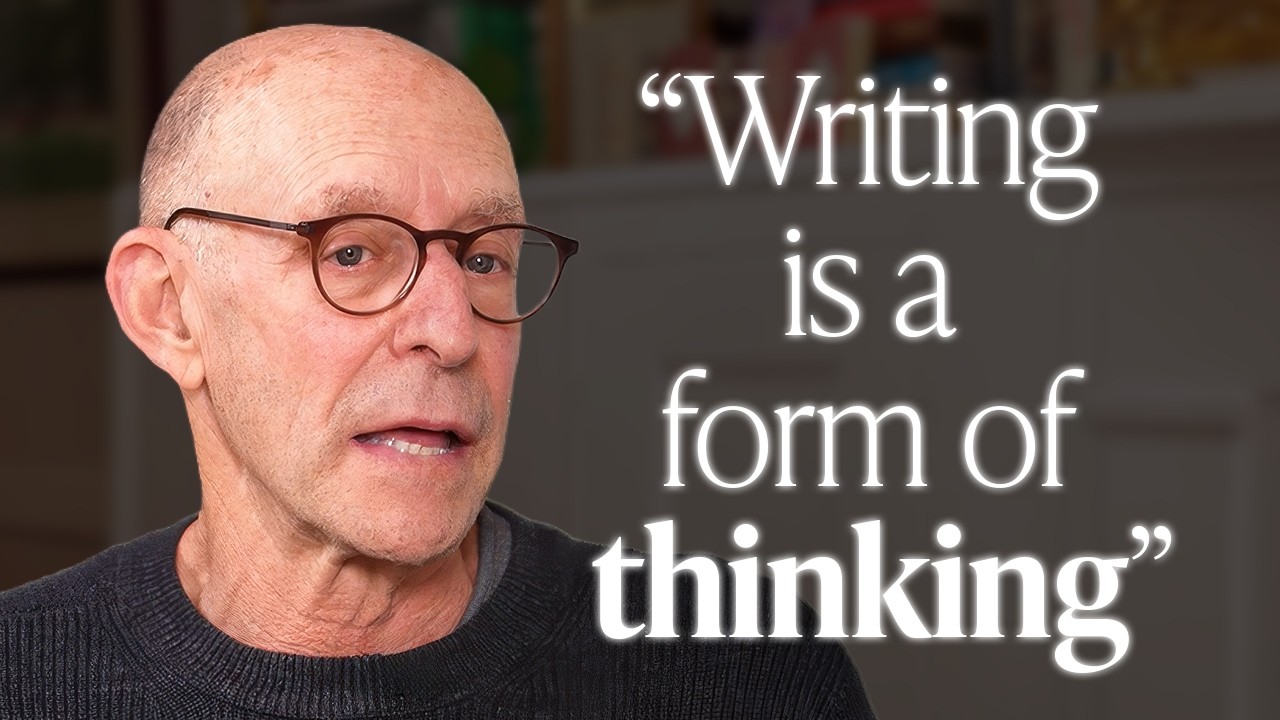
    • 4/5Thumbnail imageThe portrait is crisp, recognizable, and cleanly separated from the blurred background. The subject's expression is serious and intellectual without looking exaggerated.A close-up shot of Michael Pollan in glasses and a dark crewneck looking slightly off-camera against a warm, soft-focus interior.
    • 4/5Thumbnail text““Writing is Thinking””Three words summarize the core premise of the interview in large, clean typography. It redefines the purpose of writing before the viewer even clicks.Large white serif text in quotation marks on the right side reading 'Writing is Thinking'.
    • 4/5TitleThe title leans heavily on high-status institutional credibility. It specifies what will be taught and identifies the guest clearly.The title starts with 'Harvard Professor Teaches Writing' followed by '(Michael Pollan Interview)'.
    • 4/5Title + thumbnailThe title provides the institutional authority and practical lesson, while the thumbnail supplies the big philosophical takeaway. Together they create a clear intellectual hook.The thumbnail quotes the guest's core philosophy while the title positions him as a Harvard instructor teaching a masterclass.

    Curiosity gap: How does viewing writing as the act of thinking transform the way you actually put words on paper?

    The three hooks

    The title, the thumbnail text and the first words spoken each make a promise, and each does a different job.

    • Title“Harvard Professor Teaches Writing (Michael Pollan Interview)”AuthorityProofOutcomeIt makes the viewer want elite writing instruction from one of the world's most prestigious universities.
    • Thumbnail text““Writing is Thinking””Contrarian takeNoveltyCuriosityIt makes the viewer want to discover how writing functions as a tool for thinking rather than just recording thoughts.
    • First words spoken“Michael Pollan, one of my all-time favorite non-fiction writers.”AuthorityProofIt makes the viewer want to learn the proven methods of a master writer who has decades of successful work.
    • PairingDifferent jobsThe thumbnail text presents a philosophical reframe while the title pitches institutional teaching and authority.
    • StakesFitsThe packaging promises elite masterclass instruction, and Pollan directly breaks down the practical reporting, structuring, and drafting methods behind his bestsellers.
    • UrgencyNoneThe video offers timeless long-form education on writing craft without inventing artificial deadlines or breaking-news FOMO.

    The first 20 seconds

    TimeWhat you seeWhat you hearWhat it does
    0:00Michael Pollan talking with animated text showing 'Michael'Michael Pollan, one of my...Instantly introduces the guest and confirms the video title.
    0:01Text completes to 'Michael Pollan' as he gestures...all-time favorite...Establishes the subject's high status in the host's eyes.
    0:02Wide studio shot of Pollan and host sitting in armchairs...non-fiction writers.Shows the interview setting and confirms a real face-to-face conversation.
    0:03Wide studio shot continues as Pollan explains something(breath / brief pause)Lets the setting settle for a moment before moving into proof.
    0:04Book cover graphic of 'The Omnivore's Dilemma'A guy who's been writing about food...Displays visual proof of Pollan's bestselling body of work.
    0:05Book cover switches to 'The Botany of Desire'...and nature...Reinforces Pollan's breadth across different topics.
    0:06Book cover switches to a consciousness-themed title...and consciousness for decades now.Cementing Pollan's decades-long authority.
    0:07Cut to host sitting on couch talking directly to cameraAnd for him...Shifts focus directly to the core lesson of the video.
    0:08Host gesturing while addressing camera...the writing process...Signals that the video will break down practical writing craft.
    0:09On-screen text 'begins with a question' appears...begins with a question.Delivers the foundational insight of Pollan's method.
    0:10Host talking with hand gesturesHe finds something that he's interested in...Starts mapping out the step-by-step creative loop.
    0:11Host leans forward, roleplaying Pollan's mindset...and he says, 'All right...Builds an engaging narrative framing around research.
    0:12Host looks directly at viewer...I'm going to go on an adventure.Frames non-fiction writing as real-world exploration.
    0:13Host sweeps arm outwardI'm going to experience things...Keeps physical energy high to maintain momentum.
    0:14Host continues rhythmic hand gestures...I'm going to talk to people, I'm going to learn stuff...Summarizes the field-reporting phase in accessible terms.
    0:15Host on couch bringing hands together...and I'm going to come back...Sets up the synthesis stage of book writing.
    0:16Cut to b-roll of Pollan and host walking outside...and put it all into a book.'Shows personal rapport between host and guest in an informal setting.
    0:17Outdoor shot continues with both men smiling and chatting(instrumental music builds)Provides visual variety away from the studio setup.
    0:18Wide garden walkway shot continues(upbeat background music)Maintains relaxed, candid documentary feel.
    0:19Both men walking toward the cameraAnd his writing...Pivots to breaking down the exact mechanics of his prose.
    0:20Outdoor shot as host speaks...process...Leads directly into the next technical insight.
    Click confirmation
    Delivers immediately. At 00:00, Michael Pollan appears on screen with his name in large text, matching the title instantly.
    Time to the point
    0:09
    Hook
    bold claim, authority
    Reason to stay
    The promise of seeing how a legendary writer turns simple curiosity and real-world adventure into bestselling books.
    Missing on purpose
    No channel bumper, no 'welcome back', no sponsor read, and no call to subscribe before providing value.
    Pace and texture
    Fast and varied. Visuals change every two to three seconds across studio shots, book covers, direct-to-camera commentary, and outdoor b-roll.

    Story map

    Tutorial. A writing instructor questions a master author to extract his complete non-fiction toolkit, facing the messy reality of research and writer's block to deliver actionable structural rules.

    TimeSectionNew tensionStakesTurnLoops
    0:00 –0:49The Masterclass HookCan an hour-long interview actually deliver an entire Harvard semester's worth of writing instruction?RisePerell sets up Pollan's career and teases buying a cow, therefore framing the video as elite tradecraft rather than promotional chat.Opens: How does buying a steer teach you how to write?Closes: None
    0:49 –6:35The Chemistry of FocusDoes peak mental focus require stimulants or abstaining from them?HoldPollan admits coffee abstinence gave him severe brain fog, but finding spotlight consciousness through caffeine is what makes sitting down to draft possible.Opens: How do other mind-altering substances shape the creative mind?Closes: None
    6:35 –9:41Psychedelics as HypothesesAre drug-induced creative epiphanies real insights or just chemically induced delusions?RiseMost psychedelic epiphanies are banal, but treating them as testable hypotheses led Pollan directly to breakthrough reporting on plant intelligence.Opens: How does spontaneous mind-wandering translate into disciplined scientific reporting?Closes: How do other mind-altering substances shape the creative mind?
    9:41 –10:45Sponsor Interlude: Wispr FlowWill the commercial derail the analytical depth of the interview?FallSag: no turnOpens: NoneCloses: None
    10:45 –12:57Spontaneous Thought & Creative ResearchCan creativity actually be measured or induced scientifically in stuck professionals?HoldFadiman's 1960s study proved LSD unblocked stuck professionals, but psilocybin works specifically by fueling spontaneous mind-wandering.Opens: How do you capture fleeting spontaneous insights before they evaporate?Closes: How does spontaneous mind-wandering translate into disciplined scientific reporting?
    12:57 –16:30Note-Taking and the Virtue of ForgettingDoes effective non-fiction require cataloging every single fact you uncover?RiseHuman memory is naturally limited, therefore forgetting acts as your first and best natural editing filter.Opens: How does a writer turn a messy raw journal into polished morning prose?Closes: How do you capture fleeting spontaneous insights before they evaporate?
    16:30 –20:38Daily Drafting RoutinesShould you write rough first drafts quickly or polish line by line from page one?HoldPollan starts every morning by hand-editing yesterday's printout, revealing the contrast between 'printer' and 'pixel' writers.Opens: Why adopt an intimate first-person voice instead of detached journalistic authority?Closes: How does a writer turn a messy raw journal into polished morning prose?
    20:38 –26:10First-Person ImmersionDoes using the first-person pronoun destroy journalistic credibility?RiseThe omniscient third person fakes an unearned authority, therefore putting yourself in the arena creates authentic trust with the reader.Opens: What does participatory immersion look like on a difficult, closed-door assignment?Closes: Why adopt an intimate first-person voice instead of detached journalistic authority?
    26:10 –34:05Anatomy of an Immersion ProjectHow do you penetrate secretive corporate industries like industrial feedlots?RisePollan was blocked by corporate PR, but spending $600 to buy steer 534 transformed him from a hostile journalist into a paying client with total access.Opens: How do you turn a mountain of industrial data into an engaging story?Closes: How does buying a steer teach you how to write?
    34:05 –39:05The 'Laundry Line' Narrative ArchitectureHow do you keep readers engaged through complex technical exposition without boring them?RiseExposition alone makes a piece sag, therefore you must string a chronological story like a laundry line and clip facts onto it in spaced intervals.Opens: How do you convince readers of your thesis without preaching at them?Closes: How do you turn a mountain of industrial data into an engaging story?
    39:05 –42:50The Strategic MetaphorCan you change minds without making direct moral or political arguments?RiseExplicit arguments trigger defensive debate, but framing cattle food chains as 'sunlight versus oil' persuades the reader instantly without preachiness.Opens: Where should the guiding argument of a complex book actually be established?Closes: How do you convince readers of your thesis without preaching at them?
    42:50 –51:24Framing Central Questions & IntroductionsWhy do promising non-fiction books get completely misunderstood by readers and critics?RiseDiving straight into the plot leaves your premises open to attack, therefore rewriting introductions 30 times sets the rules and immunizes your work.Opens: How do you keep an authorial voice humble when you already know all the answers?Closes: Where should the guiding argument of a complex book actually be established?
    51:24 –55:40Voice, Rhythm, and NaivetyIs it dishonest to act naive at the start of a book after spending years mastering the subject?HoldWriting from the summit of conclusions repels readers, therefore you must deliberately recreate your initial ignorance so the reader learns alongside you.Opens: How do you locate compelling story lines inside an infinite sea of digital data?Closes: How do you keep an authorial voice humble when you already know all the answers?
    55:40 –1:01:47Information Overload and Scientific BetsHow do you structure engaging narratives out of dry scientific literature?HoldFacts alone contain zero momentum, but locating internal civil wars and personal bets between experts instantly injects dramatic conflict.Opens: What makes a real-world expert compelling on the page?Closes: How do you locate compelling story lines inside an infinite sea of digital data?
    1:01:47 –1:06:05Casting Eccentric CharactersWhy do standard expert sources often fall flat in narrative non-fiction?HoldPredictable experts produce boring quotes, therefore casting nonconformists who play against their professional stereotype drives the story forward.Opens: What happens to the human mind if we outsource sentence generation to AI?Closes: What makes a real-world expert compelling on the page?
    1:06:05 –1:11:06Writing as Thinking vs. Machine OutsourcingIs delegating drafting to generative AI an efficiency gain or an intellectual loss?RiseDrafting is not transcribing pre-existing thoughts, therefore outsourcing text to an LLM robs the author of the very cognitive process that generates original insight.Opens: How does a writer survive the inherent misery of the drafting desk?Closes: What happens to the human mind if we outsource sentence generation to AI?
    1:11:06 –1:12:46Advice to Aspiring WritersIs struggling on the blank page a sign of amateur incompetence?FallEven veteran bestsellers feel lost and deficient during drafting, therefore struggle must be embraced as the natural friction of the craft.Opens: NoneCloses: How does a writer survive the inherent misery of the drafting desk?

    Payoff: delivered fully at 34:05. Pollan delivers his core narrative structural tool ('the laundry line'), showing exactly how to hang heavy analytical exposition onto a chronological narrative spine. Ending: Pollan offers warm, reassuring advice that drafting is an agonizing struggle even for masters, ending on a friendly mutual handshake rather than a sales pitch.

    Leaks

    Where a viewer might leave. Guesses from watching, not retention data.

    • 9:41 A hard cut from deep philosophical discussion on plant consciousness into an unannounced direct sponsor read for Wispr Flow breaks conversational immersion.
    • 45:30 The discussion pivots into inside-baseball industry complaints about a 1990s architectural book review, dragging down narrative pace.
    • 55:55 Pollan begins speaking broadly about university library websites and Google Alerts, drifting into generic digital habits rather than unique craft insights.

    Steal this

    1. The 'Laundry Line' structural rule Chronological events serve as the taut line; analytical exposition is the clothing hung upon it. Spacing out facts along an action timeline prevents pacing sags. 34:21
    2. Bipolar metaphor persuasion Instead of arguing moral judgments, frame two choices as sensory opposites (e.g., 'sunlight-based food chain' vs. 'oil-based food chain') so the reader naturally picks your side. 39:46
    3. Categorical framing taxonomies Labeling complex habits into simple, contrasting creative camps (e.g., 'printer method' vs. 'pixel method') gives viewers immediate self-identification and memorable handles. 19:05
    4. Recreating initial ignorance Even after finishing all research, intentionally begin your work at the baseline of an uninformed idiot so the audience experiences discovery instead of being preached at. 54:50

    Skip this

    • Relying on big-budget institutional access and months of paid exploratory reporting. Pollan had The New York Times Magazine pay him for a month just to find a story and could afford $600 personal cash to buy a calf; indie creators must validate ideas much faster.
    • A static two-person study setup across 72 minutes with minimal visual aids. This format works primarily because of Pollan's celebrity status among intellectual readers; lesser-known creators need more aggressive visual demonstration and pacing.

    Open questions

    • Did viewer drop-off spike noticeably during the sponsor endorsement at 09:41?
    • Which chapter topic drove the highest replay rate: the Steer 534 reporting story or the AI critique?
    • What percentage of clicks came from Michael Pollan's name recognition versus the 'Harvard Professor' authority title?

    Teardown by Avail.video from the thumbnail, the title, the first 20 seconds and the report's notes on the whole video.

    On screen

    Everything the video showed you

    Slides, frameworks, quotes and formulas, captured verbatim with the moment they appeared. Tap any card to jump there.

    Reference shelf

    People, ideas and things mentioned

    Said means mentioned aloud; Shown means it appeared on screen.

    People27

    • Michael PollanAuthor, journalist, and professor known for books on food, nature, and consciousness.0:00Said0:01Said + shown18:10Said
    • David PerellWriter, online writing educator, and host of the How I Write podcast.0:02Said + shown9:41Said + shown
    • Martin BureauPhotographer credited for Getty Images cattle photo.0:34Shown
    • Alison GopnikDevelopmental psychologist and philosopher who formulated spotlight vs. lantern consciousness.4:12Said
    • Ernest HemingwayAmerican novelist known for his concise prose style and drinking habits.6:00Said + shown
    • Kary MullisBiochemist and Nobel laureate who invented the polymerase chain reaction (PCR).7:18Said + shown7:21Said
    • William JamesPioneering American psychologist and philosopher, author of The Varieties of Religious Experience.8:49Said + shown8:50Said
    • James FadimanPsychologist known for early research on psychedelics, microdosing, and creativity.11:15Said + shown11:40Said
    • Raphael MechoulamIsraeli chemist who isolated THC and studied cannabinoids and memory.15:53Said + shown15:55Said
    • Lewis LaphamLongtime editor-in-chief of Harper's Magazine who mentored Pollan.17:46Shown22:34Said
    • George PlimptonJournalist, author of Paper Lion, and co-founder of The Paris Review.23:55Said23:58Said + shown
    • Leonard BernsteinAcclaimed conductor of the New York Philharmonic and composer.25:24Said
    • Eric SchlosserInvestigative journalist and author of Fast Food Nation.26:37Said26:40Said + shown
    • Adam MossFormer editor at The New York Times Magazine.27:01Said
    • Gerry MarzoratiFormer editor at The New York Times Magazine.27:03Said
    • Bill NimanCattle rancher and founder of Niman Ranch.27:45Said
    • Orville SchellFormer Dean of the UC Berkeley Graduate School of Journalism.27:50Said
    • Witold RybczynskiArchitect, professor, and author who reviewed Pollan's early work.46:14Said
    • Ann GodoffBook publisher and president of Penguin Press.48:00Said
    • Paul ToughJournalist and author who advised Pollan on narrative structure.48:04Said
    • Edward HoaglandAmerican essayist and nature writer, author of Compass Points.52:46Said + shown
    • Wendell BerryAmerican novelist, poet, environmentalist, and author of Jayber Crow.53:07Said + shown
    • Michael LewisNon-fiction author of Moneyball and The Big Short.55:53Said + shown
    • Christof KochNeuroscientist known for his work on consciousness and a 25-year bet with Chalmers.57:04Said + shown1:00:50Said
    • David ChalmersAustralian philosopher who formulated the hard problem of consciousness.57:13Said + shown1:01:10Said
    • Michael Faraday19th-century English scientist who discovered electromagnetism.58:27Said
    • Marcel ProustFrench novelist and author of In Search of Lost Time.1:09:44Said

    Ideas & frameworks16

    • The Omnivore's DilemmaMichael Pollan's 2006 book examining industrial, organic, and foraged food chains.0:03Shown26:30Shown26:45Said40:40Shown42:25Shown44:20Said
    • The Botany of DesireMichael Pollan's 2001 book exploring co-evolution through apples, tulips, cannabis, and potatoes.0:04Shown15:37Said + shown47:49Shown48:03Said
    • A World AppearsMichael Pollan's book exploring consciousness, perception, and natural intelligence.0:06Shown4:08Shown7:56Said + shown48:47Shown1:09:00Shown
    • Caffeine: How Coffee and Tea Created the Modern WorldMichael Pollan's Audible Original exploring the history and pharmacology of caffeine.1:04Said + shown
    • Paper LionGeorge Plimpton's 1966 participatory journalism book about training with the Detroit Lions.23:55Said23:58Shown
    • Fast Food NationEric Schlosser's investigative book exploring the American fast food industry.26:37Said26:40Said + shown
    • Second NatureMichael Pollan's 1991 book of essays on gardening and the human relationship with nature.20:53Shown
    • This Steer's LifeMichael Pollan's 2002 New York Times Magazine article following a calf to slaughter.26:17Said + shown
    • A Place of My OwnMichael Pollan's 1997 book chronicling his design and construction of an outbuilding.45:30Said + shown
    • Compass PointsEdward Hoagland's memoir reflecting on his life, writing, and travels.52:46Said + shown
    • Jayber CrowWendell Berry's novel following a community barber in fictional Port William, Kentucky.53:07Said + shown
    • MoneyballMichael Lewis's 2003 book on data analytics in Major League Baseball.56:06Said + shown
    • The Big ShortMichael Lewis's 2010 book detailing the build-up of the 2007–2008 housing bubble.56:09Said + shown
    • The Varieties of Religious ExperienceWilliam James's 1902 lectures analyzing personal religious experiences and mysticism.8:50Said
    • Spotlight vs. Lantern ConsciousnessAlison Gopnik's framework contrasting adult focused attention with childlike panoramic awareness.4:12Said
    • The Laundry Line Narrative StructureWriting technique where a chronological narrative serves as a clothesline supporting informational exposition.33:50Said

    Organizations4

    • Harper's MagazineMonthly American magazine of literature, politics, and culture where Pollan served as editor.17:45Shown18:10Said
    • The New York Times MagazineSunday magazine supplement of The New York Times that published Pollan's steer article.26:20Said
    • The Paris ReviewLiterary magazine co-founded by George Plimpton in 1953.23:55Said
    • Detroit LionsNFL football team George Plimpton trained with for his participatory journalism book Paper Lion.23:55Said

    Things on screen2

    • Wispr FlowAI-powered voice dictation app that converts speech into formatted writing.9:49Said + shown9:55Shown10:39Shown
    • iPhoneSmartphone used to demonstrate the Wispr Flow dictation application.10:02Shown
    Video description

    A description you can paste into YouTube

    A hook, a summary, chapters in YouTube's format and what the video mentions. Copy it, edit it, and paste it into YouTube Studio.

    1,983 / 5,000 characters
    By the numbers

    What YouTube shows about this video and its channel

    As of Oct 29, 2026. YouTube's public numbers first, then Avail.video's own arithmetic on them.

    The video

    Views
    440.4K
    Likes
    6.7K
    Comments
    166
    Published
    Jun 17, 2026
    Length
    1:12:47
    Category
    People & Blogs
    YouTube's topics
    Knowledge
    Captions
    No
    HD
    Yes
    Language
    English
    Paid promotion
    None declared
    Made for kids
    No
    License
    Standard YouTube

    Creator's tags

    • writing advice
    • how to write
    • writing guide
    • writing
    • advice
    • writing lessons
    • writing books
    • writing online
    • writing essays
    • writing articles
    • knowledge
    • productivity
    • david perell
    • how i write
    • podcast

    The channel

    Subscribers
    333K
    Videos
    771
    Total views
    26.3M
    Channel age
    9 years (since Jan 2017)
    Country
    United States
    Uploads
    about every 6 days
    Across the last 8 long-form uploads
    Before this video
    —

    Calculated by Avail.video from YouTube's public numbers

    Outlier score
    2.6× · Above typical
    Views against the median of the channel's last 8 long-form uploads
    Views per subscriber
    1.32
    Likes vs the channel's usual
    1.0× the channel's usual
    1.5% of views vs a usual 1.5%
    Comments vs the channel's usual
    0.3× the channel's usual
    0.038% of views vs a usual 0.12%
    Rank among recent uploads
    #1 of 9
    By views: this video and the channel's last 8 long-form uploads
    Take it to your AI

    Ask Claude or ChatGPT about this video

    Copy this report as context, paste it into a chat, then ask anything. It includes timestamps, so answers can point back to the video.

    Then ask
    • Turn the main ideas into a checklist I can use this week.
    • What are the strongest claims in this video, and what evidence does it give for each?
    • Write a short summary for someone who hasn't watched it, linking the key moments.
    • Quiz me on this video, one question at a time, and cite the timestamp for each answer.

    Watched by Avail.video · 2026-10-29