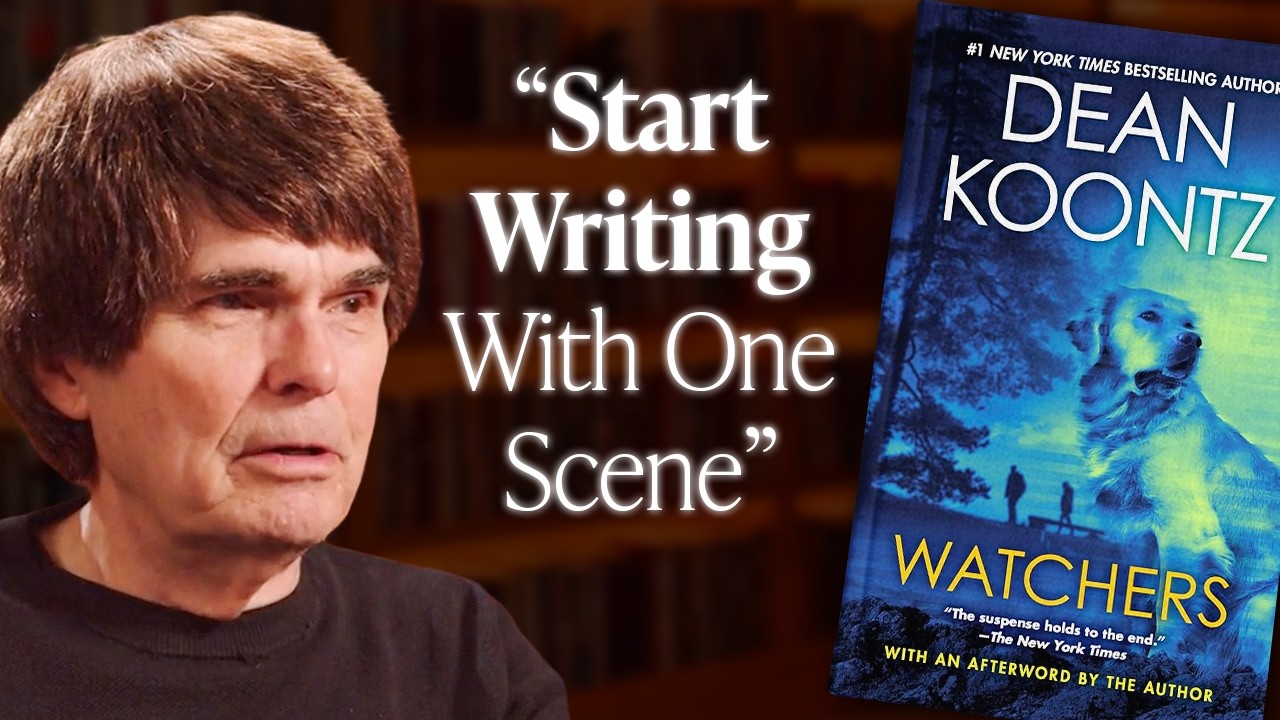
In an intimate interview recorded in his private library, bestselling author Dean Koontz unpacks the philosophy and practical habits that have shaped his career of over 100 novels and 500 million copies sold. Koontz explains that one of his greatest creative breakthroughs occurred when he decided to stop outlining his books0:38. Frustrated by rigid contracts where publishers expected finished manuscripts to match initial outlines, Koontz realized that plotting in advance suffocated imaginative discovery. By granting his characters genuine free will3:37, he allowed plots to unfold organically, discovering that this surrender to intuition propelled him from a midlist author into a perennial bestseller.
Koontz connects this creative surrender to a profound openness toward the mysterious and supernatural. He recounts an unsettling real-life event where he and his realtor explored a newly constructed floor of his house and discovered a completely furnished drywall room5:40 that existed nowhere on the blueprints. The next day, a master stone craftsman revealed that the room sat right where a solid two-foot support wall7:25 stood, making its physical presence impossible. Koontz argues that confronting such moments forces writers into intellectual humility. Rather than clinging to settled assumptions, writers should recognize that nature is beyond comprehension11:50, drawing creative power from a perpetual sense of wonder.
Addressing technological shifts, Koontz rejects generative AI in storytelling, pointing out that copyright law prohibits claiming ownership of AI outputs and that models inevitably construct derivative pastiches. More fundamentally, David Perell recites Psalm 115 on lifeless idols24:50, prompting Koontz to emphasize that artificial intelligence lacks physical senses like touch and taste25:40. Without direct physical sensuality and bodily experience, an algorithm can never truly convey the emotional depths of lived human reality.
Koontz illustrates his intuitive storytelling approach through the plotting of his acclaimed thriller Intensity. While drafting the escape scene of his protagonist China Shepherd, he realized at the convenience store hideout1:00:10 that she could not abandon an abducted girl to the serial killer. This sudden realization spawned an unpredictable cat-and-mouse plot twist1:02:15 that neither the author nor the audience anticipated. In closing, Koontz reflects on how discovering loving Italian Catholic family gatherings1:08:55 grounded him after an abusive childhood, urging creators to look at the intricate machinery of human cells1:11:20 and embrace the sheer wonder of existence.