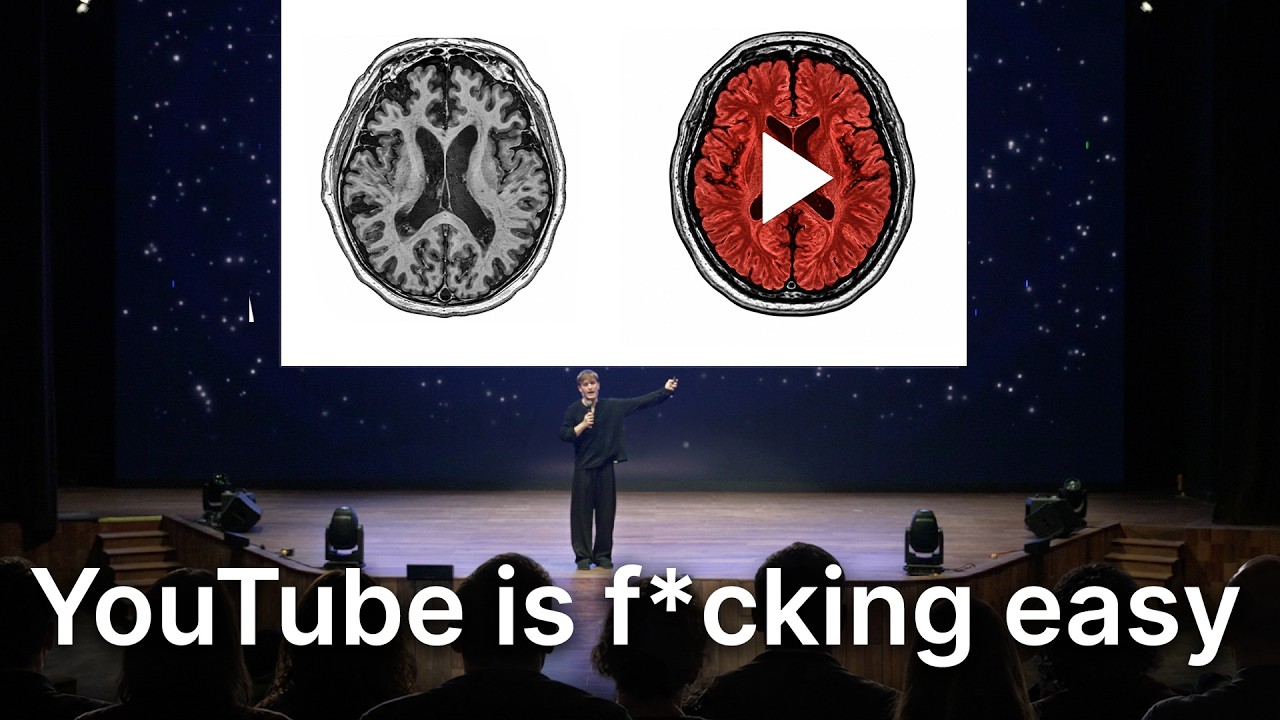
Most YouTube creators fail because they copy superficial tactics without understanding the cognitive principles and audience psychology behind them. In this talk, Jake Trinder reframes video creation as a problem of reliability engineering1:44. In a series system, every component—topic selection, packaging, hook, and editing—must succeed; if any single part breaks, the entire video fails. Even when making multiple choices that are 90% accurate across five stages2:18, the cumulative probability of total success drops to only 59%. Success on YouTube is therefore a quality game of decision-making rather than camera equipment or visual effects.
Every effective decision begins with information. Drawing on Herbert Simon's economic principle of bounded rationality3:37, Trinder explains that creators make sub-optimal decisions because they only observe a fraction of the platform. Rather than guessing audience desires, creators must rely on revealed preference4:53: studying what prospective viewers actually choose to watch rather than what they say they want. By researching a topic's view floor and ceiling5:20, creators determine baseline feasibility and can subsequently stack high-demand entities—such as pairing lead generation strategy with Alex Hormozi6:10—to vastly elevate total addressable reach.
Once a viable topic is established, packaging determines where the video lands within that potential range. Instead of copying isolated viral outliers, creators should seek out consistent cross-niche framing patterns7:56, such as the 'New Rules' construct used for Gary Vaynerchuk. However, Trinder warns against algorithmic overfitting8:58—blindly applying a format without understanding why it resonated with its target demographic. An effective thumbnail must be recognized and understood in a split second, establishing authority and opening a curiosity gap9:48 that the title resolves just enough to win the click.
Winning the click creates an immediate obligation. Viewers arrive with an expectation and a doubt, requiring a hook built on the four Ps framework10:48: Promise, Proof, Plan, and Persona. To ensure the body fulfills this promise, creators can adopt software engineering's acceptance criteria method11:58, breaking down the title's core promise into non-negotiable conditions. Viewer satisfaction—not raw watch retention—is what fuels YouTube's algorithmic recommendation engine. Post-upload analysis should focus on positive comment ratios14:08 and diagnosing retention cliffs to iteratively refine future content.