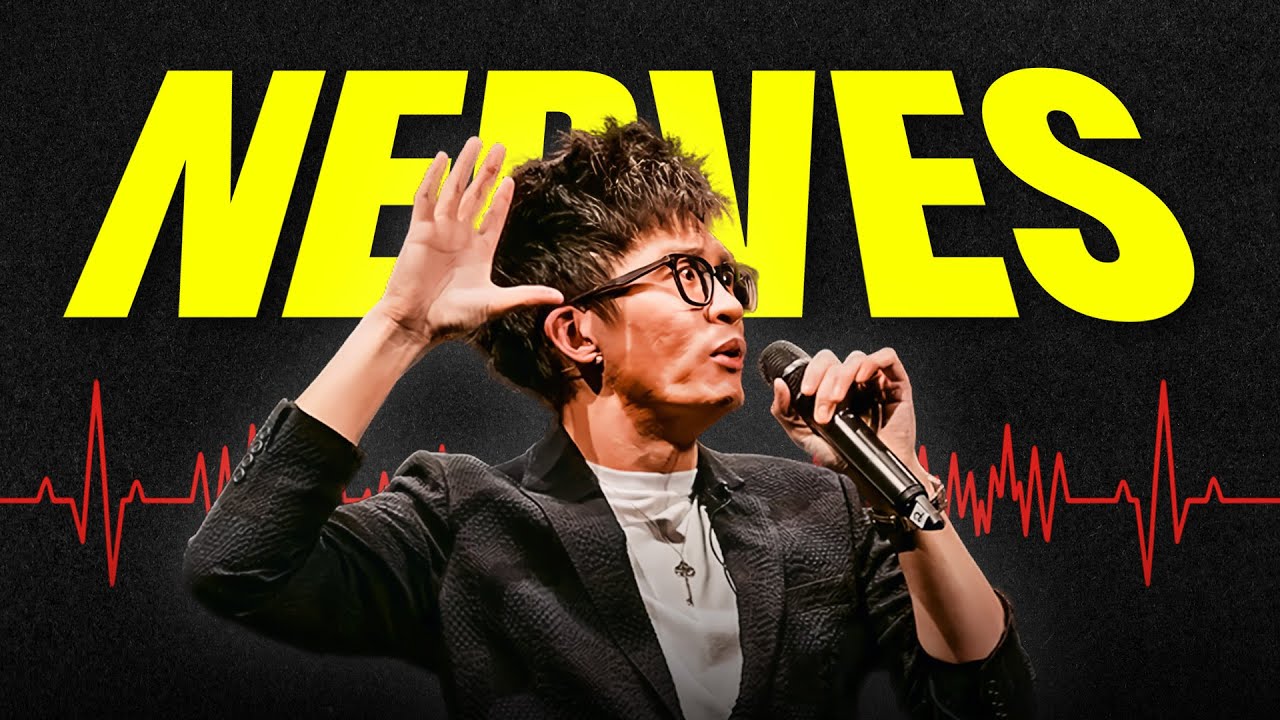
Public speaking anxiety is a universal human response driven by our evolutionary fight-or-flight mechanism. Keynote speaker Vinh Giang opens by recounting a career-defining moment in 2018 when he had to speak to over 38,000 people0:27. Overwhelmed by racing thoughts and severe physical symptoms, he relied on five core strategies to conquer his panic and earn a standing ovation. As Giang highlights at the whiteboard, courageous individuals do not eliminate fear; instead, they transform it through the Fear + Action formula2:13.
The first and most vital technique is Wim Hof breathing3:30. Giang performs three cycles—each consisting of 30 deep breaths, an extended breath-hold upon exhale, an inhalation hold for 15 seconds, and a full exhale. This practice regulates both psychological and physiological arousal, resolving what he estimates to be 80% of his pre-stage nerves. The second tool addresses physiological chemistry: managing excess adrenaline5:19. When fight-or-flight floods the bloodstream, unspent adrenaline causes shaky hands, wobbly knees, and a trembling voice. Giang recommends burning off this energy backstage through push-ups and star jumps5:51 before stepping into the spotlight.
The third tool is a critical mindset shift toward becoming audience-conscious7:12. Giang explains that severe stage fright is rooted in intense self-consciousness and worrying about judgment. By intentionally redirecting attention to serving the audience and changing their lives, you deplete cognitive capacity for self-criticism. Giang also mentions expanding on these principles in his free conversational mastery training9:50.
The fourth strategy relies on behavioral feedback: Look + Sound = Feel9:50. Giang breaks down the elements one can influence—thoughts/feelings, body language, and voice. Because internal thoughts and emotions are the hardest to control under stress, speakers should instead focus on projecting an upright posture and a resonant, confident vocal tone. This physical posture sends neurological and auditory signals back to the brain, effectively allowing speakers to act their way into feeling confident.
Finally, Giang advises speakers to reframe fear into excitement9:50. The human body produces identical physiological reactions—rapid heart rate, dry mouth, shaking, and sweating—for both terror and extreme positive anticipation, such as winning the lottery9:50. By intentionally telling yourself that bodily arousal is energy fueling your performance rather than panic, you successfully break negative anxiety loops and enter a state of ready empowerment.