Avail.video · Watched for you · 12:57 video · 2 min read

How to Be a Better Public Speaker

Outlier score203×Breakout

4,625,506 views vs a median of 22,831 across the channel's last 15 long-form uploads · as of Oct 28

Avail.video calculation

This motivational guide outlines four core principles for mastering public speaking, featuring insights from Simon Sinek and Isaac Serwanga. Sinek emphasizes adopting a generous giving mindset rather than seeking self-promotion or approval. Serwanga presents the 'Three A's of Public Speaking'—authenticity, situational awareness, and audacity—anchoring each principle in personal speaking experiences and the persuasive power of storytelling.

Read the teardown

How it earns the click and holds attention, second by second.

Find in this video

Search what was said and shown

One search covers the transcript, on-screen text, claims and references. Every result jumps to its moment.

    The explainer

    What the video says, with a link to every moment

    A 2-minute read. Each underlined phrase opens the video at that second.

    Effective public speaking is a learnable craft rather than an innate gift. The presentation opens with a timeless reflection from Ralph Waldo Emerson highlighting that speech exists to persuade, convert, and compel, establishing the transformative stakes of public address during the introductory montage0:16.

    quote
    “Speech is power. Speech is to persuade, to convert, and to compel.”-Ralph Waldo Emerson
    ▶ 0:15
    On screen at 0:15

    In the first segment, leadership author Simon Sinek explains that the single most critical shift for any speaker is moving from a taking mindset to a giving mindset, as discussed in Simon Sinek's interview0:35. Many presenters inadvertently alienate audiences by attempting to drive book sales, cluttering slides with social media handles, or reciting lengthy credentials to elevate their status. Sinek contrasts these self-centered habits with renowned TED speakers such as Sir Ken Robinson, Amy Cuddy, Brené Brown, and Dan Pink, arguing in the giver versus taker distinction1:44 that exceptional communicators deliver value freely without demanding applause, book orders, or validation.

    slide
    How to Be a Better Public Speaker
    ▶ 0:36
    On screen at 0:36

    Next, speaker Isaac Serwanga outlines his practical framework known as the 'Three A's of Public Speaking,' starting with the premise that authenticity engages audiences, outlined during Isaac Serwanga's stage presentation3:42. Serwanga recounts preparing for his first TEDx talk at age 26, when he polled twelve friends and family members on whether to use PowerPoint slides, resulting in a dead-even split. He realized that before soliciting outside opinions, a speaker must look inward and trust their gut, as audiences immediately detect pretense and respond only to genuine conviction, emphasized in listening to yourself first5:38.

    Serwanga’s second principle is situational awareness, which enables a presenter to pivot seamlessly when reality diverges from expectations. Sharing an anecdote about an engagement in Sioux Falls, South Dakota, Serwanga describes encountering an audience that had enjoyed an open bar for hours before his keynote, documented in the Sioux Falls open bar story7:00. Rather than delivering a rigid corporate lecture, he leaned into situational humor to build immediate rapport, illustrating how situational flexibility wins audiences9:45.

    Finally, Serwanga introduces audacity as the essential antidote to the fear of criticism and failure. Audacity empowers speakers to command the room with bold delivery, primarily through storytelling. Highlighting research showing that 85% of top TED talks are story-centric, Serwanga notes in the power of storytelling11:55 that the human brain thinks in vivid imagery. He concludes with a guiding maxim for impactful presentations: never tell a story without making a point, and never make a point without telling a story, reinforced in the closing storytelling principle12:05.
    Highlights
    1. 0:16Ralph Waldo Emerson quote on speech
    2. 0:35Simon Sinek on showing up to give
    3. 2:18Isaac Serwanga introduces the Three A's
    4. 3:42Authenticity engages and TEDx preparation story
    5. 6:32Awareness connects the speaker to the audience
    6. 10:14Audacity informs and inspires through storytelling
    Chapters across the 12:57 runtime
    How it's told

    Curated keynote clips linked by kinetic text

    Format: Lecture. The video interweaves an interview clip and a live stage keynote with illustrative b-roll and kinetic text cards to outline four core principles of effective public speaking.

    Story arc

    1. 0:00HookQuick compilation of famous orators establishing public speaking as a masterable skill.
    2. 0:23Tip 1 - Giving MindsetSimon Sinek explains that great speakers arrive to give value rather than seek approval or sales.
    3. 2:17Tip 2 - AuthenticityIsaac Serwanga demonstrates through his TEDx preparation that speakers must trust their authentic style before seeking outside opinions.
    4. 6:28Tip 3 - Situational AwarenessIsaac recounts adapting to an unruly, alcohol-fueled event by reading the room and using spontaneous humor.
    5. 10:14Tip 4 - Audacity & StorytellingIsaac emphasizes overcoming fear through bold delivery and structuring presentations around evocative stories.
    6. 12:22OutroStandard production credits followed by a channel subscription card.

    Setups and payoffs

    1. 4:41Setup Isaac polls twelve friends and family members on whether to use slides
      ↳
      5:32Payoff The 6-6 tie reveals he neglected the most crucial opinion: his own comfort level.
    2. 6:40Setup Isaac travels to Sioux Falls expecting a formal corporate presentation
      ↳
      7:59Payoff Discovering an open bar party prompts him to throw out his scripted serious opener and start with a funny travel story.
    3. 10:26Setup Isaac asks how many experience fear of criticism or messing up words
      ↳
      11:10Payoff The antidote is presented as bold storytelling, which captures human imagination and overcomes anxiety.

    Devices

    • Kinetic text overlaysEmphasizes key takeaways and quotes on black backgrounds to separate main thematic sections.0:010:212:17
    • Interactive audience pollingSpeaker asks for shows of hands to establish immediate rapport and shared vulnerability.2:202:42
    • Personal failure / learning anecdoteRelatable storytelling detailing indecision and awkward environments humanizes the speaker's advice.4:417:45
    • Empirical data citationCiting a study of top-viewed TED talks lends objective authority to the recommendation of story-centric presentations.11:2511:34

    From the video's own structure, matched to the transcript and on-screen text.

    Teardown

    Simon Sinek's face on the thumbnail earns the click with instant authority, and the video holds retention by cutting into high-energy, relatable stage stories that model the exact speaking techniques being taught.

    A breakout: 203× its typical views (4,625,506 vs a median of 22,831 across the channel's last 15 long-form uploads, as of Oct 28) · Long-form lecture · 2,626 days old

    The promise

    You will learn four practical rules from master presenter Simon Sinek to hold any audience's attention.

    Packaging

    How it looks in the feed

    Show the feed as
    12:57

    4 Tips To IMPROVE Your Public Speaking - How to CAPTIVATE an Audience

    Motivation2Study4.6M views · 7y ago4 Tips to Become a Great Public Speaker! How to Improve Your Public Speaking! ►Inspired? Learn How to Speak with No Fear: https://amzn.to/31KPqRM ►Learn 9…

    Views and age as of the teardown, Oct 28, 2026. Other videos are blanked out.

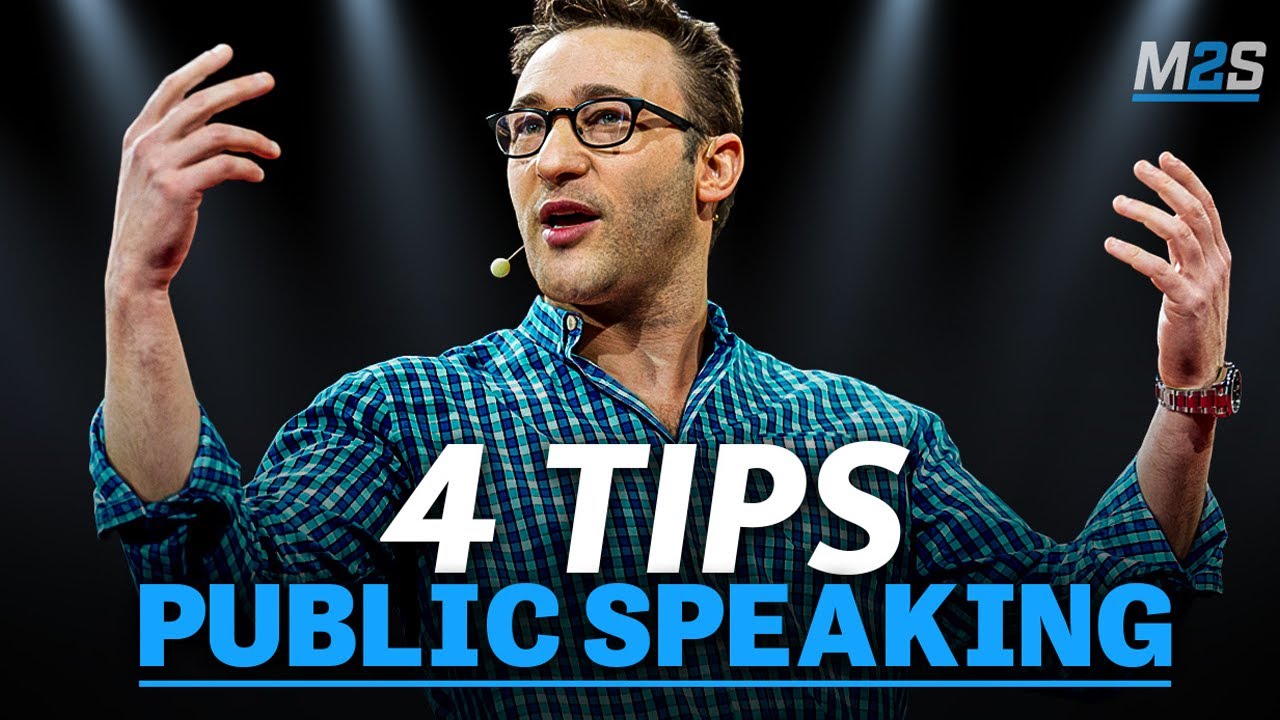
    • 4/5Thumbnail imageSimon Sinek's recognizable face and mid-speech hand gestures instantly establish subject authority. The stage lighting cuts him out sharply against the black background.Simon Sinek in glasses and a headset mic with both hands raised under bright spotlights.
    • 3/5Thumbnail text“4 TIPS PUBLIC SPEAKING”The text is bold and easy to read at small sizes. However, it completely repeats the first four words of the title rather than adding new curiosity.White text '4 TIPS' stacked over cyan text 'PUBLIC SPEAKING' with a bottom border line.
    • 4/5TitleThe title clearly defines the skill and offers a low-friction number. The phrase 'How to CAPTIVATE' targets the exact emotional outcome every presenter wants.A 12-word title featuring capitalized keywords 'IMPROVE' and 'CAPTIVATE' alongside a four-tip list promise.
    • 4/5Title + thumbnailThis packaging worked because Sinek's visual presence provides immediate proof for the title's claim. Even with duplicate phrasing, viewers instantly trust that a famous keynote speaker has secrets worth hearing.A photo of an elite speaker on stage paired with a headline promising to teach you how to captivate a room.

    Curiosity gap: Viewers know Simon Sinek commands huge stages, but they do not know which four specific rules he uses to do it.

    The three hooks

    The title, the thumbnail text and the first words spoken each make a promise, and each does a different job.

    • Title“4 Tips To IMPROVE Your Public Speaking - How to CAPTIVATE an Audience”How-toOutcomeCuriosityIt makes the viewer want practical steps to command the attention of an entire room.
    • Thumbnail text“4 TIPS PUBLIC SPEAKING”Number promiseOutcomeIt makes the viewer want a quick, bite-sized list to solve a difficult communication problem.
    • First words spoken“Say do what you can, where you are, with what you have, and never be satisfied.”AuthorityOutcomeProofLes Brown's explosive delivery makes the viewer want to command an audience with that same effortless vocal power and conviction.
    • PairingRepeatsThe thumbnail text repeats the title's topic and number rather than introducing a separate hook or teaser.
    • StakesFitsThe video promises four practical rules to captivate an audience and delivers four fundamental, relatable communication strategies.
    • UrgencyNoneThe packaging and opening present public speaking as an evergreen life skill rather than a time-sensitive problem.

    The first 20 seconds

    TimeWhat you seeWhat you hearWhat it does
    0:00Black screen.Low atmospheric background music begins.Creates brief silence before speech begins.
    0:01Monochrome cutout of Les Brown speaking, text reads 'The best public speakers started from the bottom'.Les Brown: 'Say do what you can...'Hooks viewer with an iconic speaker and establishes the topic of public speaking mastery.
    0:02Les Brown gestures passionately with both hands.Les Brown: '...where you are, with what you have...'Demonstrates high-energy physical delivery on stage.
    0:03Les Brown continues delivering his speech against the pitch-black backdrop.Les Brown: '...and never be...'Maintains rhythmic cadence of motivational speech.
    0:04Les Brown lowers hands as text stays on screen.Les Brown: '...satisfied.'Completes the first speaker's soundbite.
    0:05Cut to Tony Robbins speaking, text reads 'It is a skill that everybody can master'.Tony Robbins: 'Anticipation is the ultimate...'Introduces another legendary speaker while assuring viewer that speaking can be learned.
    0:06Tony Robbins speaks intensely looking to the side.Tony Robbins: '...advantage...'Reinforces credibility through visual variety.
    0:07Tony Robbins speaking with focused expression.Tony Robbins: '...in business...'Connects speaking skill to real-world outcomes.
    0:08Tony Robbins finishes sentence.Tony Robbins: '...and in life.'Completes second speaker quote.
    0:09Tony Robbins pauses as background music swells slightly.Music continues playing under clip.Allows beat to breathe before next speaker cut.
    0:10Brief transition frame.Music rhythm continues.Paces the montage.
    0:11Cut to Eric Thomas in hoodie and cap, text reads 'Follow these steps to become an extraordinary speaker'.Eric Thomas: 'Like, you not 100%...'Directly delivers the video value proposition to the audience.
    0:12Eric Thomas speaks emphatically with open hands.Eric Thomas: '...sure...'Shows raw conversational stage presence.
    0:13Eric Thomas continues speaking with intensity.Eric Thomas: '...what could happen if you...'Builds emotional momentum.
    0:14Eric Thomas leans into his delivery.Eric Thomas: '...keep going.'Concludes third motivational snippet.
    0:15Cut to Zig Ziglar, text displays Ralph Waldo Emerson quote: 'Speech is power...'Zig Ziglar: 'You can do it.'Presents classical public speaking authority and philosophical quote.
    0:16Zig Ziglar raises his index finger in a teaching gesture.Zig Ziglar: 'Tomorrow...'Draws focus to key speaking technique.
    0:17Zig Ziglar holds finger up, smiling slightly.Zig Ziglar: '...is going...'Uses deliberate vocal pacing to build anticipation.
    0:18Zig Ziglar looks directly ahead.Zig Ziglar: '...to be...'Holds the room with suspense.
    0:19Zig Ziglar lowers finger and speaks warmly.Zig Ziglar continues speech.Shows masterclass in tone shift and pacing.
    0:20Zig Ziglar remains on screen delivering line.Zig Ziglar audio continues.Closes introductory montage into the main lesson.
    Click confirmation
    Yes. At 00:01, famous orator Les Brown appears with text about public speaking, directly validating the title's public speaking promise.
    Time to the point
    0:11
    Hook
    bold claim, in the middle of the action
    Reason to stay
    The on-screen prompt promises a set of steps to match the extraordinary speaking skills of the legends featured in the opening montage.
    Missing on purpose
    No channel intro, no personal greeting, no animated logo, and no subscription request before delivering value.
    Pace and texture
    Fast montage cutting every 4 to 5 seconds across four legendary speakers, set against high-contrast black backgrounds with minimal text overlays and continuous background music.

    Story map

    List/countdown. A nervous speaker wants to captivate an audience without freezing up, but they obsess over slides, external approval, and rigid scripts; by adopting a giving mindset, trusting internal authenticity, reading the room, and anchoring points in stories, they learn to command any room.

    TimeSectionNew tensionStakesTurnLoops
    0:00 –0:21Intro Montage: The Power of SpeechCan an ordinary person ever speak with the power of world-class orators?HoldMost people believe great speakers are born, but legendary orators started from the bottom, therefore speaking is a skill anyone can master.Opens: Which four steps allow an everyday person to become an extraordinary speaker?
    0:21 –2:17Tip 1: Show Up to Give (Simon Sinek)Why do most presentations feel transactional and repulse the audience?RiseSpeakers often push their social handles and pitch books to take from the room, but audiences detect self-promotion instantly, therefore elite speakers focus entirely on giving value without expecting approval.Opens: What are the remaining three rules after adopting a giving mindset?Closes: Which rule Simon Sinek uses to approach every presentation.
    2:17 –6:31Tip 2: Authenticity Engages (Isaac Serwanga)Should a speaker rely on presentation slides or just their own presence?RiseIsaac surveys twelve close friends on whether to use slides and gets a split tie, but outside opinions create paralysis, therefore presenters must check their own gut comfort before seeking external advice.Opens: How does a speaker maintain connection when external conditions go wrong?Closes: How to resolve conflicting presentation feedback.
    6:31 –10:13Tip 3: Awareness Connects (Sioux Falls Story)What happens when the room's energy completely clashes with your prepared speech?RiseIsaac prepares a serious corporate keynote, but walks into an open-bar party crowd, therefore he throws out his prepared opener and tells a spontaneous travel joke to win them over.Opens: How do you conquer the underlying fear of speaking before you even step on stage?Closes: How to handle an unpredictable or rowdy audience.
    10:13 –12:20Tip 4: Audacity and StorytellingHow can a speaker overcome the fear of judgment and tripping over words?HoldSpeakers let fear dictate their delivery, but human brains naturally think in visual scenes, therefore packaging points inside bold stories dissolves stage fright and commands attention.Closes: The final rule needed to captivate an audience.
    12:20 –12:57Credits & Channel OutroNone.FallSag: no turn

    Payoff: delivered fully at 12:13. The video delivers four concrete, actionable speaking principles, though only the first rule is delivered by Simon Sinek before switching entirely to Isaac Serwanga. Ending: It ends abruptly after the fourth tip, cutting straight into 35 seconds of silent attribution text credits and an end card.

    Leaks

    Where a viewer might leave. Guesses from watching, not retention data.

    • 2:17 The video abruptly transitions away from Simon Sinek to Isaac Serwanga on a stage, prompting drop-off from viewers who clicked expecting Sinek for the entire runtime.
    • 4:41 Isaac breaks down a slow, repetitive poll of individual family members ('sister... mom... bro'), causing the pacing of actionable advice to drag.
    • 12:20 The speech cuts abruptly into a wall of raw Creative Commons attribution text URLs over a black screen, signaling the content is finished.

    Steal this

    1. Rapid Authority Stacking Hook Cutting across four legendary figures within twenty seconds with minimal text proves the topic's importance without wasting time on channel intros. 0:01
    2. The Polling Paradox Anecdote Setting up a dead-heat poll among trusted advisors creates light comedic tension and dramatizes why seeking too much feedback backfires. 4:41
    3. Mismatch Pivot Storytelling Describing an extreme mismatch between expectation and reality (a serious lecture vs. an open-bar party) makes the tactical advice of 'reading the room' memorable. 6:40
    4. Data-to-Aphorism Finish Backing a creative tip with a hard data point (85% of top TED talks) and capping it with a rhyming rule ('never make a point without a story') gives viewers a sticky takeaway. 11:25

    Skip this

    • Bait-and-switch packaging featuring Simon Sinek for a video that is mostly Isaac Serwanga. This tactic works for third-party curation channels, but burns trust and creates retention dips if attempted on an original creator brand.
    • A 35-second silent Creative Commons text credit roll at the end. Scrolling plain text attribution URLs kills watch time and tanks click-through rates on end-screen recommendations.

    Open questions

    • What was the exact retention drop-off at 02:17 when Simon Sinek disappeared from the screen?
    • Did Motivation2Study license Isaac Serwanga's keynote directly or pull it from an open Creative Commons repository?
    • What proportion of the 4.6M viewers clicked specifically because of Simon Sinek's face versus the promise of public speaking improvement?

    Teardown by Avail.video from the thumbnail, the title, the first 20 seconds and the report's notes on the whole video.

    On screen

    Everything the video showed you

    Slides, frameworks, quotes and formulas, captured verbatim with the moment they appeared. Tap any card to jump there.

    Reference shelf

    People, ideas and things mentioned

    Said means mentioned aloud; Shown means it appeared on screen.

    People9

    • Simon SinekAuthor, speaker, and leadership expert.0:21Said + shown0:35Said0:56Shown1:46Shown
    • Isaac SerwangaInspirational speaker, educator, and founder of Inform & Inspire.2:17Said + shown2:20Shown3:41Said + shown4:08Shown4:33Shown6:12Shown6:28Shown7:39Shown8:17Shown9:44Shown10:38Shown11:36Shown12:00Shown
    • Ralph Waldo Emerson19th-century American essayist, poet, and philosopher.0:15Said + shown
    • Sir Ken RobinsonBritish author, speaker, and international advisor on education.1:51Said + shown
    • Amy CuddySocial psychologist and author known for research on body language.1:52Said + shown
    • Brené BrownProfessor, lecturer, and author known for research on vulnerability and courage.1:53Said + shown
    • Daniel H. PinkAmerican author of books on work, management, and behavioral science.1:54Said + shown
    • Kevin HartAmerican stand-up comedian and actor.8:48Said
    • Martin Luther King Jr.Civil rights leader renowned for historic oratorical skill.11:46Said + shown

    Ideas & frameworks1

    • Three A's of Public SpeakingPresentation framework consisting of Authenticity, Awareness, and Audacity.3:28Said

    Organizations1

    • TED TalksGlobal conference talk series known for short, impactful presentations.1:50Said3:44Said11:32Said

    Things on screen1

    • Sioux FallsThe most populous city in the U.S. state of South Dakota.6:52Said
    Video description

    A description you can paste into YouTube

    A hook, a summary, chapters in YouTube's format and what the video mentions. Copy it, edit it, and paste it into YouTube Studio.

    1,234 / 5,000 characters
    By the numbers

    What YouTube shows about this video and its channel

    As of Oct 28, 2026. YouTube's public numbers first, then Avail.video's own arithmetic on them.

    The video

    Views
    4.6M
    Likes
    81.5K
    Comments
    1K
    Published
    Aug 19, 2019
    Length
    12:57
    Category
    Education
    YouTube's topics
    —
    Captions
    Yes
    HD
    Yes
    Language
    English
    Paid promotion
    None declared
    Made for kids
    No
    License
    Standard YouTube

    Creator's tags

    • motivation
    • inspiration
    • public speaker
    • public speaking
    • public speaking advice
    • public speaking tips
    • 4 Tips to Instantly Improve Your Public Speaking
    • 4 tips
    • tips for public speaking
    • how to be a better speaker
    • how to speak in public
    • fear of public speaking
    • how to become a better speaker
    • m2s
    • motivation2study
    • motivation2study public speaking
    • study motivation
    • motivational video
    • motivational speech
    • motivational speaker
    • simon sinek
    • simon sinek speaking tips
    • speaking

    The channel

    Subscribers
    4.6M
    Videos
    916
    Total views
    397.4M
    Channel age
    9 years (since Mar 2017)
    Country
    Canada
    Uploads
    about every 7 days
    Across the last 15 long-form uploads
    Before this video
    —

    Calculated by Avail.video from YouTube's public numbers

    Outlier score
    203× · Breakout
    Views against the median of the channel's last 15 long-form uploads
    Views per subscriber
    1.00
    Likes vs the channel's usual
    1.2× the channel's usual
    1.8% of views vs a usual 1.5%
    Comments vs the channel's usual
    0.7× the channel's usual
    0.023% of views vs a usual 0.034%
    Rank among recent uploads
    #1 of 16
    By views: this video and the channel's last 15 long-form uploads
    Take it to your AI

    Ask Claude or ChatGPT about this video

    Copy this report as context, paste it into a chat, then ask anything. It includes timestamps, so answers can point back to the video.

    Then ask
    • Turn the main ideas into a checklist I can use this week.
    • What are the strongest claims in this video, and what evidence does it give for each?
    • Write a short summary for someone who hasn't watched it, linking the key moments.
    • Quiz me on this video, one question at a time, and cite the timestamp for each answer.

    Watched by Avail.video · 2026-10-28