Avail.video · Watched for you · 1:10:01 video · 2 min read

Tim Ferriss Live Q&A: AI, Overcoming Paralysis, Vision Training, Back Pain, and Health Protocols

Outlier score3.2×Overperformer

45,338 views vs a median of 14,366 across the channel's last 15 long-form uploads · as of Oct 28 · 6 days old, early

Avail.video calculation

In this extensive live Q&A session, Tim Ferriss answers audience questions on adapting The 4-Hour Workweek to the era of artificial intelligence, overcoming paralysis through small daily actions, and training eyesight with neuroplasticity software. He also critiques John Sarno's back pain theories, details his pre-podcast cognitive stack, and highlights high-leverage physical and relationship protocols for busy individuals and new parents.

Read the teardown

How it earns the click and holds attention, second by second.

Find in this video

Search what was said and shown

One search covers the transcript, on-screen text, claims and references. Every result jumps to its moment.

    The explainer

    What the video says, with a link to every moment

    A 2-minute read. Each underlined phrase opens the video at that second.

    In this wide-ranging live stream, Tim Ferriss addresses listener queries spanning career strategy, cognitive enhancement, chronic pain, and lifestyle design. Opening with a query regarding the future of work, Ferriss explores The 4-Hour Workweek in the Age of AI0:41. He asserts that artificial intelligence functions primarily as an amplifier, meaning that without strict adherence to the foundational DEAL stages—specifically definition and elimination—automation merely accelerates useless or distracting tasks rather than producing genuine freedom.

    Ferriss addresses behavioral momentum and decision fatigue when answering Daniel's question on breaking paralysis with micro-actions8:50. Rather than getting lost in prolonged introspection, he recommends establishing minimum effective doses of daily physical commitment, such as doing five push-ups before each meal or making a brief phone call of gratitude, drawing on principles from Atomic Habits and BJ Fogg9:56. When evaluating long-term commitments, he highlights Peter Thiel's six-month thought experiment19:30 and recommends red-teaming projects with trusted friends22:10 by asking how an initiative might fail within two to three years.

    slide
    NEW YORK TIMES BESTSELLERTiny Changes, Remarkable ResultsAtomic HabitsAn Easy & Proven Way to Build Good Habits & Break Bad OnesJames ClearAvery
    ▶ 9:56
    On screen at 9:56

    On physical optimization and sensory health, Ferriss shares updates regarding his vision toolkit, highlighting Oryx Neuro software24:31 which trains visual cortical processing to restore near-distance reading acuity without altering the eye's physical lens. Balancing hyper-optimization with life emergence, he advocates Ramit Sethi's 10X investment heuristic29:10 to heavily fund health and deep relationships, while reading works like The Surrender Experiment by Michael Singer34:00 to guard against the illusion of absolute control.

    slide
    MICHAEL A. SINGERTHE SURRENDER EXPERIMENTmy journey into life's perfectionHarmony Books
    ▶ 33:58
    On screen at 33:58

    Ferriss also provides clinical insights into mental health and neuromodulation, detailing accelerated TMS and the ONE-D protocol39:05, which pairs theta burst stimulation with D-cycloserine to treat treatment-resistant depression and anxiety. Discussing communication and public performance, he outlines his State, Story, Strategy mental model43:30, fueled physically by DeltaG exogenous ketones44:55 and Neutonic caffeine toothpicks45:45.

    slide
    Real-world effectiveness of a single-day regimen for transcranial magnetic stimulation using Optimized, Neuroplastogen-Enhanced techniques in Depression (ONE-D)Research Square
    ▶ 39:13
    On screen at 39:13

    Addressing musculoskeletal health, Ferriss presents a balanced critique of John Sarno's Healing Back Pain52:11, acknowledging its psychosomatic insights while insisting that structural damage, nociceptor variation, and mechanical issues cannot be dismissed. Finally, he confirms the enduring utility of the Slow-Carb Diet and intermittent fasting1:01:15 from The 4-Hour Body, and offers new parents practical, low-cost recommendations including Terry Real's Fierce Intimacy1:05:55, The Happy Body program1:07:40, and gymnastic strength training1:08:45.
    slide
    WITH A NEW PREFACE FROM THE AUTHORThe New York Times BestsellerHEALING BACK PAINTHE MIND-BODY CONNECTIONJOHN E. SARNO, MDGrand Central Publishing
    ▶ 52:17
    On screen at 52:17
    Highlights
    1. 0:41The 4-Hour Workweek in the Age of AI
    2. 8:50Breaking Paralysis with Micro-Actions
    3. 18:35The 10-Year Goals in 6 Months Thought Experiment
    4. 24:31Oryx Vision Training Technology
    5. 29:00The 10X Investment Heuristic for Health and Relationships
    6. 52:11Critique of John Sarno's Back Pain Theory
    Chapters across the 1:10:01 runtime
    How it's told

    A live solo Q&A answering audience questions

    Format: Podcast. Tim Ferriss fields a curated sequence of audience questions covering lifestyle design, AI, mental health, vision training, and physical longevity. He balances practical personal experiments with conceptual frameworks and book recommendations.

    Story arc

    1. 0:00Hook and Heuristic PreviewFerriss introduces the livestream with a teaser on Ramit Sethi's 10x priority investment heuristic.
    2. 0:404-Hour Workweek in the Age of AIFerriss re-evaluates the DEAL framework, warning against using AI to accelerate unnecessary work.
    3. 5:50Adapting Advice Over TimeFerriss discusses the importance of reassessing past recommendations as life circumstances evolve.
    4. 8:35Breaking Paralysis with Micro-ActionsFerriss explains how tiny, manageable habits help overcome behavioral inertia and self-doubt.
    5. 12:34High-Leverage Interview QuestionsFerriss discusses formulating questions aimed at extracting actionable insights rather than abstract theory.
    6. 14:15Navigating Friendships Across DividesFerriss details non-preachy communication strategies for maintaining relationships with drifting friends.
    7. 18:35When to Persist vs. QuitFerriss recommends timeboxing and red-teaming ventures using thought experiments like Peter Thiel's 10-year goal prompt.
    8. 23:42Vision Training with Oryx NeuroFerriss recounts using perceptual learning software to improve near vision and read in dim light without reading glasses.
    9. 28:2510X Priority InvestmentsFerriss outlines how intentionally prioritizing health and relationships crowds out trivial micro-optimizations.
    10. 31:01Intentionality and SerendipityFerriss balances structured personal planning with letting go, referencing Michael Singer's The Surrender Experiment.
    11. 36:13Live Q&A Dynamics and Rapid InteractionsFerriss answers quick audience queries regarding climbing grip strength, listener feedback, and fatherhood.
    12. 38:34Accelerated TMS and Bioelectric HealthFerriss reviews accelerated transcranial magnetic stimulation, single-day ONE-D protocols, and vagus nerve research.
    13. 43:16State, Story, Strategy FrameworkFerriss details Tony Robbins's sequence to prime physical state before speaking or writing.
    14. 47:49Writing Routines and MeditationFerriss shares late-night writing habits involving muted movies and electronic music, alongside brief meditation practice.
    15. 52:14Critique of Sarno's Back Pain ModelFerriss dissects psychosomatic tension myositis syndrome versus structural biomechanics like Stuart McGill's methods.
    16. 59:52The 4-Hour Body After 40Ferriss examines the durability of the Slow-Carb diet, intermittent fasting windows, and supplement updates.
    17. 1:05:04Parenting and Minimalist Fitness SystemsFerriss highlights relationship communication books and the minimalist conditioning regimen from The Happy Body.
    18. 1:09:49Outro and SubscribeFerriss wraps up the livestream and points viewers to relevant resources and subscriptions.

    Setups and payoffs

    1. 0:01Setup Tim previews Ramit Sethi's heuristic on investing 10 times more in priority areas.
      ↳
      29:20Payoff Tim breaks down how he applies Sethi's 10x heuristic specifically to his health and relationships.
    2. 15:28Setup Tim references the book Crucial Conversations when discussing navigating polarized friendships.
      ↳
      1:04:41Payoff Tim revisits Crucial Conversations alongside Fierce Intimacy as essential relationship toolkits for parents and couples.
    3. 27:48Setup Tim mentions gathering real-time feedback on podcast formats from live streams.
      ↳
      36:13Payoff Tim explains directly how live chat comments and audience prompts steer his show's creative direction.
    4. 38:39Setup Tim describes accelerated transcranial magnetic stimulation (TMS) as an emerging clinical tool.
      ↳
      42:58Payoff Tim discusses portable innovations like Ampa Health and notes its recognition in Time magazine.
    5. 43:44Setup Tim introduces Tony Robbins's State, Story, Strategy sequence for personal performance.
      ↳
      1:01:02Payoff Tim connects the physical 'State' foundation to metabolic protocols, including nutrition and exogenous ketones.

    Devices

    • Kinetic ExcerptsDisplaying highlighted quotes and book excerpts onscreen to ground classic frameworks.1:1610:04
    • B-Roll Product DemonstrationsCutaway b-roll showcasing digital interfaces and physical devices in action.10:2424:3943:06
    • Live Physical Prop DemoFerriss physically opens and drinks an exogenous ketone supplement on camera while explaining dosing.45:04
    • Thought ExperimentsPosing forcing questions to bypass cognitive assumptions and test venture viability.0:1319:4322:20
    • Contrast ComparisonsContrasting competing health frameworks to explore nuanced middle grounds.34:4543:5553:08

    From the video's own structure, matched to the transcript and on-screen text.

    Teardown

    This video overperforms by taking Tim Ferriss's famous 15-year-old frameworks and directly updating them for today's two biggest anxieties: AI taking work and bodies breaking down after 40.

    A real overperformer: 3.2× its typical views (45,338 vs a median of 14,366 across the channel's last 15 long-form uploads, as of Oct 28) · Long-form podcast · 6 days old, early

    The promise

    Tim Ferriss delivers direct answers on updating his iconic lifestyle and fitness systems for modern artificial intelligence and aging past 40.

    Packaging

    How it looks in the feed

    Show the feed as
    1:10:01

    Q&A with Tim — The 4-Hour Workweek in a World of AI, The 4-Hour Body After 40, and More

    Tim Ferriss45K views · 6d agoThis episode explores what The 4-Hour Workweek looks like in the age of AI, rebuilding momentum when you’re stuck, navigating friendships, making room for…

    Views and age as of the teardown, Oct 28, 2026. Other videos are blanked out.

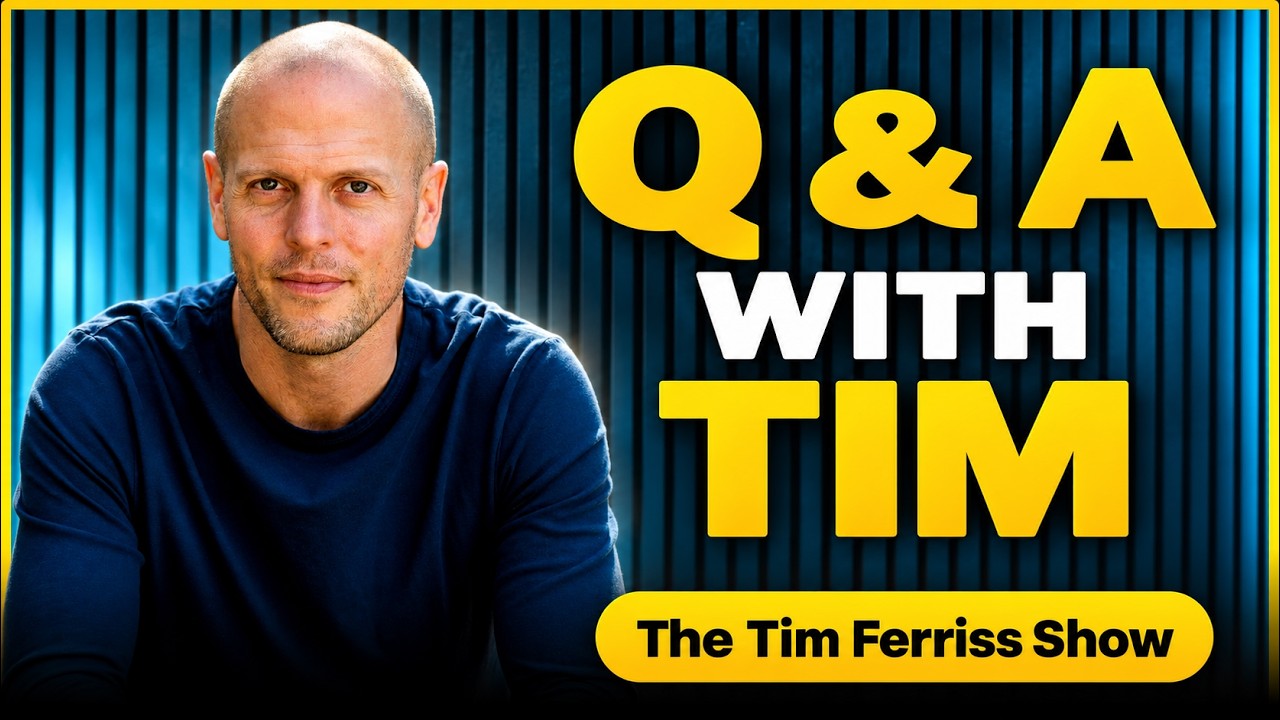
    • 4/5Thumbnail imageTim's direct eye contact and sharp studio lighting immediately establish authority. The high-contrast yellow typography against dark vertical slats ensures clear visibility even on small mobile screens.A close-up portrait of Tim Ferriss staring directly into the camera beside bold yellow block text on a blue slatted backdrop.
    • 3/5Thumbnail text“Q & A WITH TIM The Tim Ferriss Show”The text relies entirely on brand recognition rather than teasing any specific subject matter. It takes up significant visual real estate without adding new intrigue.Large yellow and white text reading 'Q & A WITH TIM' above a pill badge reading 'The Tim Ferriss Show'.
    • 5/5TitleThe title successfully bridges Tim's most famous legacy IP with today's urgent topics. Juxtaposing 'The 4-Hour Workweek' with AI and 'The 4-Hour Body' with aging provides immediate relevance.The title names 'The 4-Hour Workweek in a World of AI' and 'The 4-Hour Body After 40'.
    • 4/5Title + thumbnailWhile the thumbnail text repeats the title's opening words, the combination worked by pairing Tim's recognizable face with high-value topic updates in the title. The curiosity gap is driven primarily by the title.The thumbnail presents the host's face and show branding, while the title lists the updated frameworks.

    Curiosity gap: How must the foundational lifestyle and physical optimization principles from Tim's classic bestsellers evolve to survive AI disruption and middle age?

    The three hooks

    The title, the thumbnail text and the first words spoken each make a promise, and each does a different job.

    • Title“Q&A with Tim — The 4-Hour Workweek in a World of AI, The 4-Hour Body After 40, and More”Curiosity gapCuriosityNoveltyOutcomeIt makes the viewer want to discover how to adapt proven productivity and fitness playbooks to AI automation and physical aging.
    • Thumbnail text“Q & A WITH TIM The Tim Ferriss Show”AuthorityCuriosityIt makes core fans want direct, unfiltered access to Tim's personal thoughts.
    • First words spoken“I'll borrow a heuristic from Ramit Sethi, who is better known as a sort of finance guru of sorts...”AuthorityCuriosityNoveltyIt creates immediate curiosity by teasing a radical multiplier heuristic from a known financial authority before Tim reveals how he personally applies it.
    • PairingRepeatsThe thumbnail graphic duplicates 'Q & A WITH TIM' from the start of the title rather than introducing a distinct hook.
    • StakesFitsThe video directly addresses whether Tim's life's work still applies to AI automation and middle age, delivering concrete adjustments rather than vague motivation.
    • UrgencyNoneThere is no manufactured deadline or countdown driving the packaging; the appeal is timeless advice updated for modern conditions.

    The first 20 seconds

    TimeWhat you seeWhat you hearWhat it does
    0:00Tim Ferriss talking to camera via webcam in a kitchen setting."I'll borrow"Introduces a direct conversational thought right away without ceremony.
    0:01Yellow 'COMING UP' banner appears in the top right corner."a heuristic from"Signals to the viewer that this is an upfront preview of a highlight from the episode.
    0:02Tim continues speaking on webcam."Ramit Sethi,"Name-drops a recognized financial expert to establish instant authority.
    0:03Tim talking with 'COMING UP' overlay visible."who is better known as a"Contextualizes who Ramit Sethi is for unfamiliar viewers.
    0:04Tim speaking directly to the camera."sort of finance"Keeps the framing informal and personal.
    0:05Tim smiling slightly while explaining."guru of sorts,"Maintains a relaxed, unpretentious tone.
    0:06Tim gesturing slightly with his head."has a great"Builds curiosity about the specific insight being borrowed.
    0:07Tim pauses briefly while thinking."podcast"References Sethi's interview show as the context for the idea.
    0:08Tim lifts his hand to gesture."where he interviews couples about various"Explains the real-world setting where the question gets asked.
    0:09Tim's hand gestures in the air as he finishes sentence."money problems and so on."Sets up the premise before delivering the actual framework.
    0:10Cut to B-roll clip of Ramit Sethi seated in a podcast studio with a microphone."And he'll ask people, what would it look like"Visual cutaway verifies the reference and breaks visual monotony.
    0:11Close-up on Ramit Sethi gesturing while seated."to invest"Builds tension around the high-impact question.
    0:12Ramit Sethi talking on his set with show overlay 'I Will Teach You To Be Rich'."ten times more"Delivers the provocative multiplier that defines the heuristic.
    0:13Wide angle showing the couple sitting across from Ramit on the set."in"Shows the interview format in action.
    0:14Ramit actively gesturing with both hands towards the couple."one or two areas that matter most."Clarifies the core question: extreme focus on high-priority categories.
    0:15Wide studio shot continues with Ramit leaning forward.[speech continues]Lets the viewer internalize the thought experiment.
    0:16Wide shot holding on the discussion."So for me,"Pivots the question from a generic finance tip to Tim's personal answer.
    0:17Cut back to Tim Ferriss talking directly into his webcam."I am..."Plants the open loop right as Tim begins revealing his personal choice.
    0:18Tim speaks intently into the camera."I am..."Builds anticipation right before the cut.
    0:19Tim pausing mid-thought on screen.[audio trails off into transition]Leaves the viewer eager to hear which areas Tim invests 10x more into.
    0:20Fade/cut transition beginning.[audio ends]Forces the viewer to stay into the episode to hear his specific answer.
    Click confirmation
    The title advertises a broad Q&A with Tim Ferriss covering work, body, and AI. This opening cold open operates as a 'Coming Up' teaser teasing a practical framework from Ramit Sethi rather than immediately answering the title's questions.
    Time to the point
    0:14
    Hook
    payoff preview, question, curiosity-gap
    Reason to stay
    Tim sets up the concept of investing 10x more into the 1 or 2 areas that matter most, says 'So for me, I am...', and then the clip cuts off before revealing what his personal areas are.
    Missing on purpose
    No channel intro, no greeting, no music sting, and no sponsor reads—just straight into an intriguing thought experiment cut off right at the punchline.
    Pace and texture
    Fast teaser edit: 10 seconds of talking head setup, a 7-second cutaway to Ramit Sethi's podcast footage, and a quick cut back to Tim right before the cliffhanger.

    Story map

    Explainer. An iconic lifestyle-design author evaluates whether his classic playbooks still hold up against rapid AI disruption, physical aging, and modern burnout. The obstacle is that technology now accelerates trivial work rather than freeing up time, requiring radical elimination rather than just better tools.

    TimeSectionNew tensionStakesTurnLoops
    0:00 –0:40Heuristic Cold OpenWhat high-leverage rule does Tim use to cut through life clutter?HoldRamit asks what it looks like to 10x your focus on what matters, but Tim cuts the thought off right as he names his own choices.Opens: What are the specific areas Tim is over-investing in?Closes: none
    0:40 –5:50The 4-Hour Workweek in an Age of AIDoes the 4-Hour Workweek framework survive AI agents?RisePeople assume AI creates automatic leisure time, but it actually accelerates trivial work and creates digital overwhelm unless you aggressively eliminate first.Opens: How should people re-evaluate Tim's past advice across different life stages?Closes: How the DEAL framework adapts to AI.
    5:50 –12:35Author Life Stages & Breaking ParalysisWhat advice did Tim get wrong, and how do you escape overthinking?HoldIntrospection feels productive, but excessive self-analysis turns into avoidance; therefore, action must start absurdly small.Opens: What single question cuts through abstract talk in an interview?Closes: Which past advice needs caveats; how to break executive paralysis.
    12:36 –18:34High-Leverage Questions & Drifting FriendshipsHow do you stay connected with friends who are drifting into polarized rabbit holes?HoldLecturing friends never works, so you must model personal experiments instead and accept that some paths diverge.Opens: When is a project a dead end versus needing more time?Closes: The ultimate interview question; handling diverging worldviews.
    18:35 –28:25Quitting vs. Persisting & Age-Related VisionHow do you fix middle-age physical decline without just relying on reading glasses?RiseLenses physically stiffen with age, but brain perceptual learning can retrain visual processing to read dim menus again.Opens: What does Tim deliberately refuse to optimize anymore?Closes: How to red-team a failing venture; toolkits for aging eyes.
    28:26 –38:3410X Over-Investing & Intentional SerendipityCan you over-engineer your life to the point of ruining it?HoldTrying to eliminate everything creates rigid tunnel vision, therefore over-investing in health and relationships acts as a natural forcing function.Opens: What clinical interventions work for stubborn mental health loops?Closes: The cold open loop regarding Ramit Sethi's 10x priority areas.
    38:35 –52:10Neuro-stimulation & Fast Answering FrameworksHow does Tim rapidly answer complex questions without hesitating?FallMost people try to change strategy, but strategy fails if you don't prime your physical state and biochemistry first.Opens: Does John Sarno's famous psychosomatic back pain diagnosis actually hold water?Closes: Accelerated TMS protocols; State-Story-Strategy breakdown; writing rituals.
    52:11 –59:48Critique of Dr. John Sarno & Low Back PainIs chronic back pain really all in your head?RisePsychosomatic therapy cures some patients, but claiming physical damage is completely irrelevant insults mechanical biology.Opens: Does The 4-Hour Body diet and training hold up for people over 40?Closes: Where Dr. Sarno's model helps and where it fails.
    59:49 –1:10:01The 4-Hour Body After 40 & Protocols for New ParentsWhat survives from The 4-Hour Body, and what should exhausted parents actually do?HoldSag: no turnOpens: noneCloses: 4-Hour Body updates for older adults; minimalist fitness and relationship advice for parents.

    Payoff: delivered fully at 3:16. Ferriss immediately tackles the headline promise at 00:50 and delivers his core thesis by 03:16: AI accelerates whatever you feed it, making 'Definition' and 'Elimination' far more critical than automation. Ending: A concise wrap-up listing recommended bodyweight training systems for new parents, followed by a silent visual end card with subscribe prompts.

    Leaks

    Where a viewer might leave. Guesses from watching, not retention data.

    • 25:52 The video halts its philosophical narrative for an extended pitch and discount code on Oryx software.
    • 37:37 Tim shifts away from high-stakes productivity frameworks to chat questions about climbing grips and silly hypotheticals.
    • 47:53 A digression into looping movies like Babe while writing feels indulgent compared to the tactical frameworks promised in the packaging.

    Steal this

    1. The Mid-Thought Teaser Cut a compelling guest or host soundbite right as they begin stating their personal conclusion ('So for me, I am...'), forcing the viewer to watch the episode to hear the actual list. 0:17
    2. Legacy Framework Modernization Take an iconic, dated framework of your own (or another author's) and explicitly stress-test its core steps against a brand-new cultural disruption like generative AI. 1:09
    3. On-Camera State Priming Demo Demonstrate the advice in real time instead of just lecturing—taking the supplement or performing the micro-routine on camera anchors abstract philosophy in reality. 45:04

    Skip this

    • Relying on a 20-year catalog of bestselling books and personal investor access to high-end medical pilots. Tim can hold attention while reviewing unpublished clinical tech or quoting his own books from 2007 because the audience has followed his personal journey for decades.

    Open questions

    • What percentage of the total view count came from live-stream attendees versus post-broadcast on-demand viewers?
    • Did viewers drop off significantly during the Oryx Neuro software pitch between 25:00 and 27:00?

    Teardown by Avail.video from the thumbnail, the title, the first 20 seconds and the report's notes on the whole video.

    On screen

    Everything the video showed you

    Slides, frameworks, quotes and formulas, captured verbatim with the moment they appeared. Tap any card to jump there.

    Reference shelf

    People, ideas and things mentioned

    Said means mentioned aloud; Shown means it appeared on screen.

    People17

    • Tim FerrissAuthor, podcast host, angel investor, and lifestyle optimization researcher.0:00Said + shown0:40Said + shown5:50Said + shown1:09:49Said + shown
    • Ramit SethiPersonal finance author and host of the I Will Teach You To Be Rich podcast.0:01Said0:02Said0:12Shown29:20Said + shown
    • Peter DruckerInfluential management consultant and author.5:37Said + shown
    • James ClearAuthor of Atomic Habits.9:56Said + shown
    • BJ FoggStanford behavior design researcher and author of Tiny Habits.10:00Said + shown
    • Peter ThielVenture capitalist and entrepreneur known for asymmetric questions.0:26Said19:30Said
    • Michael A. SingerSpiritual teacher and author of The Surrender Experiment.33:58Said + shown40:41Said
    • Dr. Jonathan DownarPsychiatrist and neuroscientist at the University of Toronto researching TMS.39:48Said + shown
    • Kevin J. TraceyNeurosurgeon, bioelectronic medicine pioneer, and vagus nerve researcher.42:04Said42:33Said + shown
    • Tony RobbinsAuthor, coach, and speaker who originated the State-Story-Strategy model.43:30Said + shown
    • Chris WilliamsonPodcaster and creator of Neutonic nootropics.45:49Said
    • Henry ShukmanZen teacher, writer, and meditation instructor on The Way App.49:36Said + shown
    • John E. SarnoPhysician and pioneer of the psychosomatic model for chronic back pain.52:16Said + shown
    • Stuart McGillProfessor emeritus of spine biomechanics and author of Back Mechanic.59:17Said + shown
    • Terry RealFamily therapist and author of Fierce Intimacy.1:05:57Said + shown1:06:07Said + shown
    • Sir Richard BransonEntrepreneur and founder of the Virgin Group.1:07:04Said + shown
    • Jerzy GregorekOlympic weightlifting coach and co-founder of The Happy Body system.1:07:38Said + shown1:08:06Said + shown

    Ideas & frameworks10

    • The 4-Hour WorkweekProductivity and lifestyle design book authored by Tim Ferriss.0:47Said0:56Said + shown
    • The Effective ExecutiveProductivity and management book written by Peter Drucker.5:38Said + shown
    • Atomic HabitsBehavioral habit-formation book authored by James Clear.9:56Said + shown
    • Crucial ConversationsCommunication framework book for high-stakes interpersonal dialogue.15:27Said + shown1:04:41Said
    • The Surrender ExperimentSpiritual autobiography written by Michael A. Singer.33:58Said + shown
    • Accelerated TMSHigh-frequency transcranial magnetic stimulation administered in compressed multi-session daily protocols.38:35Said38:40Said
    • Healing Back PainBook on Tension Myositis Syndrome (TMS) by Dr. John E. Sarno.52:15Said52:17Said + shown
    • The 4-Hour BodyHealth, rapid fat loss, and physical optimization book by Tim Ferriss.59:52Said + shown59:55Said
    • On Grief and GrievingBereavement guide written by Elisabeth Kübler-Ross and David Kessler.1:04:30Said + shown
    • The Happy BodyMinimalist strength and mobility system created by Jerzy and Aniela Gregorek.1:07:49Said + shown

    Organizations1

    • AmpaMedical device company developing portable, camera-guided TMS hardware.38:48Shown42:58Said43:06Shown

    Things on screen4

    • The Way AppMeditation app guided by Zen teacher Henry Shukman.10:24Shown49:35Said + shown
    • Oryx NeuroPerceptual vision training software designed to improve near-sight visual acuity.24:35Said + shown25:52Shown
    • deltaG KetonesExogenous ketone ester supplement.44:57Said + shown45:04Said + shown
    • NeutonicCaffeinated nootropic toothpicks developed by Chris Williamson.45:44Said + shown
    Video description

    A description you can paste into YouTube

    A hook, a summary, chapters in YouTube's format and what the video mentions. Copy it, edit it, and paste it into YouTube Studio.

    1,851 / 5,000 characters
    By the numbers

    What YouTube shows about this video and its channel

    As of Oct 28, 2026. YouTube's public numbers first, then Avail.video's own arithmetic on them.

    The video

    Views
    45.3K
    Likes
    556
    Comments
    90
    Published
    Oct 21, 2026
    Length
    1:10:01
    Category
    Howto & Style
    YouTube's topics
    Health, Lifestyle (sociology)
    Captions
    No
    HD
    Yes
    Language
    English
    Paid promotion
    None declared
    Made for kids
    No
    License
    Standard YouTube

    Creator's tags

    • tim ferriss
    • 4 hour workweek
    • 4 hour body
    • 4 hour chef
    • timothy ferriss
    • tim ferriss blog
    • timothy ferriss speaker
    • Tim Ferriss Podcast
    • the tim ferriss show

    The channel

    Subscribers
    1.8M
    Videos
    1.8K
    Total views
    146.2M
    Channel age
    19 years (since Nov 2006)
    Country
    United States
    Uploads
    about every 2 days
    Across the last 15 long-form uploads
    Before this video
    3 days after the previous long-form upload

    Calculated by Avail.video from YouTube's public numbers

    Outlier score
    3.2× · Overperformer
    Views against the median of the channel's last 15 long-form uploads
    Views per subscriber
    0.03
    Likes vs the channel's usual
    2.3× the channel's usual
    1.2% of views vs a usual 0.55%
    Comments vs the channel's usual
    3.1× the channel's usual
    0.20% of views vs a usual 0.064%
    Rank among recent uploads
    #4 of 16
    By views: this video and the channel's last 15 long-form uploads
    Take it to your AI

    Ask Claude or ChatGPT about this video

    Copy this report as context, paste it into a chat, then ask anything. It includes timestamps, so answers can point back to the video.

    Then ask
    • Turn the main ideas into a checklist I can use this week.
    • What are the strongest claims in this video, and what evidence does it give for each?
    • Write a short summary for someone who hasn't watched it, linking the key moments.
    • Quiz me on this video, one question at a time, and cite the timestamp for each answer.

    Watched by Avail.video · 2026-10-27