Avail.video · Watched for you · 1:25:48 video · 2 min read

Finding Product-Market Fit with the Pull Framework | Rob Snyder (The Power of Pull)

Outlier score0.4×Too early to tell

17,149 views vs a median of 46,534 across the channel's last 15 long-form uploads · as of Oct 26 · under a day old, early

Avail.video calculation

Startup advisor and author Rob Snyder breaks down his 'Pull' framework, a pragmatic methodology for navigating the zero-to-one stage of startup building. Rather than convincing customers through feature lists or pain points, founders must identify unavoidable projects where existing options fail, and test demand through lean discovery calls, cold outbound, and a repeatable case study factory.

Read the teardown

How it earns the click and holds attention, second by second.

Highlights
  1. 7:35Defining the PULL framework acronym
  2. 10:00Jump AI note taker case study
  3. 23:55The two-slide hypothesis pitch
  4. 29:20Throwing the Hail Mary question
  5. 42:10Running the 30-minute discovery call
  6. 1:12:30The case study factory mental model
Chapters across the 1:25:48 runtime
How it's told

A structured interview progressing through startup growth stages

Format: Podcast interview. Lenny Rachitsky interviews advisor Rob Snyder about his PULL framework for finding B2B product-market fit. Snyder details step-by-step tactics starting from idea discovery and outreach calls up to pricing, retention, and scaling.

Story arc

  1. 0:00Hook and TeaserMontage of key soundbites introducing customer pull, discovery sales call structure, and the Hail Mary pivot question.
  2. 1:16IntroductionLenny welcomes Rob Snyder and reviews his track record advising over 50 startups to $1M ARR alongside his book The Power of Pull.
  3. 7:32The PULL FrameworkRob breaks down the PULL acronym (Project, Unavoidable, Look, Lacking) and demonstrates why pull is an attribute of a specific person rather than an entire company.
  4. 17:15Finding Startup IdeasWhy most successful startup ideas stem from direct operational observation, and how founders can test hypotheses quickly using a two-slide deck.
  5. 31:15Validation and Anti-patternsRob explains why unpaid design partnerships are traps and details cold outreach benchmarks that signal authentic buyer interest.
  6. 41:28Running Discovery CallsStructuring a 30-minute sales conversation, prompting prospects to state their own need, and transitioning into a focused pitch.
  7. 56:42Pricing and ClosingSetting prices anchored against cost of inaction and backward-planning deal close dates to the champion's reporting deadlines.
  8. 1:07:11The Case Study FactoryViewing an early-stage company as an engine that repeatedly clones one validated customer success story across acquisition and delivery.
  9. 1:13:01Onboarding and RetentionIdentifying the leading indicator of retention and engineering onboarding workflows to prevent churn before it happens.
  10. 1:21:39Lightning RoundRob shares book recommendations, tarpit startup ideas to avoid, and essential operating tools.
  11. 1:25:24OutroLenny delivers closing remarks and provides links to Snyder's book, newsletter, and podcast archives.

Setups and payoffs

  1. 0:46Setup Teaser previews Rob mentioning the 'Hail Mary' sales discovery question.
    ↳
    29:03Payoff Rob provides full context and script examples on asking prospects what on their to-do list they would pay to have removed.
  2. 1:23Setup Lenny displays Rob's physical book 'The Power of Pull'.
    ↳
    7:32Payoff Rob unpacks the core thesis and four-part PULL acronym detailed in the book.
  3. 11:44Setup Rob highlights Jump AI's success with wealth managers due to regulatory compliance notes.
    ↳
    51:28Payoff Rob contrasts Jump's vertical integration with generic AI tools that lack regulatory-compliant CRM integrations.
  4. 32:00Setup Rob warns founders that unpaid design partnerships give misleading demand signals.
    ↳
    1:02:25Payoff Rob explains why demanding paid commitments upfront validates authentic operational urgency.
  5. 1:08:07Setup Rob references Mark Roberge's concept of customer retention leading indicators.
    ↳
    1:14:00Payoff Rob explains how to design onboarding steps directly around that metric to halt downstream churn.

Devices

  • AcronymThe PULL acronym (Project, Unavoidable, Look, Lacking) provides the conceptual structure for evaluating customer demand throughout the interview.7:3224:49
  • MetaphorThe 'coiled spring' illustrates a prospective customer who is actively trying to push through a barrier with existing options pushing back.6:0551:25
  • MetaphorA 'metal detector versus spoon' comparison illustrates targeted validation versus aimlessly digging for startup problems.1:21:07
  • Catchphrase'Goblin mode' describes high-intensity, unorthodox founder legwork to secure customer discovery meetings in person.40:021:18:36
  • Slide visual aidA structured two-slide framework graphic illustrates the exact conditions required for buyer pull.24:49

From the video's own structure, matched to the transcript and on-screen text.

Teardown

This video converts viewers by turning the nebulous concept of product-market fit into a concrete, fill-in-the-blank sales script and decision tree.

Below the channel's typical: 0.4× its typical views (17,149 vs a median of 46,534 across the channel's last 15 long-form uploads, as of Oct 26) · Long-form podcast interview · 0 days old, early

The promise

A viewer believes they will get an exhaustive, step-by-step masterclass on how to reliably achieve product-market fit.

Packaging

How it looks in the feed

Show the feed as
1:25:48

An 86-minute guide to finding PMF | Rob Snyder (Author, The Power of Pull)

Lenny's Podcast17K views · 13h agoRob Snyder is the author of The Power of Pull and writes the newsletter The Physics of Startups. He has advised more than 50 startups on growing from zero to…

Views and age as of the teardown, Oct 26, 2026. Other videos are blanked out.

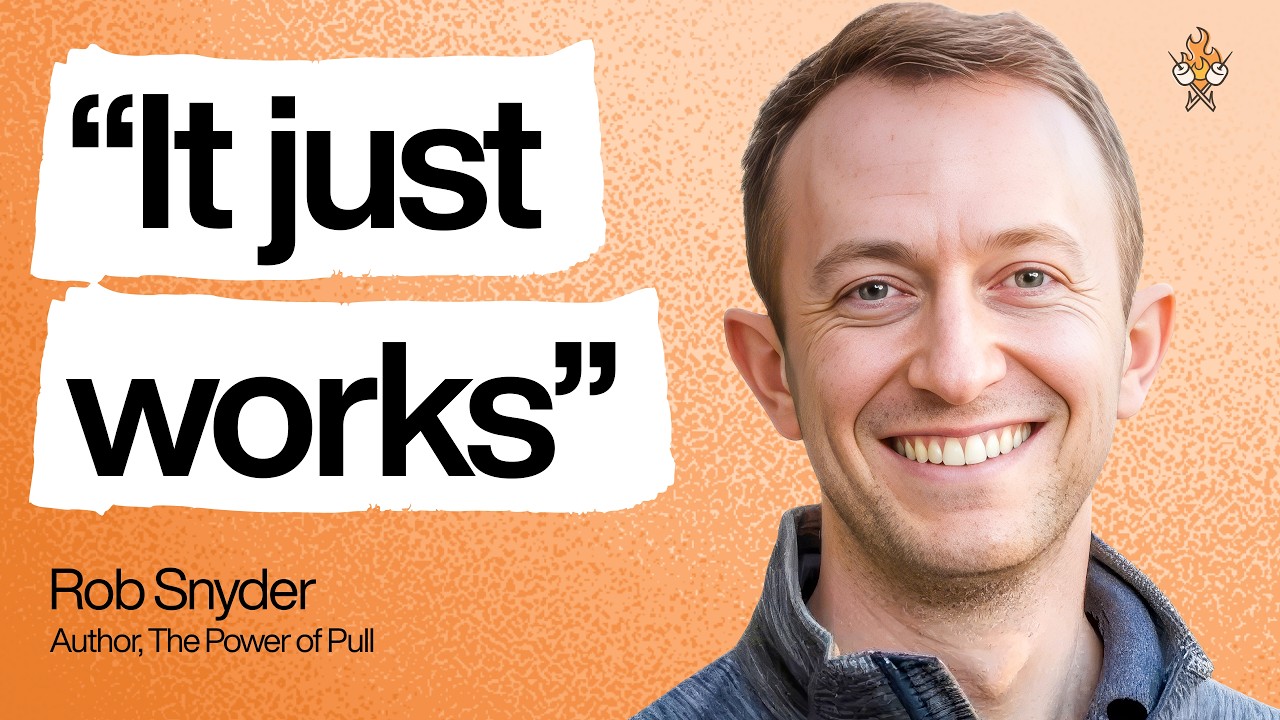
  • 4/5Thumbnail imageThe layout is clean and uncluttered. The guest's direct eye contact and warm expression ground the frame against the bright orange backdrop.Rob Snyder smiles directly at the camera on the right side, framed against a textured orange background.
  • 4/5Thumbnail text““It just works””At three words, it is concise and readable at any scale. It teases an easy or foolproof solution without spoiling the core insight.The phrase 'It just works' appears in quotation marks across two white paper cutouts in bold black lettering.
  • 4/5TitleThe exact runtime sets clear expectations for depth. Stating 'PMF' targets founders and product builders directly.The title names the format and exact length ('An 86-minute guide'), the goal ('finding PMF'), and the guest's author credential.
  • 4/5Title + thumbnailThe image text creates curiosity by claiming simplicity, while the title grounds it in a concrete, difficult topic.The thumbnail claims 'It just works' while the title clarifies that the video is an 86-minute guide to finding PMF.

Curiosity gap: What is the simple framework that reliably solves the notoriously difficult search for product-market fit?

The three hooks

The title, the thumbnail text and the first words spoken each make a promise, and each does a different job.

  • Title“An 86-minute guide to finding PMF | Rob Snyder (Author, The Power of Pull)”How-toOutcomeCuriosityThis hook makes the viewer want a comprehensive, start-to-finish manual for taking a product to market fit.
  • Thumbnail text““It just works””Curiosity gapCuriosityReliefOutcomeThis hook makes the viewer want to discover the straightforward mechanism that eliminates the struggle of finding product-market fit.
  • First words spoken“The theory behind a sales call is, if you have pull, you're going to rip the thing out of my hands.”Contrarian takeCuriosityOutcomeIt promises an operational test that proves whether customer demand is real or just polite conversation.
  • PairingDifferent jobsThe thumbnail hook sparks curiosity with an assertion of simplicity, while the title specifies the subject matter and runtime.
  • StakesFitsThe 86-minute runtime matches the exhaustive end-to-end framework promised for diagnosing product-market fit.
  • UrgencyNoneThe content positions itself as an evergreen reference manual rather than a breaking time-sensitive alert.

The first 20 seconds

TimeWhat you seeWhat you hearWhat it does
0:00Rob Snyder speaking to camera with microphone, book visible in backgroundThe theoryEstablishes guest and teases a core concept
0:01Rob Snyder gesturing with handbehind a sales call is,Focuses the topic on sales dynamics
0:02Cut to Willy Wonka movie scene with Willy Wonka holding candyif you haveUses a familiar movie visual to break visual monotony
0:03Willy Wonka surrounded by eager customerspull,Introduces the central concept of pull
0:04Willy Wonka speaking theatrically to crowdyou're going toBuilds anticipation for the definition
0:05Girl reaches forward to take candy from Wonkato rip the thingVisually dramatizes overwhelming buyer demand
0:06Wonka warning the crowd with raised fingerout of my hands.Delivers memorable definition of true product pull
0:07Still photo of Rob signing a book for an attendeeSo I have a very specificEstablishes guest authority and authorship
0:08Still photo continuesstructurePromises a structured methodology
0:09Photo of Rob presenting slides on stageof a sales callReinforces credibility as a speaker and coach
0:10Slide diagram showing Rob's B2B Sales Call Scriptinto discoveryPreviews the exact framework viewers will learn
0:11B2B Sales Call diagram remains on screenand thenGives viewers time to register the framework steps
0:12B2B Sales Call diagram remains on screenout ofTeases discovery transition mechanics
0:13Cut to host Lenny Rachitsky in studioHow can people useShifts to the host framing the practical question
0:14Lenny speaking into microphonethis frameworkAnchors inquiry to the shown framework
0:15Lenny speakingwith ideasConnects sales structure to idea validation
0:16Lenny speakinglikely toRaises the stakes around founder success
0:17Lenny speakingactually beEmphasizes real-world viability
0:18Lenny listeningsuccessful?Completes the key question viewers want answered
0:19Split screen of Lenny and Robmain mistakesTeases common mistakes viewers must avoid
0:20Split screen continues as Rob begins answeringpeople makeOpens a loop on founders' critical errors
Click confirmation
Yes. Within the first two seconds, Rob Snyder appears with his book 'The Power of Pull' in frame and immediately defines the concept of customer pull.
Time to the point
0:06
Hook
payoff preview, question
Reason to stay
The host asks how to use this specific sales framework to find ideas that actually succeed, followed immediately by the guest starting to list the main mistakes founders make.
Missing on purpose
No show intro, no podcast theme song, no guest bio, and no sponsor read.
Pace and texture
Fast teaser cut. Visuals switch every 1 to 3 seconds across talking heads, a pop-culture clip, live photos, and framework slides with bottom-center subtitles.

Story map

Tutorial. An early-stage founder wants to stop wasting months building products nobody buys. The barrier is distinguishing polite prospect enthusiasm from authentic buying demand, with the payoff being an operational playbook from customer discovery call to retained contract.

TimeSectionNew tensionStakesTurnLoops
0:00 –1:15Cold Open & Hook MontageWhy do prospective customers compliment startup demos but refuse to actually buy?RiseSnyder argues pull belongs to specific people with urgent to-do lists, not broad company logos.Opens: How does the Hail Mary question turn around a dying sales call?
1:16 –7:31Origin & The Brutal Reality of 0-to-1Why standard founder advice about solving 'hair-on-fire problems' fails in practice.HoldLenny reads community testimonials showing that founders build based on what people say rather than what gets a signed contract.Opens: What is the specific mechanical acronym behind genuine pull?
7:32 –17:14Deconstructing the PULL FrameworkCan a founder systematically diagnose whether customer demand is real before building?RiseSnyder contrasts Jump AI's regulatory CRM urgency with unmotivated insurance agents.Opens: How do you source these opportunities without sitting in a room brainstorming?Closes: What is the specific mechanical acronym behind genuine pull?
17:15 –28:50Finding Ideas & In-Person ObservationHow do you uncover non-obvious operational bottlenecks from scratch?HoldSnyder illustrates a founder shadowing physical therapists to observe workflow friction directly.Opens: What specific materials do you present to test the hypothesis?Closes: How do you source these opportunities without sitting in a room brainstorming?
28:51 –34:45The Two-Slide Pitch & The Hail Mary QuestionWhat do you say when a discovery call is falling flat?RiseInstead of pitching harder, Snyder instructs founders to ask what task on their to-do list they would pay cash right now to remove.Opens: How do you book these initial calls if you have no network or reputation?Closes: How does the Hail Mary question turn around a dying sales call?
34:46 –41:27Outbound Cold Outreach & The Design Partner TrapWhy do standard cold outbound templates and free design partnerships produce zero revenue?HoldFree design partners play Steve Jobs rather than validating genuine operational pain.Opens: How do you structure the first 30-minute sales meeting once booked?Closes: How do you book these initial calls if you have no network or reputation?
41:28 –56:41Running Discovery & The Supply PitchHow do you transition an exploratory call into an upfront buying commitment?RiseStart by asking why the prospect showed up, earning explicit permission to ask diagnostic questions.Opens: How do you price an unbuilt or manually delivered software solution?Closes: How do you structure the first 30-minute sales meeting once booked?
56:42 –1:06:40Pricing Anchors, Goblin Mode, & Deal CloseHow do you keep enterprise deals from stalling out for months?HoldAnchor pricing against the cost of alternative consultants and work backwards from the champion's fixed corporate deadline.Opens: How do you turn one closed deal into a repeatable operating engine?Closes: How do you price an unbuilt or manually delivered software solution?
1:06:41 –1:20:00The Case Study Factory & RetentionWhy do high-growth startups experience downstream churn after closing early sales?FallEarly startups are factories designed to clone a single successful customer case study around a leading retention indicator.Closes: How do you turn one closed deal into a repeatable operating engine?
1:20:01 –1:25:48Lightning Round & Channel OutroWhich popular startup spaces are traps that founders should avoid?FallSag: no turn

Payoff: delivered fully at 24:49. At 24:49, Snyder shows the exact two-slide template and four-part PULL framework that founders can fill in to validate customer buying intent before writing code. Ending: Closes with a rapid-fire lightning round covering startup book recommendations, tar pit ideas to avoid, and Lenny's channel outro.

Leaks

Where a viewer might leave. Guesses from watching, not retention data.

  • 6:22 A 69-second sponsor read for WorkOS appears right after the conceptual introduction, before the core PULL acronym is explained.
  • 40:38 A second full sponsor break for DX interrupts the pacing between outreach benchmarks and live sales call discovery tactics.
  • 1:20:01 The tactical playbook concludes, transitioning into personal reading lists, movie tastes, and podcast wrap-up cues.

Steal this

  1. The Agenda Flip Opening Disarms prospects immediately and exposes their authentic internal motive by asking why they agreed to take the meeting. 42:26
  2. The Third-Party Pricing Anchor Defuses price confrontation by asking prospects to react to an external spectrum of how others pay rather than issuing a rigid quote. 1:01:39
  3. The Diagnostic Acronym Framework Gives the viewer a mental checklist to grade their own sales conversations in real time on a blank notepad. 7:39

Skip this

  • Lenny spending three minutes reading community testimonials praising the guest. This relies entirely on Lenny's established paid Slack community social proof, which a newer channel cannot replicate.
  • The low-fi remote talking head setup with minimal b-roll past the hook. Only works because the interview targets an information-dense B2B niche willing to listen in podcast format while multitasking.

Open questions

  • What specific P&L cost category did the shadowed physical therapist end up asking to solve?
  • Which exact books and tarpit startup ideas were highlighted in the lightning round segment?

Teardown by Avail.video from the thumbnail, the title, the first 20 seconds and the report's notes on the whole video.

The explainer

What the video says, with a link to every moment

A 2-minute read. Each underlined phrase opens the video at that second.

In early-stage startup development, many founders spend months or years attempting to push solutions onto customers who politely praise their prototypes but never buy. Author and startup advisor Rob Snyder presents an alternative approach centered on demand: the PULL framework7:35. Standing for Project, Unavoidable, List of options, and Limitations, the framework establishes that strong customer demand occurs only when a specific person has an urgent priority on their to-do list that cannot be completed using existing tools or internal resources. Snyder illustrates this dynamic using Jump AI's note taker10:00, where financial advisors faced SEC compliance rules that generic tools could not satisfy.

Rather than brainstorming concepts in isolation, founders should uncover earned secrets firsthand20:15 by shadowing practitioners on the job. To test a thesis without building complex software, Snyder recommends presenting a two-slide concept23:55: the first slide describes the user's blocked project, and the second outlines a concise way to unblock them. If the prospect responds with lukewarm interest, founders should pivot and throw the Hail Mary question29:20—asking what single to-do item they would pay to have resolved immediately. Snyder explicitly cautions against unpaid design partnerships32:00, arguing that users with genuine urgency want immediate results rather than advisory sessions.

To generate customer conversations, founders should rely on founder magic outbound35:30—short, intriguing messages sent directly on LinkedIn or email aimed solely at securing a conversation. During the discovery call42:10, the founder assumes a relaxed posture, asking why the prospect agreed to meet and earning permission to explore their workflow constraints. When moving toward a commitment, founders can set pricing boundaries based on alternatives55:40 or reference comparable case study ranges.

If initial outbound yields silence, founders must enter goblin mode1:04:00, pursuing unconventional tactics such as showing up in person or attending niche conferences. Once deals close, founders must design onboarding around a specific milestone that makes it weird for the user to churn1:07:40. Ultimately, Snyder frames successful scaling not as software manufacturing, but as building a case study factory1:12:30, systematically addressing bottlenecks across pipeline, closing, and delivery to replicate high-conviction customer successes.

On screen

Everything the video showed you

Slides, frameworks, quotes and formulas, captured verbatim with the moment they appeared. Tap any card to jump there.

Reference shelf

People, ideas and things mentioned

Said means mentioned aloud; Shown means it appeared on screen.

People10

  • Rob SnyderStartup advisor, founder, and author of The Power of Pull.0:00Said + shown1:16Said + shown2:20Said6:20Said1:25:21Said
  • Lenny RachitskyHost of Lenny's Podcast and author of Lenny's Newsletter.0:13Said + shown1:16Said + shown6:53Shown1:25:24Said + shown
  • Bob MoestaCo-creator of the Jobs-to-be-Done framework and author.7:48Said
  • Alexander Graham BellInventor credited with patenting the first practical telephone.11:27Said
  • Steve JobsCo-founder and former CEO of Apple.32:33Said
  • Snoop DoggRapper and celebrity venture investor.36:03Said
  • Sam AltmanCEO of OpenAI and former president of Y Combinator.37:20Said
  • Mark RobergeFormer CRO of HubSpot, Harvard Business School senior lecturer, and author.1:08:07Said
  • Christopher AlexanderArchitect, design theorist, and author of The Nature of Order.1:21:56Said
  • Dalton CaldwellManaging Director at Y Combinator who coined the concept of tarpit ideas.1:22:56Said

Ideas & frameworks3

  • The Power of PullBook by Rob Snyder analyzing B2B customer demand and sales discovery.0:00Shown0:35Shown1:23Said + shown7:32Said
  • The Physics of StartupsSubstack newsletter authored by Rob Snyder covering startup mechanics.1:28Said
  • PULL FrameworkDemand framework defining customer need: Project, Unavoidable, Look, Lacking.0:23Shown7:32Said24:49Said + shown

Organizations4

  • Clearly AICloud security startup founded by former AWS security engineer Emily.27:10Said
  • WorkOSEnterprise software platform providing SSO, SCIM, and RBAC developer APIs.1:16Shown6:22Said + shown6:53Shown7:07Shown
  • DXDeveloper productivity intelligence and benchmarking platform.40:38Said + shown41:19Shown
  • TiroDental hygienist staffing platform whose founders acquired users via door-to-door visits.1:05:20Said

Things on screen3

  • JumpAI note-taking software designed specifically for financial advisors.10:00Said11:44Said51:28Said
  • LinearIssue tracking and project management software platform.51:20Said
  • JiraProject management and issue tracking tool developed by Atlassian.51:25Said
Find in this video

Search what was said and shown

One search covers the transcript, on-screen text, claims and references. Every result jumps to its moment.

    Take it to your AI

    Ask Claude or ChatGPT about this video

    Copy this report as context, paste it into a chat, then ask anything. It includes timestamps, so answers can point back to the video.

    Then ask
    • Turn the main ideas into a checklist I can use this week.
    • What are the strongest claims in this video, and what evidence does it give for each?
    • Write a short summary for someone who hasn't watched it, linking the key moments.
    • Quiz me on this video, one question at a time, and cite the timestamp for each answer.
    Video description

    A description you can paste into YouTube

    A hook, a summary, chapters in YouTube's format and what the video mentions. Copy it, edit it, and paste it into YouTube Studio.

    1,602 / 5,000 characters
    By the numbers

    What YouTube shows about this video and its channel

    As of Oct 26, 2026. YouTube's public numbers first, then Avail.video's own arithmetic on them.

    The video

    Views
    17.1K
    Likes
    214
    Comments
    21
    Published
    Oct 25, 2026
    Length
    1:25:48
    Category
    People & Blogs
    YouTube's topics
    —
    Captions
    No
    HD
    Yes
    Language
    English
    Paid promotion
    None declared
    Made for kids
    No
    License
    Standard YouTube

    Creator's tags

    No tags

    The channel

    Subscribers
    648K
    Videos
    1.9K
    Total views
    23.4M
    Channel age
    19 years (since Dec 2006)
    Country
    United States
    Uploads
    about every 2 days
    Across the last 15 long-form uploads
    Before this video
    7 days after the previous long-form upload

    Calculated by Avail.video from YouTube's public numbers

    Outlier score
    0.4× · Too early to tell
    Views against the median of the channel's last 15 long-form uploads
    Views per subscriber
    0.03
    Likes vs the channel's usual
    1.3× the channel's usual
    1.2% of views vs a usual 0.96%
    Comments vs the channel's usual
    2.9× the channel's usual
    0.12% of views vs a usual 0.042%
    Rank among recent uploads
    #16 of 16
    By views: this video and the channel's last 15 long-form uploads

    Watched by Avail.video · 2026-10-26